
The 2010 midterm elections may have brought seismic political changes at the state and national levels, but new governors, state legislators, and members of Congress confront a familiar set of hurdles as they seek to carry out education policy goals in the face of continued economic uncertainty.
The challenge: how to reconcile sluggish revenues and calls for slimmed-down government with a long list of ambitious—and potentially costly—education overhaul projects already in progress.
“This is education’s ‘General Motors’ moment,” says Bob Wise, a former Democratic governor of West Virginia, as K-12 systems across the country push to produce a higher-quality product while clamping down on costs.
As new governors take office, the first reports they will get from their staffs are likely to be “here’s your budget situation and how bad it is,” coupled with “our state has committed itself to far-reaching education reforms,” says Wise, who is now the president of the Alliance for Excellent Education, a Washington-based group that works to ensure students graduate from high school prepared for college and the workplace.
Politics is likely to complicate the matter, even though education has often provided ground for bipartisan cooperation.
Republicans were highly successful at the state level in the 2010 elections and now control both legislative chambers in 25 states.
And the GOP won control of six additional governors’ mansions; Republicans now hold 29 governorships to 20 for the Democrats, along with one Independent, in Rhode Island.
Many successful contenders ran on platforms of controlling spending. But, despite all the rhetoric around fiscal restraint, even conservative governors and legislatures are unlikely to relish the prospect of cutting K-12 funding, says Jennifer Cohen, a policy analyst who tracks federal and state education spending for the New America Foundation, a self-described nonpartisan think tank in Washington.
“Cutting funding for schools is going to be politically unpopular and politically difficult no matter what administration is in power,” she says.
Still, says Cohen, state policymakers must balance the need to finance education with other pressing priorities, including health and public safety—and, in most cases, shrinking revenues.
Issues of Continuity
New governors and state legislators also must decide how to deal with initiatives that were launched or agreed to by their predecessors—and which may or may not dovetail with their own educational and political agendas.
For instance, more than 40 states have signed on to the Common Core State Standards Initiative. The effort, led by the Council of Chief State School Officers and the National Governors Association, is aimed at creating a set of more uniform, rigorous standards in English/language arts and mathematics. On a parallel track, 45 states and the District of Columbia have received a share of $350 million in federal funding under the Race to the Top program, part of the 2009 economic-stimulus package, to develop shared, richer tests.
But the “common core” initiative, as it is known, is not without its detractors, in particular among those—including some of the newly elected conservatives—who view common standards as part of a slippery slope toward national standards or even a national curriculum. That could have big implications for the initiative, since governors and legislatures will have a significant role in how standards are carried out at the state level.
Policymakers at the state and local levels will also be wrestling with the end of the massive one-time federal funding tied to the economic stimulus. That includes some $100 billion in education aid under the American Recovery and Reinvestment Act, adopted in 2009 and covering fiscal years 2009 and 2010, and the $10 billion in emergency aid under the Education Jobs Fund, passed last summer.
More such aid is unlikely to be forthcoming. Republicans gained at least 60 seats in the U.S. House of Representatives, enough to retake the chamber, and bolstered their margins in the Senate, picking up six seats. Before the elections, Republican congressional leaders issued a “Pledge to America,” promising to roll back federal discretionary spending to fiscal 2008 levels, and GOP lawmakers have pledged to curtail spending at all levels of government.
Already, there are signs that some states and districts may be backing away from education overhaul goals because of the continuing economic doldrums.
Case in point: Ohio, which is struggling with the decline in the manufacturing sector. The state is among the 11 states, plus the District of Columbia, that won a slice of $4 billion in competitive grants under the federal Race to the Top Fund to bolster their progress in certain education redesign areas.
Control of Governorship, After 2010 Elections
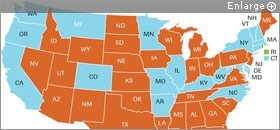
Composition of State Legislatures, After 2010 Elections

SOURCE: National Conference of State Legislatures
As of late last year, however, 50 of the initial 538 participating schools and districts had backed out of the state’s Race to the Top plan—which won Ohio $400 million—with some saying that they would have to spend more money than they’d get from the program. They feel they simply can’t afford to participate.
Despite the impending drop in federal aid and the likelihood of sluggish state revenues, incoming governors and legislatures would be prudent to stick with the education redesign initiatives, says Wise, of the Alliance for Excellent Education. Ultimately, they will get political credit for successful implementation, he says, adding, “Nobody ever remembers you for being the governor who simply cut the budget.”
‘More With Less’
U.S. Secretary of Education Arne Duncan, an architect of the education portion of the recovery act, acknowledges that the lack of further emergency aid is going to make life more difficult for states and school districts, many of which have already entered what may be an era of prolonged austerity.
“It’s easy to say, hard to do, [but] ... we’re going to have to do more with less,” Duncan told education stakeholders at a meeting in Washington last fall.
The U.S. Department of Education, he added, will help by encouraging states and school districts to begin thinking about ways to cope with the new financial circumstances.
And, at a separate November event, sponsored by the American Enterprise Institute, the education secretary put forward ideas about where he’d like to see districts cut—and areas he’d like to see held harmless.
For instance, he discouraged administrators from cutting areas that directly affect the classroom, such as instructional time, and art and music classes. He also doesn’t want districts laying off “talented young teachers.”
“Unfortunately, this pattern of cutbacks has too often prevailed in the past,” he said.
Instead, districts might want to take such steps as rethinking transportation routes, and closing schools that are underenrolled, Duncan suggested. And he urged districts to consider “modest but smartly targeted increases in class size.”
Limited Options
But in some cases, states and districts have a limited set of readily available options for additional cuts. Districts may already have laid off teachers, cut programs, and reduced administrative costs. Many state education agencies are operating with skeletal staffs.
Other solutions—including examining issues that directly affect the teaching force—could prove politically perilous, or may not be legally viable, the New America Foundation’s Cohen says.
For example, districts may want to look more closely at teacher distribution, ensuring that the most effective educators are working in the schools most in need of raising student achievement. But much teacher-distribution policy is determined by agreements negotiated between district leaders and their local teachers’ unions.
Budgetary situations “aren’t going to rewrite contracts overnight,” Cohen says. “Making organizational and cultural changes in education is really hard.”
Still, some superintendents have begun to think about whether they should examine pensions and health benefits—two big-ticket personnel expenses—says Noelle Ellerson, the assistant director for policy analysis and advocacy at the American Association of School Administrators, in Arlington, Va. (“Personnel Costs Prove Tough to Contain,” this issue.)
And most districts aren’t likely to be hiring anytime soon, she says.
“We’re seven moons from an expansion of the teaching workforce,” Ellerson says.


