
Educators and researchers who specialize in the education of English-language learners are putting new emphasis on the importance of teaching oral English.
A conference here about teaching oral language and literacy to English-language learners, held Oct. 5-6 by the National Center for Research on the Educational Achievement and Teaching of English-Language Learners, or CREATE, underscored the scholarly interest in the topic.
Aida Walqui, who moved to the United States from Peru to attend college as a young adult, recalled during a presentation how she once felt like a “fake” when speaking in English rather than in her native Spanish. “I sounded more like a 7-year-old, and I was in college,” she said.
Ms. Walqui relayed her personal experience to stress that ELLs need chances to speak English in the classroom so they can find an identity, or what she called a “personal voice,” in their new language. Now, she trains teachers in how to strengthen the literacy of English-language learners by helping them develop academic concepts and skills in oral English. She’s the director of the teacher-professional- development program at WestEd, a San Francisco-based research organization.
Oral language “is a key that a lot of people forget about,” said Timothy Boals, the executive director of the World-Class Instructional Design and Assessment consortium, which developed English-language-proficiency standards and an English-proficiency test used by 19 states and the District of Columbia.
Academic Connection
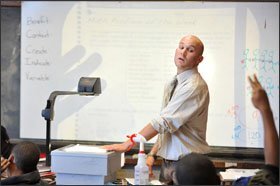
Although it’s essential that English-language learners have a chance to practice speaking and listening in the classroom, the same goes for any student with weak verbal skills, researchers say.
“This is not just an ELL issue,” said David J. Francis, a psychology professor at the University of Houston and the director of CREATE, which is based at the university. “It’s for all students who are academically at risk. Many will benefit from building of academic language and background knowledge” through oral language.
Catherine E. Snow, a professor of education at the Harvard Graduate School of Education, added that oral language is good for all students, “but the at-risk ones are totally dependent on schools to give it to them, while other kids can get it in other places.”
She observed that “deep reading” requires being able to follow a complex line of argument. “If you haven’t had a chance to try that out in debate,” she said, “you don’t have the skills to do it easily when you are reading.”
In a yet-to-be-published study, a team of researchers at Harvard University found that 52 language-arts teachers observed in California middle schools spent on average about 10 percent of their time teaching oral language. The research team was led by Nonie K. Lesaux, an associate professor in human development and urban education at Harvard’s Graduate School of Education.
Mr. Francis characterized that proportion as “not as big of an amount of the day as we’d like to see.”
Some educators who work with ELLs are advocating that teachers in their districts spend more time on oral language. That’s the case with the two learning coaches for ELLs in the 50,000-student Wichita, Kan., school system.
“It’s so scary for teachers to turn [lessons] over to kids,” said Kathyrn Nelson, the secondary level coach for ELLs for the district. In addition, she said, “They are so constrained by pacing guides, scope and sequence, that they don’t feel they have time [for oral language].”
Ms. Nelson said she’s urging teachers to support structured academic conversations by using “sentence starters” and having students talk to each other in pairs. Students at the secondary level will “shoot the breeze” during discussions if not given careful guidance, she acknowledged.
Veronica Sandoval, an assistant principal at Milstead Middle School in Pasadena, Texas, said her school recently provided a professional development session on strategies for helping students to develop oral language, such as role playing or debating, and asked teachers to implement them over a month’s time. “The techniques are good for every child,” she said.
Building Vocabulary
Quite a few research studies demonstrate that oral-language teaching can be a means to help students acquire academic vocabulary—the words used in classrooms as opposed to on the playground or in the cafeteria.
Ms. Snow and other researchers from Harvard, for example, have worked with Boston teachers through the Strategic Education Research Partnership to create Word Generation, free online materials for teaching vocabulary to middle school students through academic discussion. (“Partnership’s First Product Aimed at Middle School Vocabulary”, May 13, 2009.)
Academic words such as “analyze,” “refer,” “develop,” and “interpret” need to be taught explicitly, Claire E. White, the program director for Word Generation, said in a presentation at the conference.
Word Generation provides 25 lessons to be taught across the content areas focused on themes for debate, such as whether amnesty should be granted to undocumented students or whether junk food should be sold in schools. Each of the lessons focuses as well on the explicit teaching of five words—taken from an academic word list—for 15 minutes a day, five days a week.
An unpublished analysis of Word Generation found that Boston students who participated in the lessons during the project’s first year ended up using two of the five target words on average in weekly essays. ELLs particularly benefited from the lessons, though the materials aren’t tailored to them.
Michael J. Kieffer, an assistant professor of language and education at Teachers College, Columbia University, reported here on an evaluation conducted in 2008 in the San Diego Unified School District of an approach for teaching vocabulary developed by the Harvard research team led by Ms. Lesaux, which he was a member of while getting his doctorate at Harvard.The approach involves teaching what the researchers call “high-utility academic words,” such as “evidence” and “integrate,” over a period of nine days for each set of words. It includes having students create personal definitions for the words, learn the various parts and forms of the words, answer questions about a text that includes the words, and use the words in writing.
Mr. Kieffer said the study compared the approach developed by researchers with typical English-language arts instruction in the 6th grade. The study involved 500 students, 70 percent of whom were ELLs or former ELLs.
He said the approach was effective “in teaching the words we wanted to teach.”
The learning effect after 18 weeks was equal to about nine months of extra growth in reading comprehension, as measured on a standardized test, he said. In addition, the study showed an effect of about six months of extra growth for participating students in their ability to break down words into word parts, in comparison with control groups.
One lesson learned from the evaluation, Mr. Kieffer said, was that teachers need to teach in-depth knowledge of a word, not just one meaning.
Integrating Skills
One of the nation’s most widely used set of strategies for engaging English-language learners in the regular classroom is the Sheltered Instruction Observation Protocol, or SIOP. That set of 30 strategies is typically provided to regular content teachers as professional development.
SIOP includes a strong focus on oral-language development, such as calling for teachers to regularly give students opportunities for interactive learning and discussion, Jana Echevarria, a professor of special education at California State University, Long Beach, explained here. She is one of the researchers who developed SIOP.
Ms. Echevarria said content teachers are often at a loss for how to teach oral language systematically. She urges them to spend less time on whole-class instruction and more on supporting students to work in small groups or pairs. A goal of SIOP, she said, is for classroom activities to integrate all language skills: reading, writing, speaking, and listening.
Findings from a study of science teachers in eight middle schools in California conducted in 2007 showed that the higher the implementation of the SIOP model by teachers, the better their students performed on science and language tests, according to Cara Richards, a professor of special education at California State University, Long Beach, who presented the study’s findings here. The findings were true of students who had a command of English as well as ELLs.
Some educators at the conference said it’s not second nature for teachers to implement best practices recommended by researchers for teaching oral language, particularly at the secondary level.
Charlie Geier, an instructional coach for English-language learners at the 10,700-student Metropolitan School District of Washington Township in Indianapolis, Ind., said, for instance, that he was struggling to understand how to implement the kind of academic discussion recommended by Ms. White with Word Generation.
“What does real discussion look like?” he asked, during a break-out session on how to apply research-based approaches. “It’s not teacher-generated with the same three or four hands of students going up.”


