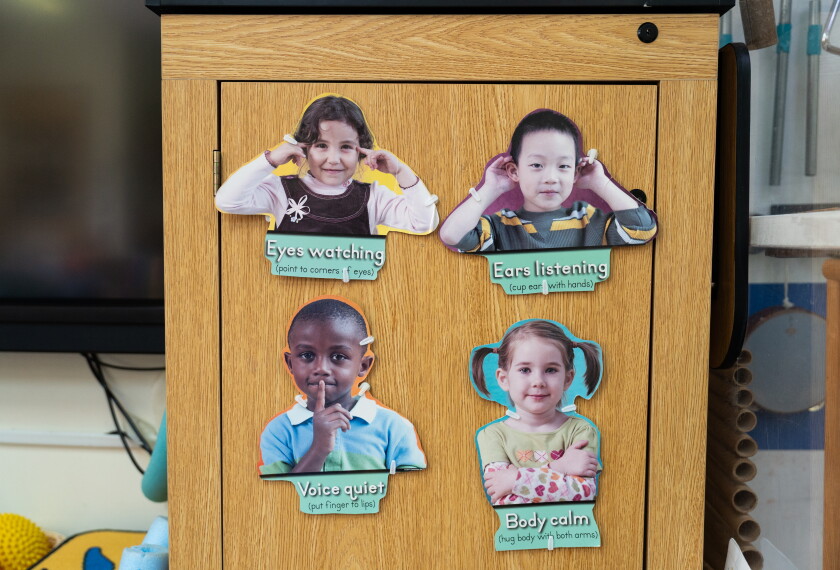
In his March 10 speech laying out his education agenda, President Barack Obama established expanded and higher-quality preschool education as the plan’s “first pillar.” That sensible foundation is consistent with Mr. Obama’s broader orientation of building on ideas that have proven successful in practice. There is now strong evidence that high-quality preschool enables children from even the most disadvantaged families to do better in the grades that follow.
The debate over the federal role in improving education would be illuminated by learning from some high-poverty school districts in New Jersey that have built on this first pillar. Their test results demonstrate that high-quality preschool connected organically to intensive literacy instruction in the primary grades can be very effective.
When New Jersey’s No Child Left Behind-mandated reading and writing test was first given to 3rd graders in 2004, for example, only 62.2 percent of Union City, N.J., students were proficient, against 79.3 percent for the state as a whole. Last year, Union City’s 3rd graders narrowed that gap to only 4 percentage points (82 percent vs. 86 percent). Elizabeth, the state’s fourth-largest city, showed even greater improvement, moving from 59 percent proficiency in 2004, to 80 percent in 2008. And Orange, N.J., an overwhelmingly African-American district, improved from 66.4 percent proficiency on the same test in 2004, to 76.2 percent in 2008.
Improvement at this scale in whole districts, as opposed to dramatic gains in scattered schools, is virtually unprecedented. Understanding why these and other high-poverty districts have shown significant improvement across the board, consistent with President Obama’s sensible orientation to what works, should influence the shape of the other pillars of the federal education agenda.
A common response to the New Jersey data is that the state’s court-ordered funding for its poorest cities offers a likely explanation for the progress. After all, the New Jersey Supreme Court, in the long-running Abbott v. Burke school finance case, required the state to at least match for these districts the spending of the wealthiest districts—and this in a state that always ranks in the top three for per-student spending nationally. After 10 years of special funding, New Jersey’s poorest districts are spending more than $3,000 per student above the state average ($15,235 vs. $12,184).
There is no question that additional funds can help, but the fact is that New Jersey’s higher-performing poor districts tend to be among the lower-spending districts, whereas higher-spending districts like Asbury Park, Camden, Newark, and Trenton are not only lower-performing but also have seen their relative achievement decline. So more money is not the explanation.
Beginning in 2002, the state shifted Abbott’s focus from monitoring compliance with dozens of court mandates to developing partnerships with struggling districts to concentrate on early literacy. The rationale was simple: Nonreaders cannot be educated, and reading is a skill learned early. Students who are not reading at grade level by the end of 4th grade have a less than 10 percent chance of ever reading on level. Public schools must do whatever is required to make certain that primary students are readers. That was the foundation of the partnership.
This was not a case of the state department of education imposing yet another “reform” or “model.” It was an offer to cooperate in a shared diagnosis of what was working or not in the district and in each struggling school. The district leadership, principals, teachers, and content specialists had to adopt a more coherent, flexible, and reflective approach. It relied on a sustained effort to do what we’ve known for a long time is essential to educating concentrations of poor children:
Focus on the classroom. Policies that ignore the fundamental transaction between teachers and students have little chance to improve the achievement of poor students. We should remember that educational TV, school-based budgeting, whole-school reform, and vouchers were only four of the scores of “reforms” that failed to deliver for most poor children.
Be specific and clear about the problems that need to be addressed. The main educational problem is that poor children do not learn to read and write well, and therefore are not educated well enough to fully participate in America’s economic and civic life. Such children start kindergarten unprepared to become strong readers because they have less general knowledge, smaller vocabularies, and little connection with the printed word.
Moreover, these poor children come increasingly from Spanish-speaking families that are not literate in Spanish, thus complicating an already massive pedagogical problem for teachers and schools. Between 1992 and 2007, Latinos leaped from 7 percent to 19 percent of students in the National Assessment of Educational Progress sample—a demographic shift unmatched in our history.
Emulate the culture and practices of effective districts. Most policy discourse focuses on effective schools, in the unrealistic hope that principals and teachers will somehow adapt their practice to mirror the Knowledge Is Power Program or some other blue-ribbon exemplar. In an age driven by state curricular standards and assessments, federal No Child Left Behind Act sanctions, and the huge increase in Spanish-language students, the notion that all problems can be sorted out by the typical public school is delusional.
In New Jersey, the state education department’s effort to improve the quality of preschool and link it to an intensive literacy program in the primary grades borrowed unashamedly from the practices and culture of one district, Union City. The department recruited the architect of Union City’s instructional program, without whom the effort would not have worked.
The poorest district in the state, Union City began in the late 1980s to focus on narrowing the “kindergarten gap,” to lengthen the literacy block in the school day eventually to two hours, and to help teachers individualize instruction based on frequent assessments. The effort paid off. Union City is one of the first large urban districts in the nation to see consistently high performance from its middle-grades students, who now test close to the state average on 8th grade assessments in math and reading.
Start early. As a result of Abbott’s mandate that each district provide high-quality preschool opportunities to every 3- and 4-year-old, New Jersey now enrolls more 3-year-olds than any state save Illinois, and is 12th for 4-year-olds. It leads in preschool spending and teacher salaries. Classroom quality has improved dramatically as a result of the state department of education’s efforts to work with the 31 Abbott districts to improve classroom observation and support and to strengthen financial management (most children attend preschool in some 400 community organizations).
Expanding high-quality preschool opportunities is a much more complicated endeavor than it may at first appear. Two major obstacles are usually overlooked: The leadership in many urban districts does not accept the connection between a quality preschool opportunity and stronger literacy; and early-childhood education is still a stepchild in most universities, state education departments, and district headquarters.
Use evidence from student work to adjust instruction. “Data-driven instruction” is yet another panacea that receives nodding acceptance before being ignored. But we know a lot about how young children learn to read. There are national norms, for example, for determining where a 2nd grader should be reading in April of a given year. Districts need to use the results from regularly scheduled assessments to identify individual student weaknesses and help teachers adjust their instruction accordingly.
Spend whatever time is necessary to bring young students up to level in reading and writing. Union City and New Jersey’s other effective Abbott districts concentrate their additional funds on compensating teachers for spending extra time with struggling students. Few investments can yield a higher payoff.
Respect teachers and treat them as adults.
In short, to narrow the achievement gap, practice good pedagogy. It begins with respecting the enormous capacity of young children to learn and accepting the difficulty of teaching in a poor city school. We have known for decades that teachers are too isolated and insufficiently supported in the classroom, and that the dimensions of their responsibility are underestimated. Recognizing that no policy or reform succeeds if teachers do not teach and students do not learn is the simple start to good practice. Sustaining that good practice is terribly difficult, never-ending work.