
Corrected: A previous version of this story gave an incorrect figure for the number of educators the program serves. Some 92,000 participants attend the project’s workshops and events annually. Also, the source for the accompanying chart was incorrect; the information was provided by local chapters of the writing project, each of which conducted the studies in the nine districts participating in the evaluation of the program.
For all the respite and reflection that might be expected in a summer writing workshop in the California hills, only limited talk of poetry and prose is going on among attendees here. The workshops sponsored by the Bay Area chapter of the National Writing Project have drawn a steady and loyal following over more than three decades among teachers seeking to refine their own skills, reflect on their practice, and learn strategies for teaching their young scribes.
But at a time when the demands of high-stakes testing have led to a curriculum dominated by reading and mathematics instruction, discussion in the seminars these days is more likely to turn to the practical challenges of fitting writing into the school day, and how to show that it makes a difference in student achievement.
After years of fending off critics and proposed budget cuts, the long-standing national program is moving beyond the notion of writing as an art form to promoting writing as a learning tool. And officials are collecting data they say will prove the program’s benefits to teachers and students.
Mary Hurley began seeing those benefits some 20 years ago, after honing her teaching skills at workshops offered by the Bay Area project.
As a 6th grade math and science teacher and elementary school math specialist, Ms. Hurley had done little to teach the subject herself until she realized the power of good writing instruction in helping her students understand the increasingly complex reading tasks and subject matter they were encountering.
“Knowing how to write well influences students’ thinking and impacts their comprehension,” said the veteran teacher, who has taught for 17 years in the Oakland Unified district. Research supports her claim. “But the writing piece has been neglected for years, and as a result, the skill set of our teachers is low.”
Now a writing coach, Ms. Hurley recommends these summer workshops, as well as other professional-development resources offered through the Bay Area Writing Project, to teachers throughout the 40,000-student district.
Getting teachers and administrators at large to understand the potential role of writing in improving student learning across subjects has been an arduous task, she said. But the prospect of helping other teachers teach writing through math, social studies, and other subjects, and a district effort to expand writing instruction and assessment, lured her out of the classroom last year.
“My goal is to shepherd writing back into the classroom,” she said. “The writing project says that the experts in doing this are the teachers two doors down from you. Let’s build on that infrastructure.”
A cornerstone of the curriculum for generations, writing has been dubbed the “neglected ‘R’ ” in recent years because of all the attention to reading and math. Yet it is gaining increasing recognition as an essential skill for developing the kinds of thinking and analytical abilities students need to master complex content, tackle college-level work, and succeed in a global and information-driven marketplace.
The congressionally authorized National Writing Project, housed at the University of California, Berkeley, has toiled to spread that message since the early 1970s, when it first offered professional- development programs locally for teachers that aim to build professional writing skills and improve their teaching. Teachers taking part return to their schools with a mission to spread the word and help their colleagues do the same, much the way Ms. Hurley has.
It has extended its reach to 200 sites across the country, serving some 92,000 teachers annually, largely fueled by a reputation for focusing on practical teaching strategies and for equipping participating teachers to become expert resources for other educators in their schools and districts.
“The writing project has opened me up to all kinds of teaching ideas from other great teachers from around the area and other resources we don’t usually have when we’re so isolated in our classrooms,” said Elise Dicharry, a middle school social studies and language arts teacher in San Francisco who spent five weeks in the summer writing institute run by the Bay Area Writing Project.
SOURCE: National Writing Project
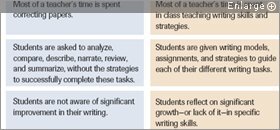
The intensive summer institute, the hallmark of the national program, is offered to about 20 participants at each of the sites around the country. Participants work on their professional writing skills, explore the research on writing and learning, and study successful teaching practices. Throughout the school year, the teachers hold follow-up discussions on how they’ve applied their new skills and share findings of their classroom research. Graduates of the institute often become teacher consultants, working with local chapters in school or district professional-development programs.
Local chapters, primarily based at universities, also provide free or low-cost weekend seminars and workshops for teachers, and guidance on curriculum and assessment.
“This project has given a tremendous learning community to me,” said Katherine Suyeyasu, a middle school teacher in Oakland who spent two weeks this summer learning approaches for teaching grammar. “Writing is a tool for thinking and learning and expression, and it’s now very much a part of everything we do in my classroom.”
Using lessons she took away from a digital-storytelling workshop she took a few years ago, Ms. Suyeyasu had her students research Japanese families sent to internment camps in the region during World War II. They then wrote and edited scripts and produced videos of their stories, complete with images and audio recordings they found on the topic.
“In a week, my students each made a four-minute movie and learned [some content] during this process of composing something that went beyond words,” she said.
In studying the abolitionists last year, Ms. Suyeyasu’s students learned how writing has been used historically to spark social action and to sway public opinion. Other workshops, she said, like the one on grammar here, often provide strategies for covering required curricular topics in writing lessons that prepare students for local and state tests as well.
Nearly 200 teachers like her from Oakland, San Francisco, Berkeley, and other nearby districts spent part of this summer learning strategies for teaching specific writing skills or genres, or for instilling science or math concepts through writing.
At the Chabot Science Center, located in a redwood forest outside of Oakland, more than a dozen teachers conducted experiments and documented their findings in notebooks as part of a workshop on science writing.
Laurie Thompson, a veteran teacher and consultant to the Bay Area Writing Project, designed the session after interviewing scientists about the role writing plays in their work. Giving students notebooks to record their hypotheses, research methods, and findings, she said, can build their understanding of difficult science concepts and analytical skills.
“It’s through the process of writing that students get deep conceptual understanding of science or any other subject,” she said.
In follow-up surveys commissioned by the national office, teachers who use the program seem to agree. A majority report that in the school year following a workshop, they expanded writing instruction in their classrooms and felt they were better teachers because of their participation.
“The philosophy of having teachers teach teachers is what makes us a different kind of program,” said Sharon Washington, who took over as executive director of the national program this past spring. “Teachers respect the support they get from us and begin to see each other as professionals.”
Despite its reputation in the field and its support among alumni, however, the National Writing Project has butted up against some harsh criticism in recent years.
President Bush has sought to zero out some $20 million targeted to the project in several of his federal budget proposals, saying the earmark is not worth the investment. The money has been put back each year by members of Congress who are fans of the program. A watchdog group that seeks to eliminate congressional earmarks, or pork, has decried the federal support.
“While the program seeks to increase the effectiveness of teachers, there is no system in place for determining whether or not the teachers’ writing skills have improved,” according to the 2006 Pig Book published by the Washington-based Citizens Against Government Waste. “Moreover, the National Writing Project can be considered a duplicative project. [The U.S. Department of Education] already spends $3 billion annually on programs meant to professionally train teachers to hone their writing skills. Hopefully, these teachers learned how to write in college.”
Other critics have charged that the program isn’t focused enough on academic goals and instead encourages writing as a way for students to explore their feelings or simply as a creative outlet.
The National Writing Project compiled data from local affiliates to measure the effect of its teacher professional development on students’ writing performance.

Source: National Writing Project
Officials with the writing project’s national office and its affiliates have taken such critiques to heart.
“With the standards-based push in schools, and with the increasing testing demands, we needed to budge, too,” said Carol Tateishi, a director of the Bay Area project. She and her colleagues have worked to combat a reputation for promoting personal writing over academic writing, which she says misrepresents their mission. “We have placed a heavier emphasis on the content. We have a real serious interest in writing poetry and fiction and creative nonfiction, but we want students to know that it’s not just about writing stories.”
Over the past several years, local and national project officials have worked to beef up the program’s offerings, its ongoing support for participants, and accountability.
In Oakland, for example, teacher consultants have drafted writing lessons that fit carefully within the district’s structured elementary language arts curriculum. They also contributed to the district’s new writing assessment for grades K-12 and coached teachers on how to prepare students for the reading, research, discussion, and revision tasks needed to complete the detailed prompts on the test.
The Bay Area chapter, the founding site in 1974, has organized ongoing discussions between high school teachers and college professors on preparing students for the demands of college writing. The sessions, and conversations via the group’s listserv, have given teachers insights into balancing basic teaching requirements, such as the five-paragraph essay format students need to master for the state high school exit exam, and college-level writing demands.
“Students can pass the reading part of the high school exit exam without writing a coherent sentence, but to go to college, they have to be able to demonstrate high-level writing ability,” said Adela Arriaga, a co-director of the Bay Area Writing Project. “If this is what we are asking them to be able to do in college, why aren’t we asking them to do this kind of writing in high school?”
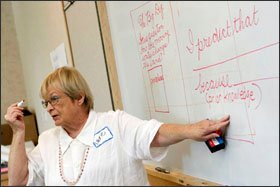
Grants from private foundations have allowed the National Writing Project to target broader student-achievement issues, like adolescent literacy, and to establish programs for integrating writing into science and social studies lessons.
Last year, the project commissioned a longitudinal study of the program’s effect on 7th and 8th graders’ learning, after federal education officials demanded more data. Early results suggest that students whose teachers have taken part in the writing project show greater improvement on a writing assessment than those whose teachers did not attend such workshops.
“We produce results in improving the teaching of writing, improvements you see at both the teacher level and the student level,” said Richard Sterling, who retired as executive director of the national program earlier this year. He started a chapter in New York City in 1978 and took the helm of the national office in 1994 with a goal of putting writing-project programs within reach of every teacher in the country. Mr. Sterling says the program needs to add some 50 more sites to ensure it is within practical distance of all teachers.
He sees that goal as more important now than ever. Mr. Sterling was a consultant to a national panel that issued a call in its 2003 report for setting an agenda for writing education.
“American education will never realize its potential as an engine of opportunity and economic growth until a writing revolution puts language and communication in their proper place in the classroom,” said the report, “The Neglected ‘R’: The Need for a Writing Revolution.”
Other reports on students’ inadequate preparation for college and the United States’ lackluster showing on international comparison tests have also emphasized the importance of student writing skills. Indeed, national assessments bear out those claims.
On the 2007 National Assessment of Educational Progress in writing, only a third of 8th graders and one-fourth of 12th graders in nationally representative samples were deemed proficient.
The National Writing Project, Mr. Sterling argues, is the single largest national undertaking to tackle the problem.
“I regard us as a national resource that is unlike any other,” he said. “And our good press doesn’t come accidentally. ... The National Writing Project is a bargain when you compare it to similar programs in other subjects like the National Science Foundation. If it were lost, you would hear a cry from teachers across the nation.”

