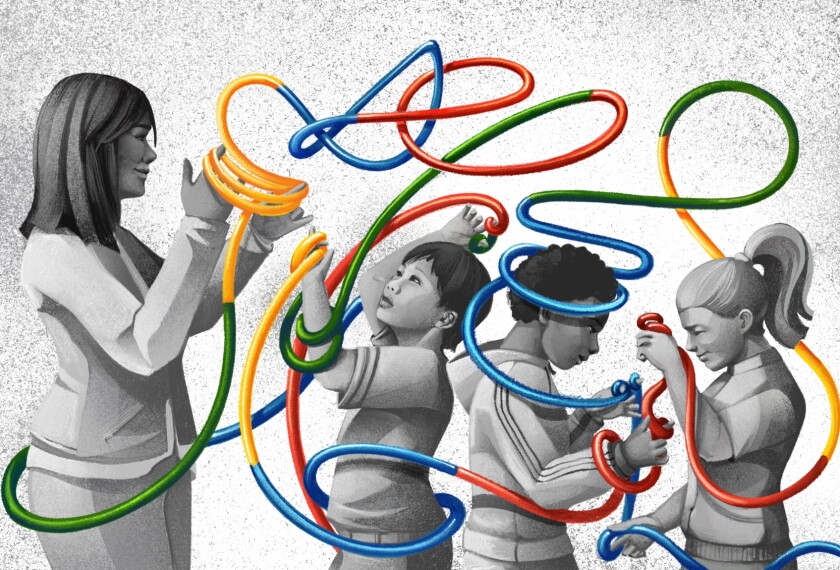
| The code of ‘niceness’ carries a price we may not wish to pay. |
Teachers, confronted with the responsibility of keeping peace in a classroom, generally construct a set of norms and rules to ensure a civil, considerate, fair-minded, and orderly social environment. Many of the rules are summed up by what young children call “being nice": helping, sharing, taking turns; avoiding “being mean": fighting, bullying, and saying, “You can’t play.” The moral premise supporting such norms and rules is that all children, equally, deserve to flourish at school, that one child should not flourish at the expense of another, and that flourishing is compromised when children’s feelings are hurt. It is this code of being nice and not hurting that I wish to explore.
Socialization into niceness starts early. Consider the following kindergarten scene. Three children are constructing a model city. When a fourth child asks to join, the leader of the three (let’s call him Tactless) comments, “We don’t want you to play with us, we don’t like you, you always tell us what to do, you mess up our buildings, and then you lie and say you didn’t.” The excluded child (Rejected) pouts and complains to the teacher. She encourages a discussion between the two boys, but when Tactless remains adamant in his refusal—"I don’t want him to play with us"—she reminds him, “Remember our rule, you can’t say you can’t play.” The teacher has no doubt about her decision. Although she believes it’s important for Tactless to voice his objections and for her to consider monitoring the children’s play, in the final analysis Rejected must not be excluded. Avoiding that hurt vastly outweighs any complaints of Tactless, even assuming their legitimacy.
Children have absorbed the norm that it’s wrong to say or do things that are hurtful. When Virginia Paley, the author of You Can’t Say You Can’t Play, asks kindergarten children for class rules (in her book Kwanzaa and Me: A Teacher’s Story), they call out: "[N]o fighting, no pushing or grabbing, you can’t be nasty, don’t be mean.” On the positive side: “Be nice.” “Ask people to play.” “Be polite.” “Say can you help people.” When my graduate students recently asked their young students, “What does ‘friend’ mean?” many responded, “Someone who is always nice.” “Someone who doesn’t say mean things to you.” No one, unsurprisingly, responded, “A friend is someone who tells you the truth, even if it is mean, even if it hurts.”
While we want children to be caring, considerate, tactful, and understanding of others, we also want them to be honest, strong-minded, and bold. |
Good as it sounds, this code of “niceness,” when enshrined as a classroom rule, carries a price we may not wish to pay. A child, not wanting to offend, will be watchful that his speech is gentle, that his actions are obliging. Tactless, in our earlier story, learns that although he is heard, his complaints never result in favorable action. He learns further that it is more important to avoid offending than to register a truthful protest. Over time, Tactless is likely to conclude that objecting to and about others is pointless; he’ll have to follow the “be nice” rule anyway. Better go along to get along. So he keeps quiet about wrongdoing. Not a very empowering message. Not a way to cultivate future whistle-blowers.
Although of course we want children to be caring, considerate, tactful, and understanding of others, we also want them to be honest, strong-minded, and bold. We want them to resist peer pressure, to speak out against wrongfulness, to refuse to go along, even at the cost of offending. An honorable child, standing by the truth, must risk hurting, perhaps alienating, another. She comes to know “goods” other than acceptance that demand her loyalty.
In the long run, truthful, though possibly hurtful, encounters could be beneficial to all, and preferable to constantly “being nice.” Out of such repeated incidents Rejected may learn that exclusion by a child is not so terrible, that he can shrug it off and play with more accepting children, that he need not perceive himself as victimized. He can learn, as well, why bullying and lying are generally intolerable. Applying a noncontingent absolute rule of inclusion deprives him of these opportunities. Although Rejected perhaps “heard” Tactless’ complaint, without suffering any consequences, without feeling the sting of insult and exclusion, there is little inducement for him to reflect and grow.
If children are to become both tactful and assertive, considerate and resistant, tolerant and principled, simple judgments and rules based on simple codes of justice—"You can’t say you can’t play"—are inadequate.
| We need to recognize that our two sets of educational objectives are in tension. |
We need to recognize that our two sets of educational objectives are in tension. For children to acquire traits in both columns, they sometimes must be supported for being “not nice,” even on occasion for offending rather than accepting a child.
A problem with the “you can’t say” rule is its one- sidedness. It assumes that there is an oppressor and a victim. The responsibility for concessions belongs to Tactless, while Rejected never forfeits any rights to inclusion. A less rule-bound teacher might say to Tactless and Rejected, “I understand that you, Rejected, very much want to play with Tactless, and I also understand that you, Tactless, have reasons for saying no.” That overture could open a nonjudgmental productive discussion if, but only if, the teacher was not already committed to the noncontingent right of Rejected to play.
Inspection of motives and context may well reveal no obvious oppressor or victim. For example, suppose Rejected messes up unintentionally or because he is clumsy. Suppose he does not understand exactly what it is to lie (as young children often don’t), nor why we frown on lying. Given such conditions, our reactions would be quite different than if Rejected was a bully and Tactless afraid of him.
On the other hand, our sympathy for Tactless would be considerably diluted if he excluded Rejected primarily to avoid competition for friends. The motives of both parties matter to our judgments and should affect our decisions. The teacher needs more information: Does Tactless have a pattern of rejecting overtures from children, or is his behavior particular to Rejected? Does Rejected have a pattern of disturbing other children? Is the overture by Rejected a sign of social progress in a child generally cowed, or is he the bully Tactless describes? Again, we react differentially depending on these facts.
Some rules are clearly justified either because they are morally inconsequential or address an obvious wrong. When teachers are required to usher large numbers of children through busy corridors, there is no disputing a line-up rule. Similarly, there is no argument against a rule that prohibits ridiculing a child about her disability, never mind the explanations. A social rejection, however, is not always obviously wrong, and therefore a no-exclusion rule must be qualified. Just because Rejected feels offended does not mean an offense has been committed. Children are easily (and frequently) offended without moral justification— because, for example, they don’t get to do what they want, because they want more than their share.
The relative emphasis one gives to tact vs. honesty is a central moral issue in the education of children (and in our own adult lives). If teachers are to help children become sensitive, empathic, and protective of each others’ feelings while simultaneously avoiding the downside— silence and deception—they need to contextualize judgments and consequences; specific rules applied uniformly regardless of circumstance won’t do the job. Of a “don’t say” type rule we need to ask the following:
When is an action or remark that hurts another justified and exclusion permissible? If Rejected intentionally messed up and deliberately lied for personal gain, the exclusion is merited. By insisting that Rejected be included, under such circumstances, the teacher turns Tactless into the victim and Rejected into the oppressor. On the other hand, it is not permissible for Tactless to exclude Rejected because he wants sole possession of his friends; a child does not own his friends.
When is an action or remark, although justified, not advisable? Even if Rejected is destructive, and Tactless justified in his umbrage, because Tactless is the more secure and dominant child, the development and well-being of both boys is fostered by at least urging that he include Rejected.
In this scenario, there is no clear oppressor or victim and, without additional facts, no way to judge the wrongness of exclusion. While at first glance it seems that only one party is seriously injured, a consideration of motives and circumstances complicates the matter.Objections to the “don’t say you can’t play rule” apply as well (if not more so) to other rules that adorn classroom walls—We Always Share, We Keep Hands to Ourselves, We’re Respectful. Assuming these are desirable behaviors, turning them into rules, imposed uniformly on every behavioral infraction, is too blunt and is often unfair. A rule that quashes honesty and rightful protest may be just as harmful as a rule that supports caring. A classroom that unfailingly protects children from hurt underrates their capacities to find morally productive lessons in such hurt.
Joan F. Goodman is a professor in the graduate school of education at the University of Pennsylvania in Philadelphia. She is the co-author, with Howard Lesnick, of The Moral Stake in Education, to be published in December by Allyn and Bacon.