Classroom Technology

Software That Monitors Students May Hurt Some It’s Meant to Help

By Alyson Klein — August 08, 2022 2 min read
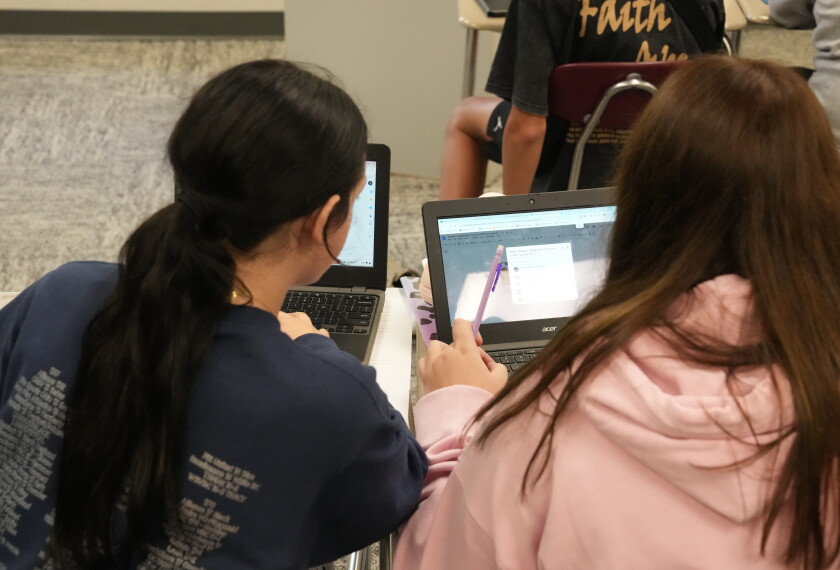
Students using computers.
  • Save to favorites
  • Print

Districts increasingly rely on monitoring software to keep students safe and on-task when they use school-issued digital devices, but the practice may do more harm than good, according to a report out this month by the Center for Democracy & Technology, a nonprofit that focuses on technology policy.

Monitoring programs can allow educators to keep an eye on students’ emails, messages, documents, and search queries, in part to scan for mental health problems or violent threats. The software can also pinpoint when students have logged into their device and for how long, and even give teachers a real-time glimpse at what’s on their students’ computer screens. Eighty-nine percent of teachers surveyed by the CDT say their districts use some sort of monitoring software, a 5 percent hike over last year.

But in addition to referring kids who may be troubled to counseling services, the software is often used for discipline purposes, the CDT found. In fact, 78 percent of teachers whose school uses monitoring software say it has helped identify students for disciplinary purposes. Just 54 percent of those teachers say the programs have been used to connect students to a counselor, therapist, or social worker for help.

Districts have also used the software to identify students as part of the LGBTQ community without their consent. Thirteen percent of all students at schools that use student activity monitoring say they or another student they know who is LGBTQ has been outed because of the software.

All of this is having a chilling effect on students’ online behavior, the survey found. About half of students said they agreed with the statement, “I do not share my true thoughts or ideas because I know what I do online may be monitored.” And about 80 percent said they were more careful about their searches because they know their school is keeping tabs on their online activities.

“We’ve found that nearly every school in the country is giving devices to students—and monitoring is hurting them,” said Alexandra Reeve Givens, the president and CEO of the CDT, in a statement. “When you combine the resurgence of violence in schools with the mental health crisis among kids, schools are surveilling students’ activities more than ever. But these efforts to make students safer more often result in disciplining students instead.”

What’s more, teachers often play a significant role in figuring out how to handle potential problems surfaced by the software, with 65 percent saying they are responsible for following up on the alerts it generates. Those alerts can flag everything from whether a student is off task, to whether they are at risk of hurting themselves or others. Despite that, just 31 percent of teachers say they have gotten guidance on how to use the monitoring systems securely.

In response to the findings, the CDT and other non-profit organizations sent a letter earlier this month to Catherine E. Lhamon, the assistant secretary for civil rights at the U.S. Department of Education urging her to “curb [the] harms” to student privacy and mental health as a result of the monitoring software through guidance and, if necessary, enforcement.

The report was informed by a survey of 1,606 6th- to 12th-grade parents and 1,008 6th- to 10th-grade teachers, as well as two surveys of 9th- to 12th-grade students conducted in late spring.

Events

Early Childhood K-12 Essentials Forum Early Childhood Education: Building Essential Skills for Success
Join this free virtual event to examine the biggest challenges in supporting young children, from preschool through elementary school. 
This content is provided by our sponsor. It is not written by and does not necessarily reflect the views of Education Week's editorial staff.
Sponsor
Student Absenteeism Webinar
Attendance Isn't an Attendance Problem
Boost attendance by strengthening relationships, belonging, and support with practical strategies from Doug Fisher & Nancy Frey.
Content provided by Corwin
This content is provided by our sponsor. It is not written by and does not necessarily reflect the views of Education Week's editorial staff.
Sponsor
School & District Management Webinar
The Principal's Role in Collective Efficacy and Student Outcomes
Learn practical strategies that help principals translate their confidence into stronger collective teacher efficacy and student outcomes.
Content provided by Otus

EdWeek Top School Jobs

Teacher Jobs
Search over ten thousand teaching jobs nationwide — elementary, middle, high school and more.
View Jobs
Principal Jobs
Find hundreds of jobs for principals, assistant principals, and other school leadership roles.
View Jobs
Administrator Jobs
Over a thousand district-level jobs: superintendents, directors, more.
View Jobs
Support Staff Jobs
Search thousands of jobs, from paraprofessionals to counselors and more.
View Jobs

Read Next

Classroom Technology It's About Quality Tech Use, Not Screen Time, Trump's Top K-12 Official Argues
Trump administration's top K-12 official urges educators to focus on whether ed tech is effective.
5 min read
Assistant Secretary for the Office of Elementary and Secondary Education Kirsten Baesler speaks during the National Forum on Education Policy in Washington, DC on Wednesday July 8, 2026.
Assistant Secretary of Elementary and Secondary Education Kirsten Baesler speaks during the National Forum on Education Policy in Washington on Wednesday, July 8, 2026. Baesler urged educators to ensure ed tech is delivering results for students, rather than focus single-mindedly on the amount of time students are spending on screens in class.
Demetrius Freeman for Education Week
Classroom Technology These Kids Are Learning Without Tech in a District That Gives Out Devices to All
Some parents in this city opted their children out of school-issued devices.
Claire Bryan, The Seattle Times
10 min read
Imran, left, confers with his math partner Nataly as the fifth graders solve a problem using base-10 rods at Hawthorne Elementary School, Tuesday, Jan. 24, 2023 , in Seattle .
Imran, left, confers with his math partner Nataly as the 5th graders solve a problem using base-10 rods at Hawthorne Elementary School in Seattle on Jan. 24, 2023. Some parents in the city, which issues devices to all students, have opted their children out of school-issued technology.
Ken Lambert/Seattle Times via TNS
Classroom Technology Q&A Why a 'Blunt Force' Approach to Screen Time May Be Problematic
District and state leaders should avoid one-size-fits-all mandates on screen time, expert argues.
3 min read
Ninth-graders Charley Mays, left, and Grace Coleman work on iPads during an honors physical science class at Minnetonka High School on Oct. 30, 2019 in Minnetonka, Minnesota .
Ninth-graders Charley Mays, left, and Grace Coleman work on iPads during an honors physical science class at Minnetonka High School on Oct. 30, 2019 in Minnetonka, Minn. Some experts caution schools not to go too far in dialing back the use of classroom technologies, a trend called the "techlash" that is driven by concerns about the overuse of technology in schools.
Jerry Holt/The Minnesota Star Tribune via TNS
Classroom Technology Spotlight Spotlight on the Screen Time Reckoning: Educators, Parents, and the Fight for Healthier Classrooms
Screens are reshaping classrooms, but educators are pushing back to restore balance, protect learning, and prioritize human connection.