The Republican announced his sweeping plans on Sept. 22, and since then, the state’s National Education Association affiliate and others have reacted to his proposals with skepticism.
Gov. Romney’s plan would make it easier for staff members to be removed from low-rated schools. He would also provide annual merit bonuses of up to $5,000 for teachers whose students score high or make big gains on state tests, and end-of-year bonuses for mathematics and science teachers who join a new teacher corps that would not be subject to collective bargaining.
“If we’re serious about keeping our kids at the forefront of a highly challenging and competitive world economy, then we have to take the necessary steps to energize our education system,” Mr. Romney said in a statement.
The governor estimates all the plans in his proposal would cost $46 million in fiscal 2006 and $143 million the following year.
Prospects for the legislative approval needed for most of his proposals range from possible to unlikely, a leading Democratic lawmaker said last week.
State Sen. Robert A. Antonioni, a Democrat who co-chairs the legislature’s joint education committee, said in an interview that he likes a part of the plan that calls for adding math specialists in schools. But he suspects the laptop computers would cost much more than Gov. Romney claims.
Mr. Antonioni added that teacher merit pay has little chance of passing the legislature. He criticized the concept as “singling out a reward for a small percentage of teachers” instead of focusing on the need for smaller classes and better training for all teachers.
Felix Browne, a spokesman for Mr. Romney, said the governor would try to build more support for his initiatives before the 2006 session. “He feels very strongly about the ideas that he put forth in this bill, and he is ready to explain them to those who show skepticism,” Mr. Browne said.
Price Tag Questioned
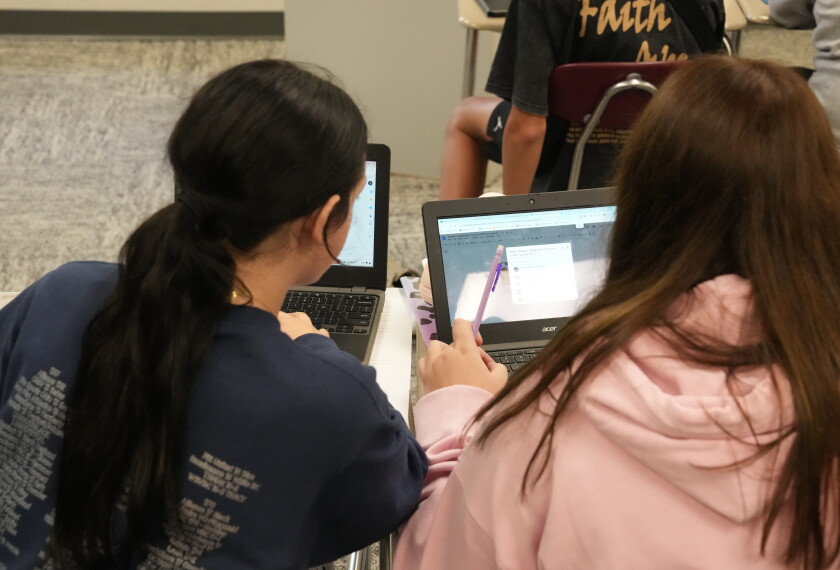
In the highest-profile part of the governor’s plan, the state would provide laptops to every middle and high school student in Massachusetts, starting with grades 6-8 in fiscal 2007.
Students would be able to keep the laptops under the estimated $27 million program. The ambitious program would be made possible by the availability of computers that cost only $100 each. The low-cost computers are being designed by the nonprofit group One Laptop Per Child, founded by faculty members at the Massachusetts Institute of Technology, in Cambridge, mainly for use in developing nations.
The computers would feature color screens and perform most applications students would need for schoolwork and research, according to the governor’s office.
Sen. Antonioni expressed doubts, however, that the laptops could be made available for students in Massachusetts at such a low cost. “God bless them if they can do it,” he said, “but I have to believe the costs are going to be more than the governor is estimating.”
Massachusetts Teachers Association President Catherine A. Boudreau blasted the governor’s plan to pay bonuses to teachers based on their students’ test scores, along with additional compensation for teaching mathematics, science, and Advanced Placement courses.
“This is political grandstanding, not genuine education reform,” declared Ms. Boudreau, whose union is the state’s NEA affiliate.
She contended that good teachers in struggling schools would be encouraged to leave for schools with higher test scores under the merit-pay blueprint.
Gov. Romney has defended his plan, saying he wants to reward teachers whose students earn high scores or show marked improvement on state tests.
Under his proposal, teachers could receive up to $5,000 in annual bonuses if local districts provided half the cost of the bonuses and limited their distribution to one-third of each district’s faculty each year.
His plan also calls for $5,000 in annual bonuses for new math and science teachers, with the goal of recruiting 1,000 new teachers in those hard-to-staff fields. Teachers also would receive $2,500 annual bonuses for each Advanced Placement class they teach, up to $5,000.
In addition, Mr. Romney is calling for all public secondary schools in the state to offer AP calculus, chemistry, biology, and physics. Small schools could meet the standard via online courses, in his view. Seven math and science academies also would open for students across the state.
Gov. Romney also proposes that all new teachers be required to pass math-literacy tests in order to get their licenses, and he wants to establish the post of state secretary of education. The secretary would be appointed by the governor and serve as the vice chairman of the state board of education.