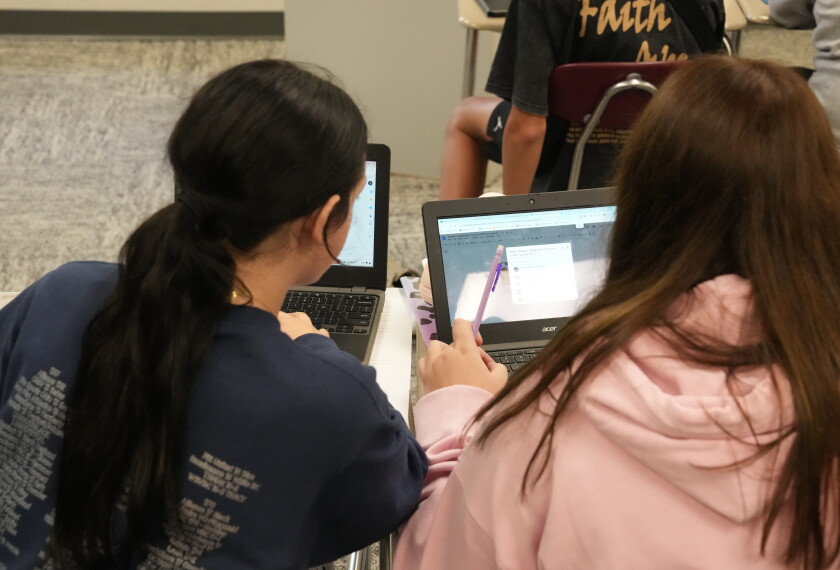
Digital learning is no longer the future of education: It is happening right now in schools across our nation. Bringing broadband access to low-income schools and libraries nationwide is an issue that we both feel passionate about. It is an investment not only in the future of our students, but also in our economy and our global competitiveness. Interactive online learning offers an opportunity to provide every child with a highly personalized, equitable, and excellent education. But if we fail to level the digital playing field, the education gap between those with broadband access and those without will only grow wider.
Historically, and far too often in the traditional American classroom, if a student fell behind, it was understood that he or she just wasn’t cut out for school. Interactive digital education offers personalized pacing and coursework to challenge every student, in their own time, whether they are behind or ahead of grade level.
If our children are going to compete in the 21st-century global workforce, we must educate them differently from the way we did in the 19th century. Instead of telling students to “power off” when they enter the classroom, we should integrate technology into lessons where it can be used effectively to engage and motivate students.
Yet there are too many instances when technology is unavailable or underutilized in classrooms because of a lack of training, tools, and broadband access. If we truly expect teachers to teach the skills students need to succeed tomorrow, we can’t equip them with the tools of yesterday. Congress recognized the importance of technology to the nation’s education system in a bipartisan way when it created the E-rate program in the Telecommunications Act of 1996.
There are too many instances when technology is unavailable or underutilized in classrooms because of a lack of training, tools, and broadband access.”
Administered by the Federal Communications Commission, E-rate has been enormously successful in bringing basic telephone and Internet access to classrooms and schools. However, the connectivity provided is no longer sufficient. According to data from the FCC, half the schools and libraries that apply for support from the program have Internet connections slower than the average American home. Without adequate broadband connections, even the best-equipped schools struggle to realize the promise of digital learning.
Ensuring that our students have broadband access to meet our nation’s goals is not a partisan issue, it is a national responsibility. It is a collective goal that our schools, teachers, libraries, and Internet providers are all pushing for, and it is one that is achievable. That’s why we, along with 24 of our congressional colleagues, sent a bipartisan letter in December of last year to the FCC urging swift action to expand and modernize the E-rate program.
This critical update will help ensure that every school has the ability to accelerate next-generation education reforms, support teachers, and enhance student learning. This is an important step toward providing our children with high-quality digital learning opportunities to improve their academic outcomes and prepare them for success in a modern economy.
We are delighted that the FCC has taken the first step in answering our call for swift action, with its announcement earlier this month that it will prioritize existing funding for high-speed Internet connections in schools and libraries. This $2 billion increase in funding is a critical down payment. It is a step in the right direction toward making the program more efficient and effective, while recognizing the urgency of reform. We applaud the FCC for finding these funds from savings within the E-rate program and using them to help meet today’s needs.
We simply cannot prepare our kids to compete for 21st-century jobs by leaving them stranded with technologies from the last century. In an age when high-speed broadband is transforming almost every aspect of our lives, surely we can’t ignore one of its most important uses. We must extend digital opportunities to every classroom.
We look forward to working with the FCC and our colleagues from both sides of the aisle in Congress in a bipartisan manner to modernize and expand the E-rate program, bringing transformative learning opportunities to every school in America.