Only one in five students who passed through the classrooms at Taft High School in Cincinnati eight years ago ended up in a graduation gown. Educators considered the school among the worst high schools in Ohio. Test scores and graduation rates were abysmal. Nearly a quarter of the students didn’t even bother to go to school.
Calls sounded to just shut it down. And those who remember the old Taft don’t sugarcoat their thoughts.
“It was an insane asylum,” said teacher Jocelynne Jason, who’s worked there for more than a decade.
“A slum school,” said Jack Cassidy, the chief executive officer of Cincinnati Bell. “You would never want your kid to go to Taft High School.”
Fast-forward to an October day in 2010.
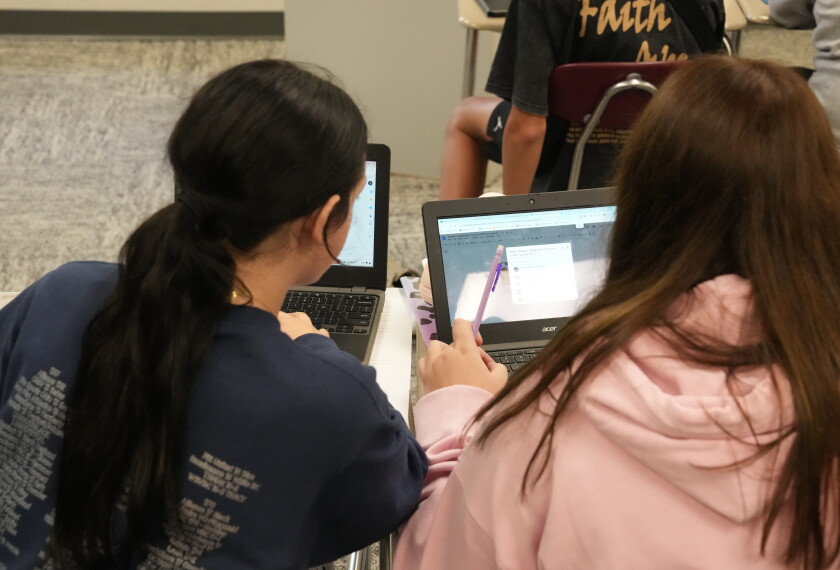
About a dozen juniors and seniors edited video clips in a well-equipped computer lab. Taft is now a technology school, and the interactive-media course is one of three technology focuses that students can pursue.
In the cafeteria, about 20 students mulled math and English questions with Cincinnati Bell volunteers during a tutoring session for the Ohio Graduation Test. Every student in the tutoring program passed the test.
Other areas show similar improvements. Graduation rates have skyrocketed from about 21 percent to more than 95 percent.
Once-nonexistent extracurricular programs thrive—the football team made the playoffs this year for the first time in history. And next spring, the school will move from a temporary location back to its old site in the city’s west end, where the district has built a state-of-the-art facility.
To top it all off, not only did the school earn an “excellent” rating on its state report card this year—its highest rating ever—it also won a prestigious National Blue Ribbon Schools award, the first Cincinnati public high school in more than 25 years to do so.
How Did It Happen?
So how did the high school, once considered a dead-end dropout factory, become one of the district’s best schools? Those who have lived it say they’re not magicians, they just had some good leadership, a good plan, good partners, and a bit of luck.
Some say there was another factor, something less tangible: People started caring.
Taft High School began to decline in the 1990s. “I was so embarrassed,” said Mr. Cassidy, recalling his first tour of the building during the 2000-01 school year.
“My God, as a taxpayer in Ohio and Cincinnati can we really have this as a place that we call a center of education?” he said. “It was literally on any metric the worst-performing high school, not only in Cincinnati but in the state of Ohio.”
Anthony Benton, a 2009 Taft graduate, recalled growing up near the school. “All you heard about Taft was a lot of bad things,” he said. “A bunch of fights. Grades were horrible.”
At the time, the school district was in the middle of a redistricting plan.
Most expected it to shut Taft down. But the community lobbied for it to be restructured instead.
Anthony Smith, a Taft graduate himself, was recruited from a Cincinnati public middle school to be the principal.
In addition to Mr. Smith, the school gained a new technology focus and a strong partnership with Cincinnati Bell, which provides students with everything from regular tutoring to cellphones to $20,000 in scholarships.
The district decided to turn Taft into a technology-focused school. Mr. Smith and a group of his teachers visited the best technology programs in the country and crafted a program for Cincinnati.
The school was renamed the Robert A. Taft Information Technology High School. All students take basic technology classes. Juniors and seniors enter the “Senior Institute,” where they choose a specific emphasis, such as Web design or information technology.
The restructuring was a huge factor in the turnaround, educators say, because the school began attracting students who wanted high-tech careers. It became a destination school rather than the default school.
And Taft has made those improvements happen while still offering open enrollment, meaning students don’t have to pass a test or meet academic requirements to get into the school.
‘All About Relationships’
Around the time of the restructuring, a fortuitous seating arrangement at a Cincinnati Business Committee lunch provided the final piece of the turnaround puzzle.
Mr. Smith happened to sit next to Mr. Cassidy from Cincinnati Bell. The pair struck up a conversation about the school.
“He said, ‘Hey, I’d really like to partner with you,’ ” Mr. Smith said.
So the pair crafted a plan. They held community forums to get feedback on the idea of a technology school. Cincinnati Bell volunteers cleaned and repainted the entire interior of the building in the summer of 2001 to celebrate the redesign.
The company now provides tutoring, scholarships, and internships for students. It set up an academic-incentive program, in which it gives free laptop computers and cellphones to all juniors and seniors who earn at least a 3.3 grade point average and wires their homes with broadband Internet.
Mr. Cassidy, who attends the football games and gives all the students his cellphone number, admits the partnership is as much about business as altruism. It creates new customers and future employees.
Mr. Smith said the relationships forged through the partnership are more valuable than any amount of money.
“It’s all about relationships,” the principal said. “When kids believe that you really want them to be successful, they’ll do whatever you want them to do.”
Taft’s turnaround wasn’t magic, Mr. Smith said. It took hard work.
But in a day and age when turnaround schools generally involve a staff overhaul and expensive help from outside experts, Taft has managed to right itself with little guidance or interest from the outside world. Its staff talks to other districts looking to turn around their own high schools. It was recently featured on the “CBS Evening News,” and it was cited in a recent Education Week commentary. (“The Neglected Topic in School Turnarounds,” Oct. 27, 2010.)
Mr. Smith said Taft’s success comes down to a lot of people who cared an awful lot, and who worked tirelessly on a turnaround plan with the attitude that failure was not an option.
“When you take on this education thing, you have to be serious about it,” he said. “If you mess up kids, you can’t go back and fix them.”