For Nancy Jacobson, online professional development just makes sense. The 5th grade teacher at Frazee Elementary School lives in a rural part of western Minnesota, 60 miles from the nearest college offering traditional in-person courses. By going online instead, she can save driving time and gas money, and complete her weekly coursework whenever she has time.
Online professional development isn’t just convenient, however. If it’s done right, it can also be as effective as face-to-face PD in helping teachers improve student performance, according to the study “Ready to Teach: Teaching Fractions Project.”
Funded in part by the U.S. Department of Education and administered by the University of Minnesota and Twin Cities Public Television, the three-year study included 57 teachers who took either an online or in-person course on teaching fractions.
The educators gave their 4th, 5th, and 6th grade students—1,073 in all—a fractions test before and after taking the course, and on average the students improved their scores in the second round by 10 points, no matter which version of the course their teachers had taken. Jacobson, a study participant who took the online training, says, “What I noticed when I taught [fractions] in class was how the children were able to understand exactly what they were all about.”
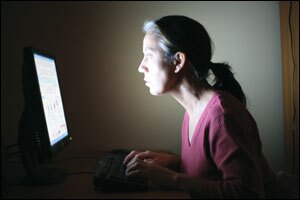
Kathleen Cramer, the University of Minnesota at Twin Cities curriculum and instruction professor who set up the workshops, says that among other reasons, the online course was successful because it managed to keep teachers engaged. But that’s something not all online professional development programs achieve. According to a recent nationwide but unscientific survey conducted by Eduventures, a research company, the small number of teachers who have used online PD don’t consider it overly helpful.
Of 92 teachers who responded to the survey, 27 percent said they had used some sort of interactive online professional development, and just 18 percent of those teachers found the programs “extremely effective.” By comparison, 91 percent of teachers participated in face-to-face and on-site training, and 44 percent of that group found those programs “extremely effective.” Teachers said they especially valued the opportunity in-person programs gave them to brainstorm and network.
'Media-rich online professional development can match the results of face to face.'
With those factors in mind, Cramer and Seth Leavitt, a Minneapolis middle school math teacher who collaborated on the project, had the teachers meet in person before the online course started. They also created online discussion groups of just four or five teachers, and posted a picture and small biography next to each teacher’s name to personalize the interface. “We learned key things about making an online course,” says Cramer. “There needs to be some sense of community.” Adds Leavitt: “The vehicle of presenting material at this point is not the deciding factor [of success]. If a course is vigorous, it will be vigorous no matter what.”
Online programs do offer unique benefits, says Chris Dede, a professor of learning technologies at Harvard University. Not every student thrives in a face-to-face environment, he notes. Going online spurs students who otherwise might not participate to join in. “There is a growing body of evidence that face to face is not the gold standard,” says Dede. “Different learners find their voice in different mediums.”
But there are also potential drawbacks to online programs, says Dennis Sparks, executive director of the National Staff Development Council. One of his concerns is that teachers may develop closer bonds with colleagues a few states away than with teachers in their own school. “I want a large part of teachers’ learning to be embedded in day-to-day work with their colleagues in teams, which doesn’t negate the value of electronic learning,” says Sparks. “It just puts it in a larger context.”
The ideal, say many educators, is a so-called blended model of professional development. As Harvard’s Dede explains, no one builds a house with just one tool; to get the best results, builders use a wide range of tools or, in the case of professional development, a wide range of media. Says Leavitt: “With all the workshops I’ve done, the one thing we’ve noticed is that if a group comes together as a community, the workshop goes better and people learn more. Face-to-face experience is important to help build that.”


