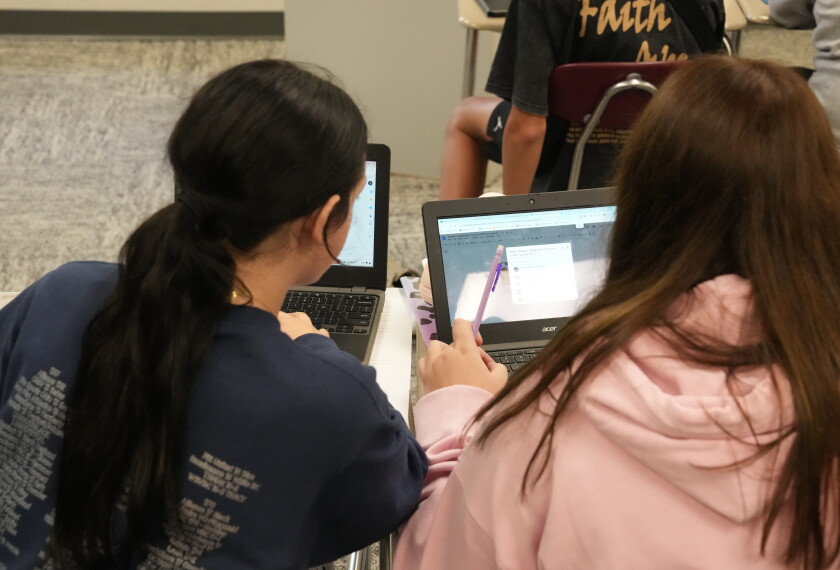
The Trump administration’s top K-12 official urged educators and policymakers to focus on whether education-technology tools offer “educational value” for students, as opposed to only considering how much time students spend on digital learning platforms each week.
Kirsten Baesler, the assistant secretary for elementary and secondary education at the U.S. Department of Education, argued that there’s a clear distinction between “recreational” technology that’s increasingly concerning to parents and high-quality instructional tools that deliver real value to students.
“The public policy debate should not be framed as a choice between technology and no technology, nor should every screen be viewed as serving the same purpose,” Baesler wrote in a “Dear Colleague” letter released Aug. 20.
“While excessive recreational screen use has raised important concerns that deserve attention, education technology can strengthen teaching, deepen learning, and expand education opportunity when aligned with clear instructional goals and implemented effectively,” wrote Baesler, a former North Dakota education chief.
The letter comes amid rising education technology backlash from across the political spectrum.
Democratic and Republican lawmakers in more than a dozen states this year supported legislation limiting screen time in schools to a certain number of minutes per week—though only a handful of those measures became law.
Districts in both Democratic- and Republican-leaning areas—such as Los Angeles Unified and Hillsborough County, Fla.—have also enacted screen-time caps.
And the Trump administration’s Surgeon General’s office has recommended schools cut back on student screen time.

Schools should evaluate the effectiveness of learning technologies, Ed. Dept. says
Instead of concentrating “solely” on whether to restrict students to a designated number of minutes on digital platforms each week, Baesler recommended that educators track whether the learning platforms they’ve invested in actually move the needle on student achievement.
She also noted that some districts have begun developing contracts that tie vendor payments, at least in part, to whether providers make good on their promises, such as better learning outcomes, a practice known as outcomes-based contracting.
Early research suggests the approach holds promise, she wrote.
“Schools should be increasingly intentional about the digital experiences they place in front of students, ensuring that technology use is purposeful, instructionally sound, and contributing to measurable student outcomes,” Baesler wrote.
For their part, ed-tech providers should publish rigorous, outside evaluations of their products if possible; be transparent about their products’ limitations; and offer districts support with implementation, according to the letter.
Baesler pointed to some of the positive impacts of education technology: It can connect rural students with rigorous coursework and tutoring, provide educators with a real-time picture of students’ academic progress, and support to students in special education.
“These examples illustrate why education technology should not be evaluated solely by the amount of time students spend using it,” she wrote. “Technology will continue to shape education, the workforce, and civic life. Preparing students for that future requires thoughtful decisions about when, where, and how technology is used in support of learning.”
Baesler’s letter doesn’t carry the force of law. Rather, it’s a recommendation to schools and a synthesis of some research on ed tech. Decisions about digital learning tools “are best made by states and local communities, with input from parents and teachers,” Baesler wrote.

Ed. Dept. carves a middle ground in the ed-tech debate
Baesler’s letter notably carves out a nuanced position on the use of ed tech in an administration that has both cheered AI-driven developments in K-12 education and called for schools to hit the brakes on the proliferation of classroom technology.
President Donald Trump has been bullish on the use of artificial intelligence in schools. Last year, he signed an executive order calling for an infusion of AI throughout K-12 education, including training teachers on how to integrate the technology into their instruction and workflows.
Trump gave AI in education a high-profile shoutout in his State of the Union Address earlier this year. Among Melania Trump’s special guests at the speech: Everest Nevraumont, a student from Alpha Schools, a network of private schools where students spend two hours a day learning reading and math using AI-powered software.
Then, in March, the first lady appeared with an AI-powered humanoid robot at a White House summit, where she touted the potential of an always-available and ever-patient humanoid educator named Plato to teach students classical studies.
But in May, Trump’s Office of the Surgeon General, part of the Department of Health and Human Services, recommended that schools limit students’ screen time to improve their focus and learning capabilities, as well as their physical and mental health.

Robert Kennedy, Jr., the HHS secretary, warned against the “addictive” power of digital learning tools. His agency called for districts to scrap 1-to-1 computing programs that give students school-issued digital devices to use in class and often at home, too, in favor of computer labs, and design assignments that rely on pen and paper “whenever possible.”
Kennedy also cheered on Iowa Gov. Kim Reynolds, a Republican, as she signed legislation limiting digital instruction for elementary school students to 60 minutes per school day—though his agency stopped short of recommending specific screen time restrictions for schools.
Baesler’s nuanced approach provides helpful guidance to district leaders trying to navigate a sensitive, politically charged issue, said Jean Claude Brizard, the CEO of Digital Promise, a nonprofit that focuses on technology and equity. Brizard previously led the Chicago and Rochester, N.Y., school districts.
If he were still a superintendent “getting a lot of pressure from a handful of parents, from some politicians in my community” to set screen-time limits, he said, “this guidance arms me with information and perhaps some leverage” to let teachers and school administrators determine how to use digital learning tools.