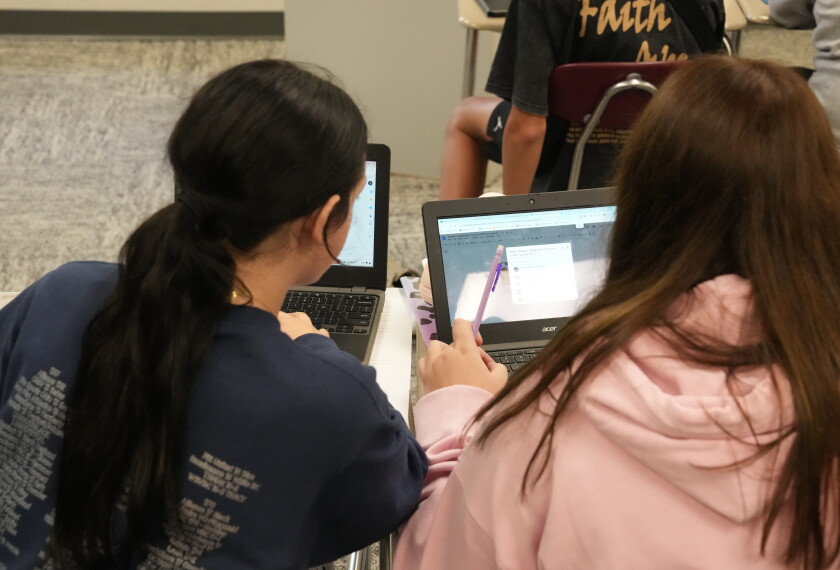
Most educators support school cellphone restrictions. But what about students’ views?
Newly released data from the Pew Research Center show that although about half of teens are not in favor of such policies, smartphone bans may have more backing from teens than educators might assume.
Forty-one percent of teens ages 13 to 17 support banning middle and high school students from using their smartphones during class time, according to the Pew survey, which was conducted in October. Fifty-one percent oppose them, and 9% are unsure.
When it comes to banning cellphones for the entire school day, support among teens drops significantly, with 17% supporting the policy and nearly three quarters of teens opposing it.
“Schools nationwide are cracking down on students’ cellphone use,” a Pew research brief on the findings said. “At the same time, support for cellphone bans is rising among U.S. adults.”
Nearly three-quarters of adults support banning cellphones during class, and 44 percent support bell-to-bell bans, according to a separate survey by Pew.
Like many of the teens in the survey, George LaComb said he could get behind a limited ban on cellphones. George is a senior at a public high school in Orlando, Fla., where the state banned cellphones during instructional time in 2023 and updated the law to ban cellphones throughout the entire school day in 2025.
“There are definitely some benefits of not seeing [your cellphone] during class to try to encourage more participation and attention,” he said.
But he thinks the bell-to-bell ban goes too far. George misses listening to music between classes to relieve stress, and messaging with his friends during lunch. He’s also frustrated with the logistical hurdles and disciplinary issues he says the cellphone bans create.
But a fast-changing state policy landscape is bending toward more restrictive policies. Emerging research is finding benefits in cellphone bans, such as improved student attention, better overall behavior, and more face-to-face social interactions.
The policy movement to ban smartphones in classrooms is growing
Since 2023, at least 33 states, the District of Columbia, and Department of Defense Dependents Schools have passed laws requiring schools to ban or restrict students’ use of cellphones during the school day, according to an Education Week tally. Twenty-three states ban students from using their cellphones for the entire school day, or bell-to-bell, while nine restrict student cellphone access only during instructional time.
Even more states are considering enacting restrictions this year, such as Michigan and Pennsylvania, or making their existing policies more stringent, such as Indiana and Utah.
But there have been negative side effects to Florida’s cellphone ban that administrators at his school have struggled to address, said George, who is also the Florida representative for the National Student Council, which is run by the National Association of Secondary School Principals.
George said when a football practice is canceled, and he doesn’t see the notification until the end of the school day, he’ll sometimes have to wait for hours before his mother can pick him up.
Students are also getting in trouble more, George said, because it’s tempting to break the new cellphone rules. That creates tension between staff and students, he said, and it’s changing the school’s climate.
“It chisels away at the relationship that the administration used to have with the kids,” George said. “My friends say it feels like school has become more and more prison-like.”
Early research on cellphone bans is promising, with caveats
Some emerging research suggests that stricter policies may produce more benefits—although there is still not much evidence of the effectiveness of different types of cellphone policies.
A research project conducted by University of Pennsylvania psychology professor Angela Duckworth and economists from Stanford University found that—based on preliminary survey data of 20,000 teachers—bell-to-bell policies and rules that require students to lock their phones away for the whole school day were linked to improved student attention in class.
Another analysis published as a working paper by the National Bureau of Economic Research found both promising and cautionary early results in Florida schools after that state implemented a cellphone ban in all its schools. Student academic achievement and attendance improved overall, but suspension rates—especially for Black students—went up in the first year of the ban before dropping back down again in the second year of the ban.
The Pew survey provides some additional context for that research: 46 percent of white teens support classroom cellphone bans, compared with 33 percent of Black students and 36 percent of Hispanic students.
Finally, early findings from research out of Kennesaw State University found that a cellphone ban improved teachers’ overall well-being and job satisfaction.