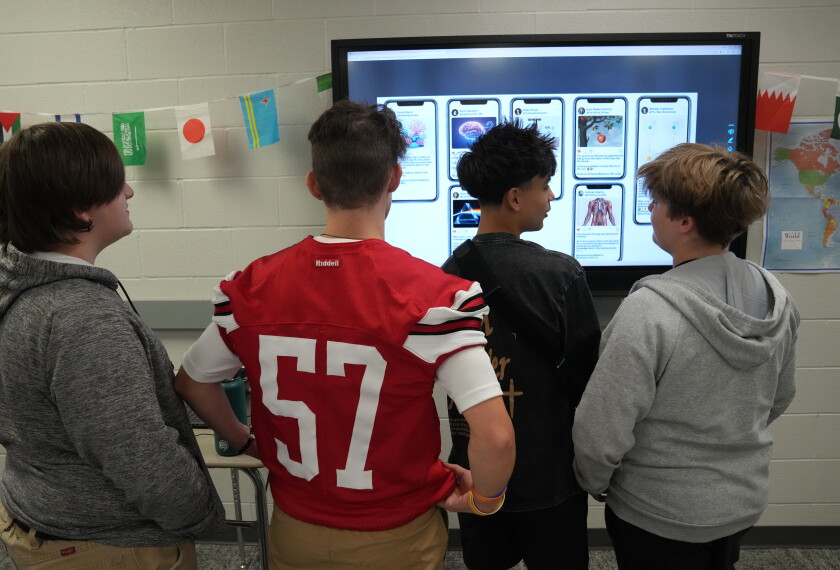
Education Week answers some of the most common questions about the use of artificial intelligence inschools. See the answers below:
How can AI be used effectively in classrooms?
More than a third of teachers are already using AI to plan lessons, according to 2024 data from the EdWeek Research Center. Teachers are also using AI to create presentation materials for teaching, writing rubrics and student assignments, and checking for student plagiarism. Experts stress, however, that teachers should always review anything AI creates and be aware that AI can be inaccurate and biased. Read more.
What jobs are in jeopardy of being replaced by AI?
In recent years, companies and schools have pushed students to learn to code in order to get high-paying computer science-related jobs. Now, though, layoffs and tech CEO comments are raising fears in students that AI will greatly diminish the number of entry-level tech jobs. Teachers and business leaders say that soft skills are key for students to be able to thrive in a workforce where AI plays a bigger role.
What teacher tasks can AI replace?
9 in 10 educators said that artificial intelligence has changed the job of teaching at least a little, according to a December 2024 EdWeek Research Center survey.
Many companies are now offering AI tools to assist teachers in tasks like lesson planning, differentiating schoolwork to match students’ skill levels or interests, and grading. The tools can also help save teachers time when writing messages to families. Experts stress that the tools should not be a replacement, but only an aide for teachers. For the most effective results, teachers need to be very clear in their prompts and check the results carefully for accuracy and bias. Read more.
Of course, AI can’t take over many key things teachers do, from building genuine relationships with students to teaching critical thinking.
Many companies are now offering AI tools to assist teachers in tasks like lesson planning, differentiating schoolwork to match students’ skill levels or interests, and grading. The tools can also help save teachers time when writing messages to families. Experts stress that the tools should not be a replacement, but only an aide for teachers. For the most effective results, teachers need to be very clear in their prompts and check the results carefully for accuracy and bias. Read more.
Of course, AI can’t take over many key things teachers do, from building genuine relationships with students to teaching critical thinking.
How should schools handle cheating in the age of AI?
Artificial intelligence is part of many aspects of K-12 education already, and likely to grow in the next few years. Many digital learning software programs used in classrooms incorporate AI tutors and AI tools for differentiating materials so they can be used with students of varying proficiency levels.
Of course, students also use AI. But while many teachers are concerned about students using chatbots to cheat on their assignments, some research suggests that students aren’t cheating more than before AI was widely available. AI-detection tools should not have the final say on whether a student plagiarized and should be punished, experts say, because they can have false positives and may be more likely to falsely identify the work of English learners as produced by AI. Instead, teachers should talk with students and, if a student admits to using AI, use it as an opportunity to talk about appropriate uses of AI.
Of course, students also use AI. But while many teachers are concerned about students using chatbots to cheat on their assignments, some research suggests that students aren’t cheating more than before AI was widely available. AI-detection tools should not have the final say on whether a student plagiarized and should be punished, experts say, because they can have false positives and may be more likely to falsely identify the work of English learners as produced by AI. Instead, teachers should talk with students and, if a student admits to using AI, use it as an opportunity to talk about appropriate uses of AI.
Find the latest news about artificial intelligence on our topics page.