
Artificial Intelligence

At OpenAI Forum, Discussion Focuses on Stronger Teen Safety Measures

By Lauraine Langreo — October 05, 2026 4 min read
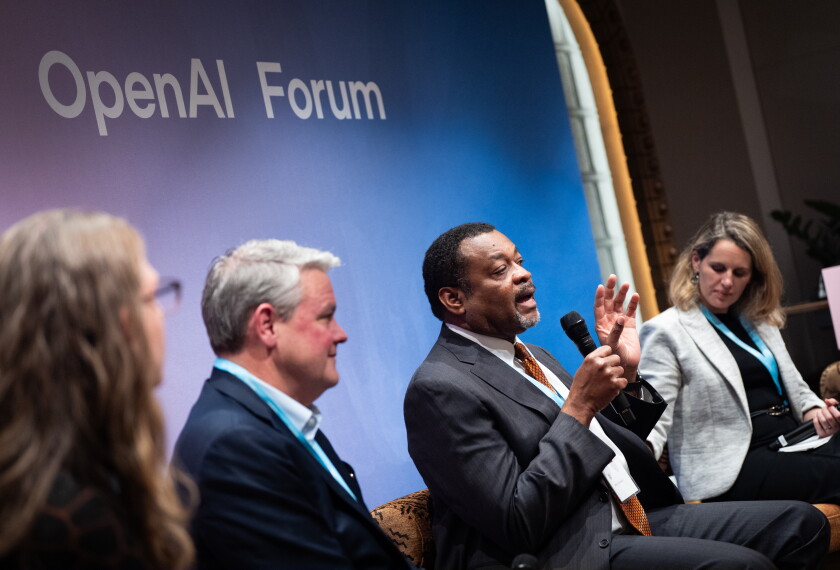
Washington, DC - October 5, 2026: Arthur C. Evans Jr., PhD, Chief Executive Officer of the American Psychological Association  speaks during the discussion. The OpenAI Forum hosted a panel on Responsible AI for Teens, how AI can support teens’ learning while promoting safe, healthy use. The program featured an OpenAI Forum panel with experts in learning, adolescent mental health, and family and online safety: Kate Ruane, Director of the Free Expression Project at the Center for Democracy & Technology, Chuck Melley, SVP of Policy, Advocacy and Communities at CodeAI, Arthur C. Evans Jr., PhD, Chief Executive Officer of the American Psychological Association and Mathilde Cerioli, Chief Scientist at everyoneAI. Chris Lehane, OpenAI’s Chief Global Affairs Officer, moderated the conversation and shared context on ChatGPT for Teens, a learning-first experience launched in August and designed to help teens think critically, deepen understanding, and use AI with confidence.
  • Save to favorites
  • Print

The growing pushback to the overuse of technology in schools has moved beyond cellphones and Chromebooks to artificial intelligence.

In September, the nation’s two largest districts—the New York City Public Schools and the Los Angeles Unified system—hit the brakes on student use of AI tools. The Los Angeles school system’s policy restricts use of the technology for all students. New York prohibits it in elementary and middle school but allows limited use in high schools.

Yet many proponents of the technology argue that because it seems likely to reshape many aspects of society, today’s students need to have AI literacy to prepare for a world in which the platforms will be used regularly in careers and everyday life.

On Oct. 5, OpenAI, the creator of the generative AI tool ChatGPT, hosted a panel of experts in technology, learning, and youth mental health to discuss how teens can use AI safely.

The discussion was moderated by Chris Lehane, the chief global affairs officer for OpenAI, and the panelists included:

  • Arthur C. Evans Jr., the chief executive officer and executive vice president of the American Psychological Association;
  • Kate Ruane, the director of the Free Expression Project at the Center for Democracy & Technology, a nonprofit that advocates for online civil liberties.
  • Mathilde Cerioli, the chief scientist for everyoneAI, a nonprofit focused on ensuring that AI serves children and young people; and
  • Chuck Melley, the senior vice president of policy, advocacy, and communities for CodeAI (formerly Code.org), a nonprofit focused on helping students build AI literacy.

Here are some of the takeaways from their discussion.

Teens need to learn how to use AI responsibly

AI brings great opportunities for supporting student learning—as long as parameters are applied, Melley said.

“It can help them deepen their thinking, as long as it doesn’t give them the answer,” he said. “It has the opportunity, if used correctly, to really help them think through challenges, think through computational issues, and how to get the best out of a dataset.”

But students need to learn how to use these tools responsibly, and schools are best positioned to teach students those skills, the panelists said.

Banning AI tools is not the answer, Ruane said.

“How do we actually teach kids how to become experts while using this technology and become experts in the technology itself, as they age?” Ruane said.

“We have to be integrating support for kids’ education throughout their life cycle,” Ruane said. “I don’t think bans necessarily accomplish that, so let’s think about it a little bit differently and in a more supportive way that guides them along the process.”

Lawmakers need to help, by creating AI literacy standards and funding professional development opportunities for teachers on how to use AI responsibly, Melley said.

AI tools need designs that reflect students’ development

AI tools for kids need to be designed differently because students’ brains are still developing, said Cerioli.

While research is still emerging about the effects of AI on kids’ development, there is already a lot of research about what children are experiencing. That research should inform software developers in determining what design choices will be good for kids and what will be harmful, she said.

See Also

Collage of student hands working on a laptop with half of a teacher's face looking at the screen. The eye is ominous as it is bright blue, while the teacher is otherwise dark in the shadows. There is a red alert symbol on the student's laptop. All is against a yellow background with a subtle binary code and broken glass texture on top.
Illustration by Gina Tomko/Education Week + Getty

Adolescents are in a very sensitive developmental stage. They’re more attuned to social cues and rewards; they’re in a stage where they need to go out into the world and explore and make connections outside of family, she said.

The role AI plays in adolescents’ learning during this period could “either support, increase autonomy, and get them to mastery, or [on the other hand] they learn around AI but then if you remove AI, they don’t know how to do it,” Cerioli said.

The question, Cerioli said, is how do we design and adapt AI tools based on a child’s age to make sure it’s safe and developmentally appropriate? There are many organizations working together to answer that question, she added.

Industry leaders, researchers, and policymakers can’t work in isolation

Designing AI tools that are safe for kids also requires collaboration between tech companies, lawmakers, researchers, educators, parents, and students, the panelists said.

Those groups shouldn’t repeat the mistakes they made with social media, Evans said.

“One of the things [the scientific community] learned [about social media] is that we needed to have acted much sooner, and we should have acted on the evidence that we had,” he said.

With AI, “we can’t sit back and wait,” Evans said. Researchers and industry need to work together to get the data necessary to examine the ways tech platforms and tools are affecting kids, he said.

Policymakers should think about children’s safety first, Cerioli said. It’s easier to relax regulations as we learn more rather than the other way around, she said. Policymakers should look at incentive responsible behavior in the corporate sector.

“We have a mental health crisis for teenagers, so parents are looking at [AI] companies,” Cerioli said. “What if the competition was who gets to be the safest? Who gets to be the product we pick because we know that’s where we’re comfortable putting our kids?”

Events

This content is provided by our sponsor. It is not written by and does not necessarily reflect the views of Education Week's editorial staff.
Sponsor
Artificial Intelligence Webinar
From Passive to Active Reading: Student Engagement in the Age of AI
What the research tells us about active reading and student engagement—and what it means for teaching in an AI-enabled world.
Content provided by Pearson
This content is provided by our sponsor. It is not written by and does not necessarily reflect the views of Education Week's editorial staff.
Sponsor
Professional Development Webinar
Micro-Learning, Macro Results: Reimagining Professional Learning
Rethink professional learning with 3 strategies that personalize professional learning, validate expertise, and support educator retention.
Content provided by Mira Education & Modiv EDU
This content is provided by our sponsor. It is not written by and does not necessarily reflect the views of Education Week's editorial staff.
Sponsor
School Climate & Safety Webinar
There But Not Present: Rethinking Student Engagement
Learn how to recognize the early signs of disengagement and what the behavioral science reveals about which interventions actually work.
Content provided by Frontline Education

EdWeek Top School Jobs

Teacher Jobs
Search over ten thousand teaching jobs nationwide — elementary, middle, high school and more.
View Jobs
Principal Jobs
Find hundreds of jobs for principals, assistant principals, and other school leadership roles.
View Jobs
Administrator Jobs
Over a thousand district-level jobs: superintendents, directors, more.
View Jobs
Support Staff Jobs
Search thousands of jobs, from paraprofessionals to counselors and more.
View Jobs

Read Next

Artificial Intelligence Opinion Why I'm Not Betting on the Future of Alpha School
A former champion of the ed-tech movement shares his concerns about this new school model.
4 min read
Conceptual illustration of classroom conversations and fragmented education elements coming together to form a cohesive picture of a book of classroom knowledge.
Sonia Pulido for Education Week
Artificial Intelligence Headlines Warn of an AI Apocalypse. How Should Schools Respond?
Panic-inducing AI headlines might prompt schools to hit pause and review the tech more carefully.
6 min read
Scary Headline AI Illustration
Vanessa Solis/Education Week + Getty
Artificial Intelligence Can Schools Trust AI to Translate for Non-English-Speaking Parents?
AI tools can translate school materials for non-English-speaking parents, but there are challenges around privacy and accuracy.
10 min read
Illustration by Nicole Xu showing a teacher in a teacher-parent conference with a laptop that translates a distorted depiction of the student. The female parent of the EL student has a swirly white line of confusion circling her head.
Nicole Xu for Education Week
Artificial Intelligence Banning AI Alone Won't Snuff Out the 'TechLash,' Parent Advocates Say
Parents worry about AI but also data privacy, video use, and screen time in general, advocates say.
6 min read
An anti-AI flag is shown during a protest against artificial intelligence in San Francisco on July 11, 2026. Parents who are advocating against the overuse of technology in education say AI bans in schools are a good step to address their concerns, but they also want to see classroom restrictions on screen time and use of platforms such as YouTube.
Jason Henry/Bloomberg via Getty Images
