Artificial Intelligence

6 Things Teachers Do That AI Just Can’t

By Lauraine Langreo — September 07, 2023 2 min read
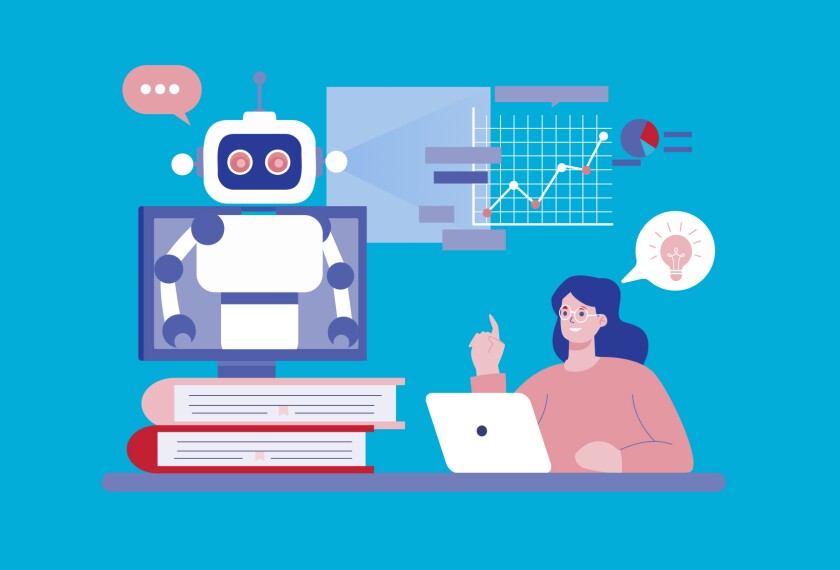
Illustration of woman using AI.
  • Save to favorites
  • Print

Tools powered by artificial intelligence have the potential to increase people’s productivity and make many tasks easier to do. In the K-12 world, educators are already using AI tools to plan lessons, create rubrics, provide feedback on student assignments, and respond to parent emails.

When asked what role AI-powered tools should play in teaching and learning, more than a quarter of educators (27 percent) said “creation of instructional materials,” 24 percent said “lesson planning for teachers,” 23 percent said “creation of assignments for students,” 12 percent said “grading students,” and 7 percent said “completing student paperwork,” according to an EdWeek Research Center survey of 1,301 district leaders, principals, and teachers conducted this summer.

Of course, there are downsides to this technology. For instance, AI tools can produce inaccurate or biased responses based on faulty data it draws from, and it has the potential to expose private and sensitive data. Many executives, researchers, and engineers have also raised red flags about AI’s potential to eliminate many jobs.

See Also

Illustration of stylized teacher student relationship with AI represented between them as layered screens.
Traci Daberko for Education Week

But teachers’ jobs are safe, experts say. While there are a handful of teacher tasks that generative AI tools can replicate, teachers also have so many other strengths and responsibilities that would be very unlikely to be replaced by those tools. In fact, even though AI “as a replacement for teachers” was one of the options in the EdWeek Research Center survey, no educator selected it as an answer.

Here are some teacher tasks that are unlikely to be taken over by AI tools, according to interviews and email responses from educators, AI researchers, and tech company CEOs:

Teaching critical thinking

   Problem solving often requires critical thinking, which involves the ability to analyze information, evaluate its relevance, and make informed decisions. Teachers guide students in developing these cognitive skills through thoughtful questioning, discussions, and activities. AI, while capable of processing vast amounts of data, lacks the depth of critical thinking and reasoning that humans possess.

— Dyane Smokorowski, digital literacy coordinator for the Wichita school district in Kansas

   A teacher is vital to the use of AI because they're going to be the gatekeepers. They're going to be the ones that validate the information and make sure that the AI isn't just sugarcoating things or putting things in the wrong category or whatever AI might do.

— Cherie Shields, high school English teacher in the Oregon Trail school district in Sandy, Ore.

Building relationships with students

   [AI is] not a human. It doesn't have relationships. It doesn't have history. It's not part of a culture. It doesn't have an understanding of students' individual needs. It can't be expected to inspire students, in terms of directions and future thinking. It doesn't understand social-emotional learning and mental health issues. It doesn't understand the family context of students. There's very many things that teachers remain critical for and always will remain critical for.

— Glenn Kleiman, senior adviser at the Stanford Graduate School of Education

   AI is unable to replicate the personal connections teachers build with their students. The emotional support and mentorship teachers provide are irreplaceable. Additionally, excellent teachers know their students well both as learners and as people. The teacher’s role to tap into student passions, talents, and curiosities to design dynamic learning experiences requires a human touch. Yes, a teacher can ask AI to help design a learning experience connected with a particular student’s passion such as soccer, anime, or computer science, but it takes the teacher to make that connection.

— Smokorowski

Motivating students

   The human touch is a huge part of motivation to learn, especially in K-12 students. Computers just can't match the kind of empathy that teachers have for their students.

— Tom Mitchell, professor and researcher in machine learning and artificial intelligence at Carnegie Mellon University

   Teachers play an extremely important role in supporting students' motivation to learn and, more generally, in helping them develop their own sense of identity as a learner, as citizen, as a future worker, and as a person. Teachers help students both through their direct interactions but also as role models. These elements of teaching and being a teacher will not be replaced by AI tools because the necessary skills and dispositions come from a lifetime of experience and involve interpersonal interactions.

— Ken Koedinger, professor of human-computer interaction and psychology at Carnegie Mellon University

Creating a positive learning environment

   AI will not replace the core work of teachers that supports positive learning experiences: inspiring and motivating students while helping them discover and explore their passions through: building of relationships with students and families; demonstrating empathy and compassion; helping students make meaning of complexities and develop meaningful questions (essential in a world where AI is prevalent); making certain students are valued, know and use their gifts and talents; ensuring physical and emotional safety and well-being; [and] building partnerships with community organizations, industry partners.

— Tara Nattrass, managing director of innovation strategy at ISTE/ASCD

   No amount of generated content or automated assessment will replace the value of teachers for students. Teachers are the ones who create a welcoming learning environment for a community of learners with diverse backgrounds and needs. Teachers are the ones who foster collaboration which prepares students to go onto a career or college. Teachers are the ones who inspire their students to become the person who they can't yet see in themselves. The purpose of school for students is broader than lessons and assessments.

— Adam Geller, founder and CEO of Edthena, which provides AI-powered professional development

   Teaching empathy, compassion, and emotional intelligence is a deeply human task that requires understanding and adaptation to each student's needs.

— Smokorowski

Providing high-quality feedback on student performance

   AI often faces challenges in delivering high-quality feedback on student work that demonstrates a deep understanding of the subject. These difficulties arise from AI's limited ability to grasp the broader context, assess subjective elements, and recognize creativity and originality. Furthermore, AI struggles with providing high quality, interdisciplinary projects, intricate problem-solving tasks, and the nuances of emotional and social interactions. Although it does an excellent job in assisting teachers as they develop products and performance ideas, it would be unable to provide high quality feedback on a choir, dance, or marching band performance, a piece of student artwork, even a student created Minecraft World.

— Smokorowski

Attending to students’ basic needs

   Teachers often have an acute awareness of their students' well-being. They can recognize signs of hunger, distress, or when a student is having a bad day. This empathetic connection allows teachers to provide not only academic support but also emotional and sometimes even physical support. AI lacks the ability to genuinely understand and address these fundamental human needs, making teachers irreplaceable in providing holistic care for their students.

— Smokorowski

Events

This content is provided by our sponsor. It is not written by and does not necessarily reflect the views of Education Week's editorial staff.
Sponsor
Recruitment & Retention Webinar
Hiring, Retention, and Fill Rates: A Data-Driven Sub Strategy
Explore what keeps substitutes coming back and hear how one district rebuilt its substitute hiring process and improved its fill rate.
Content provided by Frontline Education
Early Childhood K-12 Essentials Forum Early Childhood Education: Building Essential Skills for Success
Join this free virtual event to examine the biggest challenges in supporting young children, from preschool through elementary school. 
This content is provided by our sponsor. It is not written by and does not necessarily reflect the views of Education Week's editorial staff.
Sponsor
Student Absenteeism Webinar
Attendance Isn't an Attendance Problem
Boost attendance by strengthening relationships, belonging, and support with practical strategies from Doug Fisher & Nancy Frey.
Content provided by Corwin

EdWeek Top School Jobs

Teacher Jobs
Search over ten thousand teaching jobs nationwide — elementary, middle, high school and more.
View Jobs
Principal Jobs
Find hundreds of jobs for principals, assistant principals, and other school leadership roles.
View Jobs
Administrator Jobs
Over a thousand district-level jobs: superintendents, directors, more.
View Jobs
Support Staff Jobs
Search thousands of jobs, from paraprofessionals to counselors and more.
View Jobs

Read Next

Artificial Intelligence Spotlight Spotlight on Using AI with Purpose: Building Responsible Practices for Schools
Learn how to implement AI responsibly with practical guidance for school leaders, teachers, and district decisionmakers.
Artificial Intelligence Schools Caught Flat-Footed After Google Makes Gemini Chatbot Available to All Students
Schools wrestle with the question of whether to permit or prohibit access to the AI chatbot.
5 min read
Social Studies teacher Simon Sharick supervises students at the Plymouth High School in Ohio on how to properly prompt the Gemini Ai App to get their desired information. Students were using the Gemini App for the first time on Friday, Aug. 28, 2026.
Students in a social studies class on Aug. 28, 2026, at Plymouth High School in Plymouth, Ohio, learn how to properly prompt Google's Gemini chatbot to generate useful and accurate information. In August, Google made Gemini available to K-12 students of all ages. <br/>
Ruddy Roye for Education Week
Artificial Intelligence Bill Gates' Stark Warning on AI in Education: It Could Result in 'People Learning Less'
The Microsoft co-founder is more worried about the technology than he was just a few years ago.
5 min read
SUN VALLEY, IDAHO - JULY 09: Bill Gates, co-founder of Microsoft and co-chair of the Bill & Melinda Gates Foundation, attends the Allen & Company Sun Valley Conference at the Sun Valley Lodge on July 9, 2026 in Sun Valley, Idaho. Every year, some of the world's wealthiest and most powerful figures from the media, finance, technology, and political spheres converge at the Sun Valley Resort for the exclusive week-long conference hosted by boutique investment bank Allen & Co.
Bill Gates attends a media, technology, and finance conference in Sun Valley, Idaho, July 9, 2026. The tech leader and philanthropist recently wrote an essay warning that AI could undermine employment and education.
Kevin Dietsch/Getty Images
Artificial Intelligence What the Research Says When Does AI Help Most With Tutoring? What Emerging Research Says
A brief from Stanford's SCALE initiative examines the existing evidence on using AI in tutoring.
4 min read
Student Caleb McDowell participates in an AI tutoring program at Nina Otero Community School in Santa Fe, N.M., on Jan. 23, 2025.
Student Caleb McDowell participates in an AI tutoring program at Nina Otero Community School in Santa Fe, N.M., on Jan. 23, 2025. Emerging research suggests that the level of involvement by a human tutor is a key factor in the effectiveness of AI-assisted tutoring.
Minesh Bacrania for Education Week