Special Report
Curriculum

Who Takes the Hardest Calculus Courses?

May 05, 2020 1 min read
BRIC ARCHIVE
  • Save to favorites
  • Print

National and international tests often highlight achievement gaps among U.S. students in math, but digging a little deeper into the data can reveal ways in which differences in the content students can access can widen those discrepancies.

For example, part of the Trends in International Mathematics and Science Study gauges the skills of advanced students from the United States and more than 40 other countries and education systems at the end of their secondary school careers, and it also collects data about what courses these student take. Just over 12 percent of all U.S. 12th graders participated in the test in 2015, according to the most recent data released.

Read More: Special Report: Leveling the Playing Field in Math

An analysis by the National Center for Education Statistics finds that significantly greater percentages of black and Hispanic students than their white or Asian counterparts reported that the highest math course they had taken was Advanced Placement Calculus AB, the standard AP calculus course covering about a college semester’s worth of material. The proportions were reversed for AP Calculus BC, a class of equal difficulty but covering a year’s worth of material, according to the College Board.
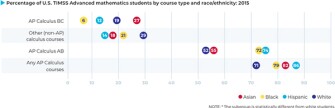
BRIC ARCHIVE

Why does that matter? Because the TIMSS Advanced shows students who completed AP Calculus BC scored significantly higher than students who took other Advanced Placement, honors, Regents, or other advanced calculus classes—not just in calculus problems, but those involving algebra and geometry, too. Students in these classes were also more likely to perform at the highest achievement levels overall.

BRIC ARCHIVE

Related Tags:

A version of this article appeared in the May 06, 2020 edition of Education Week as Calculus: Who Takes the Hardest Courses?

Events

This content is provided by our sponsor. It is not written by and does not necessarily reflect the views of Education Week's editorial staff.
Sponsor
College & Workforce Readiness Webinar
Smarter Tools, Stronger Outcomes: Empowering CTE Educators With Future-Ready Solutions
Open doors to meaningful, hands-on careers with research-backed insights, ideas, and examples of successful CTE programs.
Content provided by Pearson
This content is provided by our sponsor. It is not written by and does not necessarily reflect the views of Education Week's editorial staff.
Sponsor
Reading & Literacy Webinar
Improve Reading Comprehension: Three Tools for Working Memory Challenges
Discover three working memory workarounds to help your students improve reading comprehension and empower them on their reading journey.
Content provided by Solution Tree
Recruitment & Retention Webinar EdRecruiter 2026 Survey Results: How School Districts are Finding and Keeping Talent
Discover the latest K-12 hiring trends from EdWeek’s nationwide survey of job seekers and district HR professionals.

EdWeek Top School Jobs

Teacher Jobs
Search over ten thousand teaching jobs nationwide — elementary, middle, high school and more.
View Jobs
Principal Jobs
Find hundreds of jobs for principals, assistant principals, and other school leadership roles.
View Jobs
Administrator Jobs
Over a thousand district-level jobs: superintendents, directors, more.
View Jobs
Support Staff Jobs
Search thousands of jobs, from paraprofessionals to counselors and more.
View Jobs

Read Next

This content is provided by our sponsor. It is not written by and does not necessarily reflect the views of Education Week's editorial staff.
Sponsor
Curriculum Sponsor
Why Your Core Math Curriculum Is Failing Your Students (And What Actually Works)
Districts are already making large financial investments into core programs. So why are they still buying more resources to make up for what their textbooks can't do?
Content provided by Takeoff by IXL
An SOS sign on red paper, held up next to several books by a young student with one hand, where the student rests head on the back of the other hand that is on the top of an open book
Photo provided by Takeoff by IXL
Curriculum Q&A How In-School Banking Could Step Up Teens’ Financial Education
In-school banking has taken root in small, rural schools. Now it's spreading to the nation's largest district.
6 min read
Close-up Of A Pink Piggy Bank On Wooden Desk In Classroom
Andrey Popov/iStock/Getty
Curriculum NYC Teens Could Soon Bank at School as Part of a New Initiative
The effort in America's largest school district is part of a growing push for K-12 finance education.
3 min read
Natalia Melo, community relations coordinator with Tampa Bay Federal Credit Union, teaches a financial literacy class to teens participating in East Tampa's summer work program.
Natalia Melo, community relations coordinator with Tampa Bay Federal Credit Union, teaches a financial literacy class to teens participating in East Tampa's summer work program. In New York City, a new pilot initiative will bring in-school banking to some of the city's high schools as part of a broader financial education push.
Chris Urso/Tampa Bay Times via TNS
Curriculum 84% of Teens Distrust the News. Why That Matters for Schools
Teenagers' distrust of the media could have disastrous consequences, new report says.
5 min read
girl with a laptop sitting on newspapers
iStock/Getty
