Special Report
Curriculum

Who Takes the Hardest Calculus Courses?

May 05, 2020 1 min read
BRIC ARCHIVE
  • Save to favorites
  • Print

National and international tests often highlight achievement gaps among U.S. students in math, but digging a little deeper into the data can reveal ways in which differences in the content students can access can widen those discrepancies.

For example, part of the Trends in International Mathematics and Science Study gauges the skills of advanced students from the United States and more than 40 other countries and education systems at the end of their secondary school careers, and it also collects data about what courses these student take. Just over 12 percent of all U.S. 12th graders participated in the test in 2015, according to the most recent data released.

Read More: Special Report: Leveling the Playing Field in Math

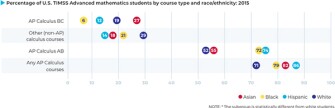
An analysis by the National Center for Education Statistics finds that significantly greater percentages of black and Hispanic students than their white or Asian counterparts reported that the highest math course they had taken was Advanced Placement Calculus AB, the standard AP calculus course covering about a college semester’s worth of material. The proportions were reversed for AP Calculus BC, a class of equal difficulty but covering a year’s worth of material, according to the College Board.
BRIC ARCHIVE

Why does that matter? Because the TIMSS Advanced shows students who completed AP Calculus BC scored significantly higher than students who took other Advanced Placement, honors, Regents, or other advanced calculus classes—not just in calculus problems, but those involving algebra and geometry, too. Students in these classes were also more likely to perform at the highest achievement levels overall.

BRIC ARCHIVE

Related Tags:

A version of this article appeared in the May 06, 2020 edition of Education Week as Calculus: Who Takes the Hardest Courses?

Events

This content is provided by our sponsor. It is not written by and does not necessarily reflect the views of Education Week's editorial staff.
Sponsor
Webinar
Smarter Tools, Stronger Outcomes: Empowering CTE Educators With Future-Ready Solutions
Open doors to meaningful, hands-on careers with research-backed insights, ideas, and examples of successful CTE programs.
Content provided by Pearson
Webinar Supporting Older Struggling Readers: Tips From Research and Practice
Reading problems are widespread among adolescent learners. Find out how to help students with gaps in foundational reading skills.
This content is provided by our sponsor. It is not written by and does not necessarily reflect the views of Education Week's editorial staff.
Sponsor
Reading & Literacy Webinar
Improve Reading Comprehension: Three Tools for Working Memory Challenges
Discover three working memory workarounds to help your students improve reading comprehension and empower them on their reading journey.
Content provided by Solution Tree

EdWeek Top School Jobs

Teacher Jobs
Search over ten thousand teaching jobs nationwide — elementary, middle, high school and more.
View Jobs
Principal Jobs
Find hundreds of jobs for principals, assistant principals, and other school leadership roles.
View Jobs
Administrator Jobs
Over a thousand district-level jobs: superintendents, directors, more.
View Jobs
Support Staff Jobs
Search thousands of jobs, from paraprofessionals to counselors and more.
View Jobs

Read Next

Curriculum Opinion Here’s Why It’s Important for Teachers to Have a Say in Curriculum
Two curriculum publishers explain what gets in the way of giving teachers the best materials possible.
5 min read
The United States Capitol building as a bookcase filled with red, white, and blue policy books in a Washington DC landscape.
Luca D'Urbino for Education Week
Curriculum The Many Reasons Teachers Supplement Their Core Curricula—and Why it Matters
Some experts warn against supplementing core programs with other resources. But educators say there can be good reasons to do so.
7 min read
First grade students listen as their teacher Megan Goes helps them craft alternate endings for stories they wrote together at Moorsbridge Elementary School in Portage, Mich., on Nov. 29, 2023.
First grade students listen as their teacher Megan Goes helps them craft alternate endings for stories they wrote together at Moorsbridge Elementary School in Portage, Mich., on Nov. 29, 2023. In reading classrooms nationwide, teachers tend to mix core and supplemental materials—whether out of necessity or by design.
Emily Elconin for Education Week
Curriculum Shakespeare, Other Classics Still Dominate High School English
Despite efforts to diversify curricula, teachers still regularly assign many of the same classic works, a new survey finds.
6 min read
Illustration of bust of Shakespeare surrounded by books.
Chris Whetzel for Education Week
Curriculum Why Most Teachers Mix and Match Curricula—Even When They Have a 'High-Quality' Option
Teachers who supplement "may be signaling about inadequacies in the materials that are provided to them,” write the authors of a new report.
6 min read
An elementary school teacher helps a student with a writing activity.
Allison Shelley for All4Ed
