Earning a national teaching certificate is now the ultimate credential quest for a small but growing number of early-childhood educators.
Margaret Brown is seeking national certification because she wants to take her preschool teaching skills to a higher level. Kristin Anderson secured the prestigious credential to help her prepare youngsters to meet increasing academic expectations of kindergarten. Whether Michelle Smith gets the certification or not, she is convinced that struggling through the yearlong process will make her a better prekindergarten teacher.
For all of them, national teacher certification is also a route to higher salaries.
Whatever their motivations, these teachers all have two things in common. First, they are among a small but growing corps of early-childhood educators across the country who have been awarded or are seeking certification from the National Board for Professional Teaching Standards. Only about 300 teachers in the early-childhood field have been awarded the credential, compared with roughly 15,700 K-12 teachers.
And Brown, Anderson, and Smith all work in the Charlotte-Mecklenburg, N.C., school district’s Bright Beginnings program, which seeks to better prepare disadvantaged preschoolers for the demands of K-12 learning.
At 44, Brown recognizes that this pursuit could be the most challenging task of her career. She’s already spending weekends writing outlines of papers she’ll submit during the process and turning down shopping trips with friends.
“I’ve had moments ... when I thought, ‘Oh, gosh, I’ve got to back out,’ ” says Brown, who originally earned her degree in physical education. She went back to school in 1997 to earn the credits she needed to be certified in early-childhood education.
But with her own son and daughter now off to college and a supportive husband at home, Brown—who describes herself as someone who enjoys new experiences— knew now was the time to begin the journey.
And fortunately, she’ll have plenty of support. Eight of the 109,000-student Charlotte-Mecklenburg district’s pre-K teachers are already nationally certified—an unusually high number for just one district. Eight more prekindergarten teachers are awaiting their results; another 10 teachers, including Brown, are just beginning the process.
“Every child deserves a teacher that is nationally certified—that is worthy of that certification,” says Kimberly Jarvis, a teacher at the district’s Tryon Hills Pre-K Center. She’s just started the certification process.
Now in her fourth year as a Bright Beginnings teacher, Jarvis originally worked with severely handicapped preschoolers. For her, working toward national certification is part of achieving her long-term goal of establishing an intergenerational program involving senior citizens and young children.
Yet for most school districts, encouraging pre-K teachers to pursue the voluntary credential “doesn’t even enter their minds,” says Barbara Pellin, Charlotte-Mecklenburg’s assistant superintendent for student, family, and community services.
But this district, which has a total of 339 nationally certified teachers, saw no reason to exclude preschool teachers.
“If we ever needed quality, certified teachers, it’s in this setting,” Pellin argues.
Now both the Arlington, Va.-based National Board for Professional Teaching Standards and the National Association for the Education of Young Children—the Washington-based professional association for the early-childhood field—are increasing their efforts to promote national certification among early-childhood teachers.
“Over the last year, we have really been trying to provide more visibility,” says Marilou Hyson, the associate executive director for professional development at the NAEYC, adding that the two organizations are trying to reach out to a variety of audiences, such as elementary school administrators, child-care centers, and preschool directors.
|
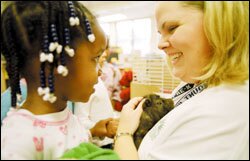
Michelle Smith: The Starmount Pre-K Center teacher, above, and student Kamela McGill play with a class hamster. Smith says that going through the national-certification process has made her a better teacher. |
For instance, the September edition of the NAEYC’s journal, Young Children, featured a two-page question-and-answer piece about the certification process. And sessions on national certification were scheduled for the NAEYC’s annual conference, held this month in New York City. (“Standards Take Spotlight at NAEYC Gathering,” this issue.)
Because most preschool teachers work outside school districts, they rarely hear about, or have easy access to, information about national certification.
But because Bright Beginnings is an integral part of the Charlotte-Mecklenburg schools—and because teachers are already required to be fully certified to work in the program—the district has encouraged prekindergarten teachers to pursue national certification.
Officials here are also hoping to recruit candidates from among the teachers who are working in the 15 community-based child-care centers that are using the Bright Beginnings curriculum.
“That’s our next step,” Pellin says.
This heavy emphasis on preschool teachers is paying off in other ways, too. The district has had a great deal of success keeping its best-trained early-childhood teachers in the early-childhood program—rather than seeing them move into the K-12 arena.
“Our teachers could be teaching anything they choose to teach, and they are choosing to teach early childhood because that’s where their heart is,” says Judy Lewis, a literacy facilitator for Bright Beginnings and a nationally certified teacher who coached several of the younger teachers through the process.
That is surely the case for Margaret Brown, who seems to thrive in the preschool setting.
On an October morning 4-year-old Damion, a child in Brown’s prekindergarten class, is having trouble choosing a task to pursue.
Brown, who teaches at Charlotte’s Double Oaks Pre-K Center, has asked him several times to find something he wants to do—which students demonstrate by carrying their “tickets” from one area of the classroom to another.
But instead of losing patience with Damion’s indecisiveness, she pauses, then explains that he’s anxious because he’s trying to attract the attention of a visitor in the class.
“He really just wants to show what he can do,” says Brown, whose friendly and relaxed nature is well matched with the loose denim shirt she is wearing. She praises Damion once he has sorted small plastic blocks by color into a round tray divided into several sections.
As she moves to check on some other children at the sand table, two young data collectors carrying clipboards crowd beside her, asking the teacher to write a survey question at the tops of their papers. She writes a question, and they proceed to ask their classmates if they want to go to a local amusement park. The little interviewers mark the answers with a line in the yes or no column.
“They’re all at different skill levels,” Brown says.
One of the NBPTS standards for preschool certification is the ability to understand how young children learn. Teachers must demonstrate this and other skills in a number of ways, including putting together portfolios that include videotapes of their teaching, samples of their students’ work, and detailed descriptions and analyses of their classroom lessons. According to the national board, teachers spend between 200 and 400 hours creating their portfolios. To earn certification, teachers must also pass exams in their specialty areas in which they respond to questions about academic content and instructional techniques.
Bright Beginnings teachers are paid on the same salary scale as those in K-12. Like their peers in the higher grades, they also have access to some significant financial incentives to pursue NBPTS credentials.
To begin with, North Carolina pays the $2,300 application fee for teachers who are seeking national certification. If they complete the program—and spend at least 70 percent of their time as a classroom teacher—they also receive a 12 percent raise each year for the 10-year life of the certificate.
The Charlotte-Mecklenburg district also gives nationally certified teachers an additional 12 percent raise on the amount by which they supplement the state’s salary schedule.
|
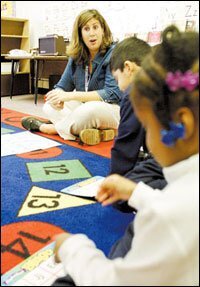
Kristen Anderson: The nationally certified preschool teacher plays bingo with her students at the Starmount Pre- K Center in Charlotte, N.C. |
With those incentives, an experienced teacher in the Charlotte-Mecklenburg schools earning $41,194 could boost her salary by more than $5,000 if she became nationally certified.
A common frustration among preschool directors is that once their teachers earn college degrees or improve their skills in some other way, they often move into elementary school teaching positions because they can earn more money.
To make matters worse, other teachers feel they’ll earn more respect if they teach in K-12. Even with the stronger emphasis states and President Bush have put on raising the quality of early-childhood programs, the field is still working to overcome the image of simply providing baby-sitting.
Yet even here, where preschool education is a top priority, teachers say they occasionally encounter surprise from colleagues who compliment them for being nationally certified, but give them slightly condescending smiles when they hear they teach 4-year-olds.
“I don’t want to say they don’t take it seriously,” says Kristin Anderson, 28, who teaches at the district’s Starmount Pre-K Center, “but there’s not a true understanding of how important this year is.”
Still, when she earned the national credential, she says teachers from the elementary grades began asking her for advice about instruction and the certification process.
A common skill possessed by most nationally certified prekindergarten teachers, for instance, is how well they engage children in conversation, instead of simply directing them from one activity to another.
“How are you going to take care of those babies?” Michelle Smith, a teacher at the Starmount Pre-K Center, asks two little girls who are sitting in the “dramatic play” area of the classroom with some dolls. Smith feigns a cry for the dolls, prompting the girls to offer pacifiers and play bottles.
Moving over to the sand table—filled with instant grits, in this case—she asks another girl to estimate how many spoonfuls it will take to fill a cup.
Smith, 28, earned her degree in child and family development, along with her birth-through-kindergarten teaching license in 1997, and was immediately hired by Bright Beginnings.
She says the support from other district teachers going through the national-certification process became even more helpful when she learned her sister-in-law had been diagnosed with cancer.
“Without the support groups, I don’t think I could have done it,” Smith says, adding that trying to keep her life in balance was one of the most challenging aspects of working toward the certification.
“Even if I don’t become nationally certified, it will make me a better teacher,” she says.
In many ways, teaching 4-year-olds can be more challenging than instructing older children, these teachers say, because the youngsters’ developmental levels range anywhere from what is typical for a 2-year-old to what is more appropriate for a 6-year-old.
Understanding how young children learn—knowing that they usually want to see proof of a concept instead of just hearing the teacher talk—is also a skill these teachers must master.
National teacher certification is also a route to higher salaries.
Standing before an easel, Zaria, a girl in Brown’s class, prepares to dip a paintbrush coated with red paint into a cup of yellow paint.
“If we use the red brush, what will happen?” Brown asks her.
Zaria, who is new to the class, stares at her teacher, implying she’s not convinced the brush will produce anything other than yellow strokes. So Brown squeezes just a dab of yellow paint into a separate cup and allows Zaria to dip in the brush. Zaria touches the brush to the paper, making small tangerine-shaded swirls.
“See?” Brown says.
During a quiet moment when she is not caught up in meeting the needs of her preschoolers, Brown reflects on why preschool teachers need to develop better skills, such as the ones that come from going through the national-certification process.
“We work with the total child,” she says. “It’s not just academic, but also social.”


