
This story is part of a special project called Big Ideas in which EdWeek reporters ask hard questions about K-12 education’s biggest challenges and offer insights based on their extensive coverage and expertise.
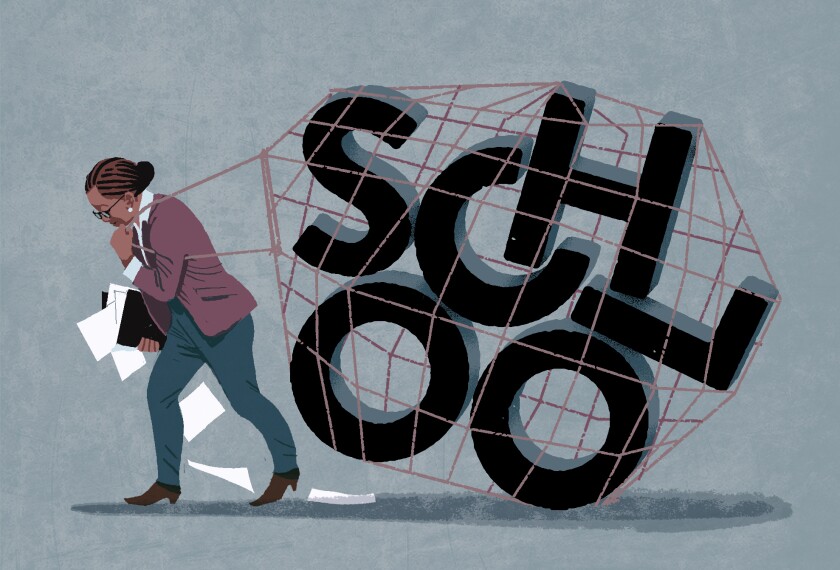
Teaching has been considered a high-stress job for years. And then the pandemic happened, and everything got worse.
Teacher stress levels skyrocketed as they pivoted to teaching online, in socially distanced classrooms, or both at the same time. They desperately tried to engage students who were checked out or who only appeared as a black box on Zoom. It was a grueling year, teachers said. And some say the start of this school year has been even worse, as the Delta variant threatens to upend in-person instruction once again. Teachers are also tasked both with catching students up academically and attending to their trauma and social-emotional needs.
I frequently talk to teachers from all over the country. I hear again and again: We’re exhausted. This isn’t sustainable. We’re not OK.
“I’ve never burned out on the kids. I’ve never burned out on my subject,” said Anne Sylvester, a former high school English teacher who left the profession this summer after more than 25 years in order to protect her mental health. “I’ve always enjoyed teaching, but the rest of it is exhausting and chronic.”
Sixty percent of teachers say they experience job-related stress frequently or always, according to a nationally representative survey by the EdWeek Research Center conducted in July. Just 9 percent say they never or rarely do. When asked what effects job-related stress has on them and their work, teachers commonly said they have a harder time sleeping, they’re less able to enjoy their free time with family or friends, and their physical health suffers.
And 41 percent of teachers said they feel like they’re less effective at their job when they’re stressed. Research shows that when teachers are stressed out, the quality of their instruction, classroom management, and relationships with students all suffer. And students tend to be more stressed when their teachers are, which could negatively affect their academic performance and engagement.
Yet, stress seems inevitable: Teachers tell me that over the past decade, they’ve had more and more responsibilities piled on their plates. There’s more of a focus on accountability and data points. Students’ non-academic needs seem greater. And over the past year, there’s been a growing amount of public scrutiny over what teachers are teaching and how they run their classrooms, leaving them feeling micromanaged and disrespected.
“The demands on teachers have gotten greater … and [they have] fewer resources and fewer choices—when you combine those two, you’re basically putting teachers in a vise,” said Patricia Jennings, a professor of education at the University of Virginia who studies teacher stress.
Teachers of color are in a particularly tough spot, as they experience both the isolation of working alongside predominately white colleagues and the pressure of often feeling obligated to lead conversations at their schools about racism and inequities, on top of all their other responsibilities. This pressure has been heightened by the national reckoning on race, as well as the public debate over how the nation’s history with racism is taught.
While teacher mental health has been getting more attention in recent years, 42 percent of teachers said administrators have not made any efforts to help relieve their stress. About one-fifth said their administrators have tried, but it didn’t help.
But here is the good news: Only 2 percent of teachers said there’s nothing their school or district could do to help relieve their stress. Administrators can help make teaching more sustainable—but it will require structural changes. Teachers commonly said it would help if their school or district provided additional time to plan or catch up, reduced class sizes, waived some expectations or required tasks during periods of particularly high stress, or reduced the number of required meetings.
But instead, many districts have offered programming that encourages self-care, which only 11 percent of teachers say would be helpful. Meredith Lesser-Gonzalez, a 5th grade teacher in Framingham, Mass., put it this way: “Do you want me to feel less stressed? Give me more time to read and respond to kids’ work.”
Encouraging yoga or meditation can’t make up for systemic issues that cause stress, experts say. “You can’t deep-breathe your way out of a pandemic; you cannot stretch your way out of terrible class sizes; you cannot ‘individual behavior’ your way out of structural problems,” said Chelsea Prax, the programs director of children’s health and well-being at the American Federation of Teachers. “Those are effective coping measures, but they don’t change the problem.”
She noted that districts are using their federal pandemic relief money to hire more staff and offer more programming, thus taking some responsibilities off teachers’ plates. But she’s heard from educators that they’re concerned that in a few years, the money will run out, and teachers will be back to square one.
To make teaching sustainable long-term, administrators must empower teachers by giving them a seat at the table and incorporating their input into any new initiatives, Jennings said. “If we’re going to give them more responsibility, give them a lot more freedom and choice,” she said.
More than a quarter of teachers said job-related stress leads them to think often about quitting.
Otherwise, the unrelenting stress will take its toll. More than a quarter of teachers said job-related stress leads them to think often about quitting, and 16 percent said they dread going to work every day, according to the EdWeek survey. While many of them won’t ultimately leave their jobs, that level of burnout will still have implications for student success and the long-term health of the profession. Already, fewer young people are studying to become teachers than a decade ago, and many teachers say they wouldn’t want their own children to follow in their footsteps.
“Nobody wants to learn from a teacher who is unhappy or dissatisfied in their job,” Danna Thomas, a former kindergarten teacher and the founder of Happy Teacher Revolution, told me. “Nobody wants to work across the hallway or sit in a staff meeting next to someone who’s unhappy.”
Happy Teacher Revolution started as a support group for teachers at Thomas’ school in Baltimore and has expanded to more than 300 schools across the United States and other countries. Teachers meet regularly to connect, offer advice, and encourage each other to set boundaries to prioritize their well-being. The group trains educators to serve as facilitators for their school and help their peers learn to manage their own emotions to address or prevent burnout. Thomas said survey results show that teachers who participate in Happy Teacher Revolution meetings report feeling calmer and less isolated.
Teachers advocating for their own mental health and putting in place boundaries, Thomas said, “is a revolutionary act.” But it doesn’t have to be. If school and district leaders prioritize teacher well-being in structural ways, their educators will be better equipped to tackle the myriad of student needs stemming from the pandemic and societal inequities. Teachers, their students, and the entire school community will thrive.


