Science Photos

Students Become ‘Citizen Scientists’ to Conduct Research on Bugs

By Education Week Photo Staff — July 09, 2019 1 min read
  • Save to favorites
  • Print

Citizen science is a method of involving students and community members in scientific research and exploration using the same parameters as professional scientists.
During the Huron River Watershed Council’s annual “Insect Identification Day” in Ann Arbor, Mich., students and volunteers identified insects to add to the group’s ecological survey. Such projects are part of a new wave of science learning that happens outside of classrooms and more directly links students to real research.
“A long time ago, it was just regular people who were scientists. We should be giving the community a lot of opportunities to integrate in our field,” says Jason Frenzel, who oversees citizen science projects for the Huron River Watershed Council.

Niklas Krantz, a coordinator with the Huron River Watershed Council, laughs with students during the council’s annual “Insect Identification Day” in Ann Arbor, Mich.
Niklas Krantz studies a bug under a microscope.
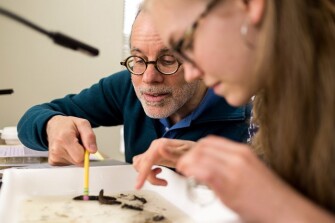
A water sample from Huron Creek.
Ann Arbor, Mich., resident Brian Carlson, 56, and his daughter Sophie, 16, inspect bugs in their water sample. They have been participating in the event together for the past four years. “It allows you to connect,” said Brian Carlson.
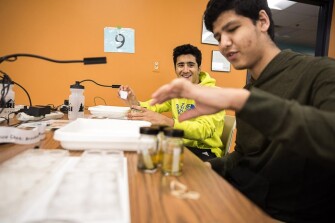
Tavan Zadeh and Zane Aridi, both seniors at Dexter High School, in Dexter, Mich., joke around as they take part in an annual census of insects.
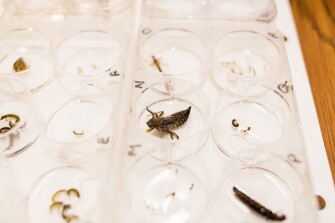
A sample of bugs.
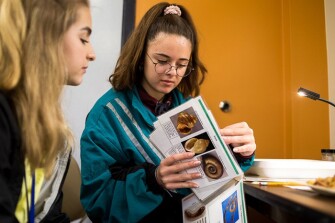
Jenna Kauffman and Jillian Chesney, seniors at Dexter High School, in Dexter, Mich., flip through a bug identification chart.

A version of this article first appeared in the Full Frame blog.

Events

This content is provided by our sponsor. It is not written by and does not necessarily reflect the views of Education Week's editorial staff.
Sponsor
College & Workforce Readiness Webinar
Smarter Tools, Stronger Outcomes: Empowering CTE Educators With Future-Ready Solutions
Open doors to meaningful, hands-on careers with research-backed insights, ideas, and examples of successful CTE programs.
Content provided by Pearson
This content is provided by our sponsor. It is not written by and does not necessarily reflect the views of Education Week's editorial staff.
Sponsor
Professional Development Webinar
Recalibrating PLCs for Student Growth in the New Year
Get advice from K-12 leaders on resetting your PLCs for spring by utilizing winter assessment data and aligning PLC work with MTSS cycles.
Content provided by Otus
School Climate & Safety Webinar Strategies for Improving School Climate and Safety
Discover strategies that K-12 districts have utilized inside and outside the classroom to establish a positive school climate.

EdWeek Top School Jobs

Teacher Jobs
Search over ten thousand teaching jobs nationwide — elementary, middle, high school and more.
View Jobs
Principal Jobs
Find hundreds of jobs for principals, assistant principals, and other school leadership roles.
View Jobs
Administrator Jobs
Over a thousand district-level jobs: superintendents, directors, more.
View Jobs
Support Staff Jobs
Search thousands of jobs, from paraprofessionals to counselors and more.
View Jobs

Read Next

Science Opinion Strategies to Help Students Embrace Science Instruction
Knowing how to redirect science denial in your classroom is a strong way to start.
9 min read
Conceptual illustration of classroom conversations and fragmented education elements coming together to form a cohesive picture of a book of classroom knowledge.
Sonia Pulido for Education Week
This content is provided by our sponsor. It is not written by and does not necessarily reflect the views of Education Week's editorial staff.
Sponsor
Science Quiz
Quiz Yourself: Evaluating Effective Science Instruction in Your District
Answer 7 questions about evaluating effective science instruction in your district.
Science Opinion Science Scores Are Down. But We Know What Would Improve Them
The when, where, and how of science instruction needs rethinking.
Emma Banay, Christine Cunningham & James Ryan
4 min read
Flat vibrant vector illustration depicting science education and learning concept. Illustration is showing different ways of learning: listening, watching, observing, exploring, experimenting, asking questions, talking and communicating, reading, drawing, and writing. The female teacher is placed on the right side and there are also two pupils each one representing different theme; one girl asking question and learning by listening  and a boy holding a hand up to answer a question.
DigitalVision Vectors/Getty
Science What's Behind the Drop in Students' Science Scores on NAEP?
Survey results from the National Assessment of Educational Progress show 8th graders do less scientific inquiry now than five years ago.
4 min read
Middle school students learn about the value and shape of matter while building containers to hold liquid during an 8th grade science class at Boys’ Latin School of Maryland on Oct. 24, 2024 in Baltimore, Md.
Eighth graders learn about the value and shape of matter while building containers to hold liquid during a science class at Boys’ Latin School of Maryland on Oct. 24, 2024, in Baltimore. Nationally, 8th graders lost ground in science, according to the 2024 National Assessment of Educational Progress.
Jaclyn Borowski/Education Week