
Eithne J. Smith, a remedial-mathematics teacher at Blackstone Valley Regional Vocational Technical High School, spent hours last year printing out old test questions from state-mandated exams and then cutting and pasting together items on the topics that gave her students trouble.
| Feature Stories |
|---|
| Delving Into Data |
| District Initiative |
|
| Risk & Reward |
| ‘National Effort’ |
| State Grades |
| Executive Summary |
| Table of Contents |
Say, for instance, that state-exam results showed that her 11th graders needed to dust off their probability skills. Smith would click on to the Massachusetts Department of Education Web site, print out old 10th grade math exams, cut out items on probability, and cobble them into mini-tests. Then, she indexed the handmade tests in a thick binder to share later with colleagues.
It was tedious work.
Now, a software program called Test Vault does Smith’s job for her. Developed by a teacher from Haverhill, Mass., the program contains more than 1,000 questions taken from previous Massachusetts Comprehensive Assessment System, or MCAS, tests and retests in 10th grade math. In minutes, it gives Smith customized tests she can use to target her students’ knowledge gaps.
“The more efficient I can be with my time and with gathering information,” she says, “the more time I have for students and the better prepared I am for them.”
In the scheme of instructional innovations, Test Vault may be a small improvement. But it’s one of many at this 950-student school in south-central Massachusetts. It also typifies the ways in which educators and administrators here have been using technology to gather and disseminate the student data they need to inform their school improvement efforts.
“I think there’s a trend in education to resist everything,” says Arthur A. Jackman, the school’s technology coordinator. “But if you show teachers what it’s going to do for them, it goes very well.”
Blackstone Valley Tech, as it’s referred to here, draws students from 13 towns in a region of Massachusetts that is best known for the manufacturing mills that once sat along its rivers.
The school’s academic-improvement efforts began in earnest after state education officials in the mid-1990s set common standards for what students in all grades should know and be able to do in core academic subjects. To ensure the standards were used, the state added a controversial requirement: Starting with the class of 2001, students had to pass 10th grade tests tied to standards in reading/language arts and mathematics to graduate.
Can-Do Attitude
At the time, many vocational-technical schools balked at the mandate, recalls Alison L. Fraser, the assistant director of Mass Insight Education, a Boston-based nonprofit group focused on improving student achievement in the Bay State.
“They were saying our kids can’t do this, or our kids can’t do academics,” she says. But Michael F. Fitzpatrick, Valley Tech’s superintendent-director, took a different tack. “He said Valley Tech is not going to be left behind, that it was going to be just like any comprehensive high school, and he did it by using data,” Fraser says.
The strategy appears to have paid off. Since 2000, the school’s MCAS scores have risen steadily. What’s more, over the past two school years, 100 percent of Valley Tech’s seniors passed the tests and graduated on time—contrary to widespread expectations among vocational educators.
Valley Tech’s administrators began their academic-improvement campaign by instituting standardized placement tests, which incoming 9th graders take in the spring of 8th grade. Using customized software programs, they analyze the results and decide which students will need extra help to pass the 10th grade MCAS tests.
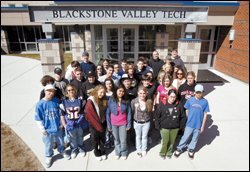
Struggling math learners in 9th and 10th grades are placed in Eithne Smith’s class. They meet with her three times a week in addition to their regular grade-level math classes. For students who fail the MCAS math tests in 10th grade, the number of remedial classes expands to five a week. A parallel remedial system is in place for students who lag in reading.
As results from the new state assessments became available, Valley Tech educators filtered them into the placement and instruction process, too. For instance, Smith and her colleagues use Test Whiz, another commercial software program, to distill detailed information on how students fare on specific test items.
“You can see what someone scored in number sense or patterns and relations, for example,” says Smith, who switched to teaching after a career in the pharmaceutical industry. “Or, why did almost every sophomore get this question wrong?”
At the school level, the results all showed that Valley Tech faced an uphill battle, and that reading was a particular trouble spot. In response, the school lengthened its academic year by 13 days and set out a new policy: Incoming students trailing in both English and math had to take remedial reading first.
Educators also infused writing into all classes, from geometry to auto shop. To graduate or be promoted to the next grade, Valley Tech students must assemble an electronic portfolio that includes essays reflecting on what they learned from their hands-on shop projects.
“All of the staff is still learning from the portfolios,” says Principal Richard P. Brennan. “Teachers will say, ‘Mr. Brennan, I’m a carpenter. How do I analyze writing skills?’ But if you’re not reading well, you’re always going to have a problem in math, science, and social studies.”
The school’s remedial-instruction program is one piece of the data-driven improvement efforts going on here. Valley Tech’s efforts have been supported in part over the years by a $750,000 bond to finance technological upgrades and a just-completed $36 million renovation. Among other steps, the school also:
• Installed a customized computer network developed by iPASS Inc. in Redwood Shores, Calif., that will eventually link the entire school community. On the system, teachers can call up a student’s name and see his or her schedule, home telephone number, attendance record, and scores from MCAS tests or the SAT. The system also tracks how far along students are in fulfilling the vocational-technical “competencies” they are required by state law to master for graduation. And it alerts teachers if a student has a medical problem or if parents don’t speak English.
• Began piloting an “electronic grade book” on the system that lets teachers, parents, and students monitor students’ daily academic progress and tracks attendance on a class-by-class basis.
• Launched a computerized system to assemble information on the special education students who come to Valley Tech from surrounding districts. Teachers can read the individualized learning plans they find on the system to figure out whether students need special accommodations in class.
• Instituted a “paperless” system for tracking and approving teachers’ professional-development activities and aligning them with school improvement goals.
“It’s a balancing act,” says Jackman, the school’s technology chief. “You can get information overload, so you’ve got to keep it focused so that the information on your system is only information that affects something.”


