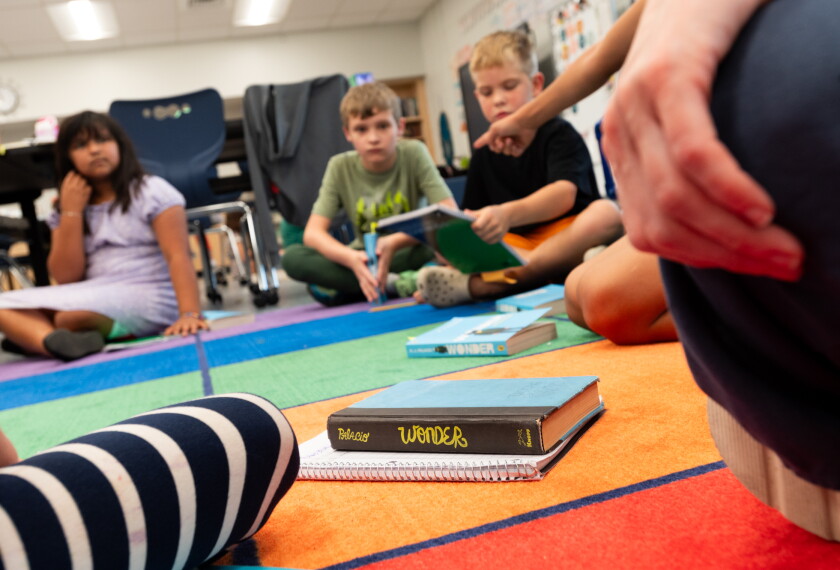
For some elementary school students, reading lessons are an opportunity to get messy and get out of their seats.
Kids learning how to map letters to sounds might trace A’s and B’s in sand or shaving cream on their desks, trace letters in the air, or stand up and form the shapes of the letters with their bodies.
It’s a type of teaching called multisensory reading instruction. Some states, including Alabama, California, Florida, Mississippi, and North Dakota, recommend or require it by law for students with dyslexia.
But does it actually help students learn more? Despite its prevalence, it turns out that research on the method is inconclusive.
Now, as multisensory instruction has become a hallmark of the “science of reading” movement, some educators and advocates have started to question its necessity, raising new questions about programs that feature the techniques, laws that prescribe it, and training that includes it among other early-reading elements.
“That’s the part that is concerning,” said Holly Lane, the director of the University of Florida Literacy Institute, or UFLI, and an associate professor of special education. “Not that doing multisensory things is going to be harmful, but relying on those and expecting that those are going to make the difference is where the problem ends up being.”
New analyses don’t give multisensory instruction an edge
There’s a strong theoretical basis to assume that adding in tactile and movement-based activities would help students store information better in their memories. In general, research also shows that incorporating movement in the school day can improve students’ attention and memory.
But several meta-analyses suggest that adding in these multisensory components doesn’t provide a definitive edge in reading ability over other forms of explicit, systematic instruction in foundational skills.
In a recent blog post, New Zealand special education advocate Linda Kimpton urged educators to dig into the research base on multisensory instruction before spending “precious and limited time” on these activities.
Research doesn’t support the idea that multisensory instruction is harmful for students, experts say. But it does raise questions about whether some multisensory activities are the best use of resources and class minutes—a constant give-and-take that schools navigate as they design their reading blocks.
It suggests that legislative mandates requiring this type of instruction go beyond the evidence.
“It’s not like the multisensory piece is bad, and if you have all the time in the world and kids seem to enjoy them and it keeps them engaged, do these activities,” said Colby Hall, an assistant professor of literacy education at the University of Virginia. She was the lead author on a 2022 meta-analysis of reading interventions for students with, or at risk for, dyslexia.
But multisensory components aren’t the key “ingredient” in foundational skills programs, she said. “The most important piece is the explicit, systematic instruction” in how letters and sounds connect.
The history and evolution behind multisensory instruction
Multisensory education was popularized by the neuropsychiatrist Samuel T. Orton and psychologist Anna Gillingham, who developed the Orton-Gillingham approach to reading instruction in the 1930s—still popular today and integrated into several commercial reading programs.
Reading programs that follow an Orton-Gillingham method take an explicit, systematic approach to teaching foundational reading skills, in which teachers introduce and help students practice all the letter-sound connections in English. Teaching these skills through multiple modalities is based on the theory that doing so will make it easier for children to store and retrieve the information.
In today’s classrooms, multisensory instruction can encompass many different kinds of activities. In part, that’s why it’s hard to study.
“Reading is inherently multisensory—you’re using sounds and letters, things you hear and things you see—and those have to work together,” said Lane.
There’s some evidence that small physical gestures, what Lane calls “micro-level” movements, can support students in learning letter-sound correspondences.
In a blog post for Collaborative Classroom, Lane described several studies that found when students attended to the placement of their lips and tongue when saying a word or watched their mouth in a mirror, their phonemic awareness (or ability to recognize sounds) and decoding skills improved.
But in practice, multisensory activities are broader in scope. The website of the Institute for Multi-Sensory Education suggests using sand, rice, or hair gel in a plastic bag for students to write letters. Teachers Pay Teachers, an online marketplace for user-created materials, offers thousands of lessons designed for multisensory reading intervention, instructing teachers to have students form letter shapes with their bodies, twist pipe cleaners into letters, or trace them in shaving cream, among other activities.
Research reviews that examine multisensory approaches broadly have produced inconclusive results.
A 2021 meta-analysis found that students with, or at risk for, reading disabilities didn’t have statistically significantly improved outcomes from Orton-Gillingham approaches compared with similar students who received alternate reading intervention. (Many of the studies included in the meta-analysis didn’t offer enough information about the alternate condition for researchers to know whether the comparison phonics instruction also was explicit or systematic.)
Another meta-analysis, which Hall and her colleagues published in 2022, analyzed 40 years of studies examining the effects of reading interventions for elementary students with or at risk for dyslexia. The researchers used statistical methods to identify whether any features of these interventions—dosage, for example, or the size of instructional groups—changed how effective they were for students.
They found that interventions that labeled themselves “multisensory” didn’t lead to better outcomes than programs that didn’t market themselves that way.
“These curricula that describe themselves as multisensory, … they have a lot of other components, too, and it’s really hard to disentangle what is the effect of the tactile, kinesthetic piece, versus just the effect of explicit, systematic instruction,” said Hall.
“What all of this tells us is that there’s a need for more research on this topic,” she said.
What does the research mean for classroom practice
In the meantime, what should these findings mean for states, schools, and teachers?
Kim Collins, the director of academics at the Institute for Multi-Sensory Education, said activities that incorporate touch and movement can be effective, if teachers are designing them to work toward learning goals.
“A lot of times people think that multisensory instruction is about using some kind of medium—using gel, or writing in shaving cream, or throwing a ball. … That’s not really the way we think about it,” said Collins.
Instead, she said, it’s about helping students link information about reading and writing through multiple pathways—understanding, for example, that the spoken sound /b/ is represented by the letter b, and learning how to form that letter in writing.
Saying the letter sound while looking at it or writing it uses different modalities—it’s verbal, visual, and kinesthetic—in service of connecting those representations in children’s minds.
If tapping out syllables on their arms helps keep students engaged, said Hall, “I don’t want to tell teachers not to do that.” But if teachers think putting out trays of shaving cream seems like a logistical nightmare, Hall wants them to know it’s not necessary.
Researchers do, however, have a different message for legislators: There’s not enough backing for multisensory instruction to put the method into mandates.
“From my perspective, if something’s going to be written into a law, there needs to be more evidence for it,” said Lane. “There’s a lot more enthusiasm than empirical evidence.”