It started as a routine phonics lesson in the 1st grade Bronx classroom I was observing to study how students learn to read. The objective was to learn the igh spelling pattern. The list of words was standard fare: bright, night, light, tight. But Ms. Sheehan made a quick decision that changed the tenor of the lesson and boosted learning to another realm. Rather than rushing through the decoding, she let her students take a moment to talk about words.
Jayla noted that there are “two kinds of tights": the bond you share with a close friend and the way you pull a knot tight. Sherina gestured to her navy tights, while Joseph made the class laugh referencing the “tight abs” he’d seen on television. The room crackled with energy.
To a casual observer, this exchange might seem like an amusing tangent. But to those grounded in the science of reading, it’s an example of the essential work of building what cognitive scientist Charles Perfetti labeled “lexical quality.” These students were not merely decoding a word; they were showing what they know about how to use the word in flexible ways and establishing the connection to meaning that allows a word to truly take root in the memory.
Too many foundational literacy lessons are missing these kinds of critical opportunities to help students understand the words they are learning to read. A recent study from the research institute SRI found that in more than half of observed foundational skills lessons, teachers mentioned a word’s meaning briefly or not at all. While there’s clearly a consensus on the need for systematic phonics, this study indicates that in the majority of classrooms, we are leaving out meaning—and leaving learning on the table.
This separation of decoding and meaning-making is a false binary that can stall student progress. When these are treated as separate tracks, we risk seeing early gains in word recognition that fail to translate into lasting reading comprehension. In a 2026 study of 1st graders, literacy researchers Lori Bruner, Elfrieda H. Hiebert, and Laura Tortorelli found that even when students can decode a text, their accuracy and fluency are significantly hampered by difficult vocabulary.
If we view phonics simply as a mechanical skill that must be mastered in isolation before meaning can be introduced, we are working against how children actually become proficient readers. While phonics provides students with a gateway into words, storing these words effectively requires knowing their meaning. That is, without a semantic landing spot, a word has nowhere to live in our long-term memory.
“Orthographic mapping” has become a familiar term for many educators in recent years, but there’s a common misconception that it’s just about connecting letters to sounds. In reality, as educational psychologist Linnea Ehri’s work has long established, orthographic mapping is the process by which the sight of a word activates its pronunciation and meaning in memory. When a student encounters a new word, they use phonemic skills and letter-sound knowledge to connect the word’s spelling (orthography) to its pronunciation (phonology). But for that word to become stable and retrievable in memory, it must also be connected to meaning (semantics).
This idea connects back to Perfetti’s lexical-quality hypothesis, which says that knowing a word is not a binary “yes” or “no” state. Instead, word knowledge has multiple dimensions. A student’s first encounter with a word may result in a “low resolution” or fuzzy mental representation in which they might be able to pronounce the word but lack the depth or clarity to use it. To achieve a “high definition” representation, the brain must fuse at least four distinct dimensions into a single, robust representation: spelling, pronunciation, meaning, and (context dependent) usage.
When we omit meaning and usage from foundational skills instruction, we risk asking students to build a library of blurry, low-resolution images that are easily forgotten.
Further, English is not only orthographically complex but also semantically complex, layered with shifting identities. Familiar words like tight, set, snap, or cap shift meanings entirely based on their surroundings. Explicitly teaching the multiple dimensions of words is essential.
The danger of separating code and meaning is most acute for multilingual learners who are still learning English. Because these students may decode words with accuracy, it is easy to mistakenly assume they also grasp the underlying meaning. But without lexical depth, their understanding is inevitably fragmented.
As Claude Goldenberg, who researches literacy and multilingual learning, emphasizes, many multilingual learners are learning to read in a language they are simultaneously learning to speak and understand. Vocabulary and oral-language development are therefore not simply add-ons to foundational skills instruction; they are essential components.
There are rarely quick fixes in education, but adding a few minutes of intentional, elaborative talk during a phonics lesson can make a massive difference for reading outcomes. A fun, low-lift way to start is with a multiple-meanings chart. This is a practical, two-minute strategy for moving words from fuzzy, low-resolution mental images to high-definition representations.
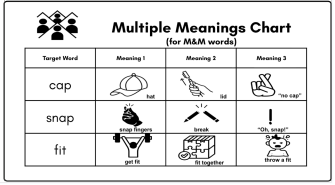
Adding a multiple-meaning chart to phonics lessons from your curriculum helps students explore semantic flexibility. Call attention to a multiple-meaning word by writing it on a chart and brainstorming its different meanings. Then, include a picture, accompanied by a written synonym (or student-friendly definition) for each of the words. The chart stays up as a reference for students. This strategy strengthens lexical representations and deepens vocabulary development, making it especially beneficial for multilingual learners. This is particularly useful for the earliest learners in K-2 but can also be an effective strategy for English learners of all ages.
There are myriad other ways teachers can infuse their decoding lessons with meaning: linking a word to students’ home languages or dialects, engaging the class in a physical action to go along with a target word, generating synonyms, or weaving in a quick morphology brainstorm by adding prefixes and suffixes to a base word being discussed. What’s key is being aware that attending to the meaning of words is not a optional during phonics instruction; it’s the bridge that can ensure words are truly retained in memory.