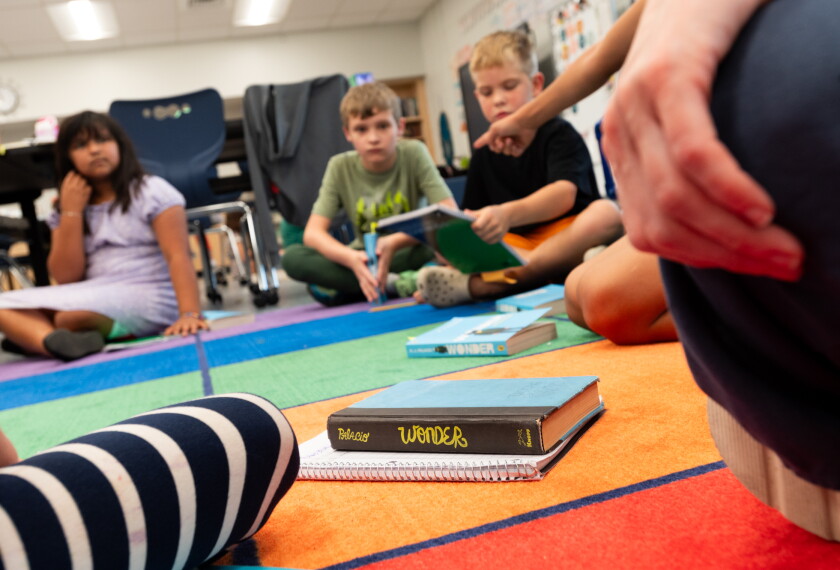
In 2021, my 4th grade students compared segregation in the children’s picture book The Other Side by Jacqueline Woodson to their own playground. Lucy Calkins was already a villain in education headlines. Her popular Units of Study reading and writing curriculum were under fire by education researchers and curriculum-evaluation organizations for not aligning with the “science of reading.” They argued her materials lacked evidence-based research and didn’t emphasize phonics enough, especially for early readers. But in my classroom, Calkins’ curriculum was magic. In Room 13, she helped my students name things, hold things, and read material that mattered.
She wasn’t perfect, but she was crucial for my students.
With the aid of Calkins’ curriculum, my 4th graders were synthesizing across texts and making meaning across genres, time periods, and ideas. We read about the American Revolution, wrote cross-text research papers, compared authors’ perspectives, and learned how to hold more than one truth at a time.
Calkins’ curriculum uses a workshop-style model that prioritizes student choice and independent learning. I taught her reading and writing units in 3rd and 4th grade, and across my 30-year career, they were among the most meaningful tools I used, not because they were easy, but because they came alive when taught with intention. They opened things up.
And yet, Lucy Calkins has become a lightning rod for literacy criticism in the education world.
Much of the criticism is likely spurred by low scores on the National Assessment of Educational Progress. In 2019, only 34% of 4th graders in my state of Missouri and 26% in the nation performed at or above the “proficient” level in reading. And while critics point to low NAEP scores, I can tell you my students were deeply engaged with the content.
I saw my students write real literary essays about justice and identity. Many of them picked thought-provoking texts like The Other Side, which follows two children who live on opposite sides of a fence in a racially segregated town. My students were able to connect the picture book to their lived experiences in Brentwood, Mo., a district that called itself “Mayberry” after the quaint town on “The Andy Griffith Show.” In a place like that, seeing and naming exclusion mattered. When my student Malik wrote, “The fence in The Other Side isn’t just wood, it’s the way adults look away when someone gets excluded,” I knew the curriculum was working.
Calkins gave us teachers more than sentence frames. She gave us a way in and anchor texts that opened conversations about power and justice to young learners. Her American Revolution unit made kids ask hard questions about whose voices were centered in our country’s history. Her World War II unit included the picture book Rose Blanche, a haunting story about a young girl in Nazi Germany who discovers children being held in a nearby concentration camp. That book helped us talk about moral courage and what it means to act in the face of injustice. When my student Janne quietly connected Rose’s story to her own family’s silence about surviving World War II in Europe, I saw what happens when we trust kids with hard truths.
However, getting students to that point wasn’t easy. Was the curriculum perfect? No. I had critiques. I saw the reading gaps, the struggling 4th graders who needed more phonics, the English learners who craved more scaffolds. I adjusted things. That’s what good teachers do.
The real problem wasn’t Calkins. It was the state and district leaders who adopted her work with no scaffolding, no differentiation, and no investment in teacher growth.

Calkins’ units were meant to be launched by experienced educators who could layer in nuance and respond to students in real time. Without that support, of course it fell flat.
Education leaders provided all teachers, whether they were in their first or twentieth year with the same professional development, materials, and mandates. I was one of the few teachers in my school building who sought out coaching through district-led PD and regional literacy workshops and used time with my professional learning community to improve my literacy instruction. And still, prepping the units in a way that felt rigorous, responsive, and human was a battle. What if our leaders had provided us with the necessary support to do our job effectively? What if they had asked us what we needed?
After I retired in 2022, I took a long-term substitute position in a 2nd grade classroom in a neighboring district. The state had passed science of reading laws that dropped curricula like Calkins’ and replaced them with programs that focused on phonics instruction. The curriculum used in this classroom relied on rigid decodable readers and phonics drills. The students were not struggling readers and booed when I announced phonics time, not out of defiance but because they had mastered it. If it had been my classroom, I would have reduced the 40-minute block to 10 minutes of targeted intervention. Instead, it ate up time that would much better have been used for independent reading. And policymakers wondered why engagement was down.
The children aren’t failing the system. The system is failing the children. Every decade, a new savior for literacy emerges: Phonics! Whole language! Balanced reading! Phonics, again! All while children wait for someone to actually teach them and teachers wait for state and district leaders to stop and ask the real questions: What do kids need, right now, in this room, with this teacher? What do teachers need, right now, in this room, with these students?
This is what policymakers must ask themselves when choosing and implementing literacy curricula in their states and districts:
- What curriculum trusts teachers to think and adjust their instruction based on their students’ needs?
- What curriculum trusts kids to grapple with big ideas?
- What happens to the kids who thrived under retired literacy curricula?
- Who decides what counts as reading? Is it just decoding and phonics or comprehension, meaning-making, and joy, too?
- How can we make sure teachers’ firsthand experience works alongside, not against, research?
- How can we ensure educators in all districts have access to the materials, support, and guidance they need?
The answer isn’t to discard the whole model. It’s to trust teachers to adapt curriculum thoughtfully, with the tools they need. The same trust curriculum creators like Lucy Calkins gave teachers. We must adjust, not abandon.