In the emerging national dialogue about threats to American leadership in the global technological marketplace, concern over the outsourcing of U.S. jobs to technologically skilled workers in India and Asia runs deep. But our educational responses to such competition have so far failed to match the level of concern. The testing requirements of the No Child Left Behind Act actually have led to a diminishing amount of class time devoted to science, as teachers focus sharply on reading and math, the first subjects tested under the federal law. Now, this new urgency about our technological progress appears to be changing the political calculus, pushing lawmakers as well as educators to give science education the attention it deserves.
—Nip Rogers
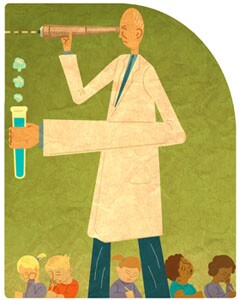
But a key ingredient—arguably the most important ingredient in effective science education—is being undervalued and overlooked: creative, engaging, and demanding elementary science. Instead, the legislative emphasis is on undergraduate and graduate education, the training of secondary school teachers, and support for Advanced Placement and International Baccalaureate courses in high schools. All of these obviously are important, but what about support for science in elementary school, the fundamental starting point in the education of our students?
The reauthorization of the No Child Left Behind law could provide an opportunity to raise elementary science to a more prominent place in the curriculum. The current law calls, in fact, for the implementation this school year of testing in science at three levels (elementary, middle, and high school). Yet, the results of these tests need not be factored into the goals for making “adequate yearly progress.” The Bush administration’s recommendations for the reauthorization of the law call for all students to be proficient in science … but not until 2019-20. Can we wait that long?
If the current expectations of most grade schools are left intact, elementary science will never adequately contribute to the effort to increase American competitiveness. For multiple reasons, elementary science takes a back seat in the curriculum and in school and district improvement plans. Many elementary educators feel undertrained in science, and therefore hesitant about emphasizing it in their classrooms. The pressure of the NCLB law has had the effect of squeezing science, social studies, and the arts out of the elementary school curriculum. And many educators assume that children can “catch up” on science when they reach middle school and high school.
This is a flawed assumption, for three reasons. First, it disregards the importance of catching children’s attention when they are most open, most curious, and most naturally disposed to asking questions about the world around them. Second, science learning is cumulative, in both process and content. If we wait too long, we will find that we have not built a strong enough fluency in the language of science, and learners will be crippled by their lack of basic understanding. The opportunity to move to higher levels of learning will have been severely limited.
A third reason is that, as a recent study published by the American Association for the Advancement of Science shows, most students have made core decisions about their academic interests by middle school. If we have not exposed them to science by then, we have stripped them of the chance to know enough about the subject to hunger for more. The lack of engaging and high-quality science at the elementary level impoverishes all students, and makes it difficult or impossible for them to catch up later, even if the opportunity to do so is available then.
Adding more attention and more testing is not enough; it is the nature of the science experience that is critical. Good test-takers do not necessarily make good scientists; and, as is evidenced by the concern of educators and business leaders in Asia, good technicians do not necessarily make innovative scientists.
Most important, the kind of attention we are talking about does not step far enough into the learning experience to completely address what a rich scientific education means. Nor does it acknowledge the consequences of a poor one. As the great science-fiction writer Isaac Asimov, himself a scientist, warned: “Science can be introduced to children well or poorly. If poorly, children can be turned away from science; they can develop a lifelong antipathy; they will be in a far worse condition than if they had never been introduced to science at all.”
Poorly presented science can deaden children’s curiosity and lessen their wonder about the world around them. It can close them off permanently from a discipline that can inform the rigor of their thinking in any field.
We have an opportunity now to engage in a national conversation about the nature of good science education, and how legislation should be framed and resources allocated to ensure that quality. Here are several suggestions:
• Stay as close to the classroom as possible. Ultimately, it comes down to the student’s experience. We must remember, in our analysis, our commitment, our policy, and our attention, to provide support that improves the nature and quality of classroom teaching.
The problem may be more acute than generally perceived. As a recent report in the journal Science examining opportunities to learn in America’s elementary classrooms noted: “Few opportunities were provided to learn in small groups, to improve analytical skills, or to interact extensively with teachers. This pattern of instruction appears inconsistent with aims to add depth to students’ understanding, particularly in mathematics and science.”
We must support our teachers, so that science comes to life for children in the classroom and in their communities. We should be advocating for legislative support of science teachers at the elementary level. We should be investing in rich preparation and professional development for science teachers, expanding their fluency and confidence in both methodology and content. We should be heeding the latest reports that have come from the National Research Council and the National Science Teachers Association about the importance of lab experiences as an integral part of learning science, and seeking funding to keep those experiences in scientific investigation working well, with appropriate resources.
• Define and develop the most challenging and engaging learning materials possible. We should be challenging the educational publishing community to work with educators to develop and implement instructional materials that enable children to be scientific inquirers, learners who weave the strengths of curiosity and careful thought into their lives. We can start by first identifying the qualities that make a good scientist, and then explore how to infuse science curricula and materials with opportunities to develop those qualities in students.
• Create and sustain community support. We must work to build a broad-based commitment by communities for education in science, so that students are learning about science in a world that understands its value.
• Develop critical and innovative thinkers. Science education is an important tool for teaching analytical-thinking skills. According to an Association for Supervision and Curriculum Development survey, 58 percent of employers identify problem-solving and critical-thinking skills as important for new workers, with 70 percent saying that current high school graduates are deficient in the latter.
Good test-takers do not necessarily make good scientists.
Turning this around will require a brand of education that expects students to inquire, to ask their own questions as well as answer those from teachers, as they develop an understanding of the kinds of knowledge needed in this new century.
• Engage students not only in the practice of science, but also the passion. Finding ways to ignite curiosity and develop inquiring habits of mind is most important for elementary-age children, who are most frequently underserved—just when their minds and attitudes are being molded for the future.
Some of these traits to be nurtured are fairly obvious, such as disciplined, rigorous thinking; careful observation and analysis; the ability to articulate reasoning processes; and an open-mindedness to other possibilities and new ideas. High-quality science curricula should, of course, foster all of these. But none will be meaningful without an underlying spark of curiosity and the passion to find answers.
Ultimately, we must develop ways, both simple and profound, to introduce young children to the wonders of the world through science and scientific inquiry. It is in their best interests, and our own, that we set about this task with clarity and a sense of resolve.


