“We read to know we are not alone.”
—C.S. Lewis
It’s a Thursday afternoon, halfway through the school year. My 11th and 12th graders file in for English class. “Are we reading today, Ms. Kelly?” Tyler asks as he holds up his copy of The Lovely Bones.
We are, I tell him. We’re halfway though Alice Sebold’s radiant book about a 14-year-old girl who is murdered and watches from heaven as her family wrestles with grief, unravels, heals, and thrives. Some chapters I assign as homework, and some we share by reading aloud.
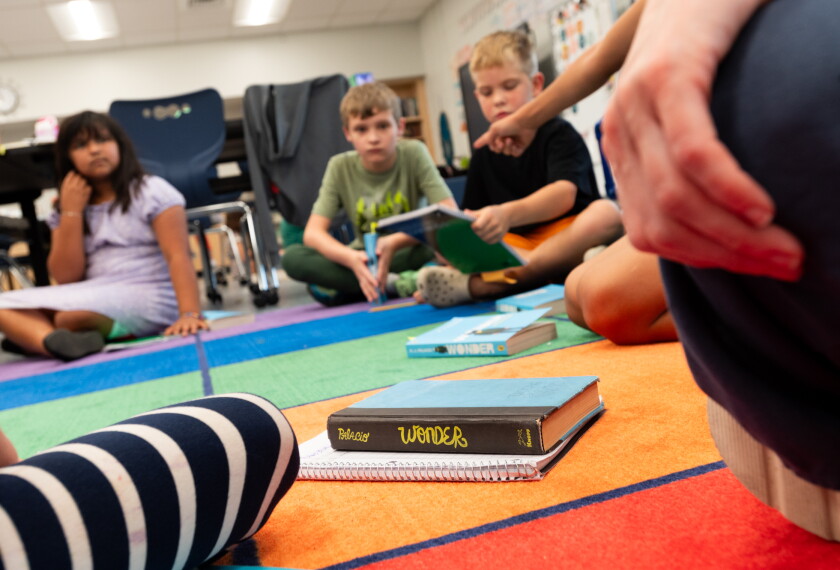
The room hushes. The students open their books, lower their heads. One by one we circle the room, as each student reads a paragraph or two aloud. We make a soft chorus of papery whispers as we turn the pages in concert. They are quiet and engrossed, their fidgety adolescent behavior silenced by the world they hold in their hands and the whir of their imaginations.
We share as a group what I have long thought of as a solitary activity—reading. The sensation of reading aloud together with my students is a surprise and a gift. It is the deepest joy I’ve found in high school teaching.
My students squawked at the beginning of the school year when I told them we would be reading aloud. They said they were too old for it. It’s for babies, they said, grammar school kids. Behind their protests I heard fear. Afraid of stumbling over words. Afraid of not reading fast enough, smoothly enough. Afraid to perform in front of their peers. Afraid of judgment.
This is not a contest, I tell them. Speed reading is an oxymoron. We are reading aloud to savor the book, to practice public speaking, to listen for melody in language, and to tap into the sense of wonder and engagement we had as children when someone read aloud to us.
They still groaned after my explanation, but I knew I had their attention. Had I been one of them, I would have groaned, too. I harbored the same idea about reading aloud when I was their age. My 7th grade English teacher stood before our class and told us the rules of reading, now that we were “big”: Don’t move your lips. Don’t use your finger to keep your place on the page. Toss out the books full of pictures. And above all, read silently.
Alberto Manguel, in his thorough and lengthy tome, A History of Reading, had a similar experience. “Later on, when I was 9 or 10,” he writes, “I was told by my school principal that being read to was suitable only for small children. I believed him, and gave up the practice—partly because being read to gave me enormous pleasure, and by then I was quite ready to believe that anything that gave pleasure was somehow unwholesome.”
I never went as far as Manguel—believing that pleasure was wrong. I was merely crossing over, as I was told to do, from reading aloud to reading alone. From childhood to adulthood.
Reading has been for me what I’m sure it has been for many—transportation, portal, lifeline, illumination.
Reading has always been in my life. I was read to as a child and read on my own as soon as I could. I devoured Nancy Drew books and had a huge crush on Nancy, “That Girl” of the sleuthing world. I was taken with her smarts and her sassy ways. She was almost real to me, which has long been the most gorgeous lure of reading: to meet and be with interesting people. The world ripples with them; books bring them to us.
Since my segue to adulthood, my world of reading aloud has been either reading bedtime stories to nieces and nephews or having my sweetheart read the occasional story to me as we snuggle. I belong to a book club, and we ardently discuss books, stories, meanings, and insights. But I’ve never had the experience of group reading aloud, of passing a book around a circle, of both reading to and being read to at the same time.
Reading has been for me what I’m sure it has been for many—transportation, portal, lifeline, illumination. Stephen King calls reading “the only proven method of time travel.” A librarian I know calls it virtual reality without the safety goggles. It is all of these things for me, and I know it will remain a part of my life, but I’m not so sure about some of my students. For most of them, reading appears to be a chore, an assignment. I see the few who always have a paperback tucked atop their pile of textbooks, but I suspect that most of my students don’t read for pleasure.
I’ve been a university journalism professor for 20 years. This is my first year as a high school English teacher, and when I took the job, I had two primary goals: to make writing a less stiff and daunting task, and to encourage students to fall in love with reading. To this end, I’m approaching both from as many angles as I can. It’s my hope that reading aloud might soften them, make them more receptive.
Though each of us labors individually, when we read aloud a particular atmosphere is created as we see the characters, feel with them, follow them, and welcome them. They’re in the room with us much more than they are when I read alone. When the mother in The Lovely Bones began an affair with the detective investigating her daughter’s murder, my students were angry and disapproving. They vented. We laugh as characters amuse us and grimace when we follow them through tough times. I call attention to sentences that resonate with excellent craftsmanship. They trip over unfamiliar words, and we reach for the dictionary to discern meaning. As we read together we question, we comment, we talk back. Stories feel more potent, more alive.
I’m grateful for the way my reading life has been enriched by reading aloud with my students. Their young, earnest voices fill with all the unknown promise of their lives before them. They are at once children and adults, and as we circle the room and read, I fill with tenderness, and the story comes alive for me in ways it never could if I were reading it alone.