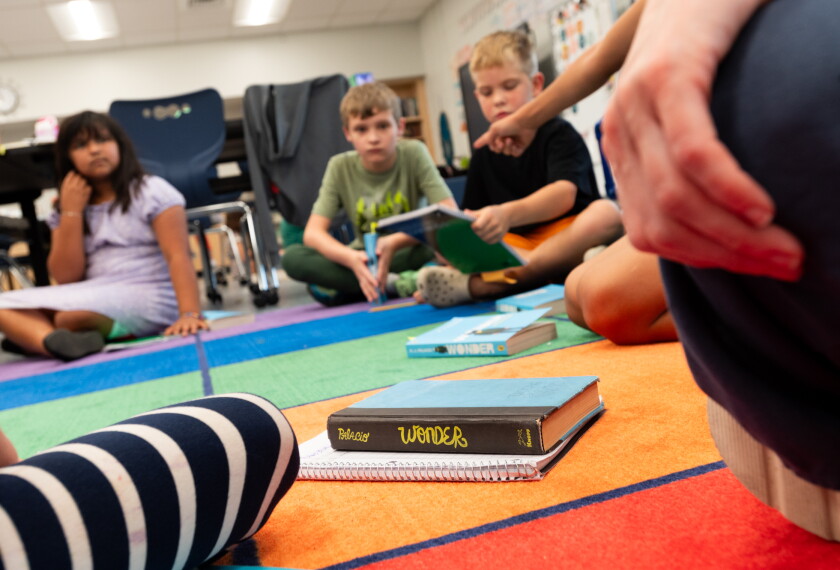
Indulge me and say the following out loud: Students should read fewer books and write less expository prose.
Did that feel right? I doubt it. But that’s the message the National Council of Teachers of English is sending its members. Its recent position statement on “Media Education in English Language Arts” demands that educators “decenter” the reading of books and the writing of essays. It instructs teachers to shift their focus from print media to digital media—including GIFs, memes, podcasts, and videos.
The statement makes some legitimate points. It rightly calls for greater relevance and engagement in the classroom, for redoubled attention to the core literacy skills of speaking and listening. It insists that students learn to assess the veracity and quality of online sources, along the lines of the good work being done by Stanford University’s Sam Wineburg and associates.
But the statement’s call to “move beyond” print is profoundly misguided. The late, great media critic Neil Postman first pointed out that the ability to analyze multimedia flows directly from a strong foundation of reading and writing. Technology can only benefit education where text literacy is given primacy.
Literacy expert Richard Vacca writes that, as adults, today’s students will be required to “read and write more than at any other time in human history.” Political commentator Thomas Friedman likewise reminds us that the primary skill set for success in the 21st century is advanced proficiency at “plain old reading and writing.” And yes, speaking. It distresses Friedman that students already spend about seven hours a day absorbed in digital entertainment media.
The central irony of NCTE’s call to “decenter” text is this: Reading and writing were decentered decades ago. When I ask audiences what two activities we are least apt to observe in an average school, it takes them about four seconds to respond, almost chorally: reading and writing. Many students don’t even read the scant number of titles they are assigned. An alarming proportion arrive at college as “book virgins”: They’ve never read an entire book.
NCTE could have an immense, positive influence by reminding teachers that books enlarge our lives and experience, nourish imagination, and immerse students in the thought-worlds of people in various cultures, times, and places. Practicing teacher and literacy expert Kelly Gallagher advocates for students to become “voracious” readers. He is appalled by the increasing encroachment of pseudo-literary activities, which he has long-dubbed “readicide”—the murder of reading.
In classroom tours, my companions and I observe writing and writing instruction less than any other activity.
Like so many of us, he knows that novels and nonfiction books open the world to young readers, offering them new modes of seeing and doing. They allow us to figure out who we are at a critical time of life.
Books also uniquely expand our general knowledge. As cognitive scientist Daniel Willingham points out, “Books expose children to more facts and to a broader vocabulary (a form of knowledge) than any other activity.”
And writing? In classroom tours, my companions and I observe writing and writing instruction less than any other activity—even less than reading. I saw the results of this when I taught writing to college freshmen. The majority struggled mightily to organize their thoughts into a clear, coherent document. This explains why many students hit an academic wall in a variety of subjects when they reach college.

I would love to see the council take the lead on educating its members on writing’s unrivaled capacity to enable students to generate, analyze, synthesize, and retain knowledge. Writing is almost miraculous in the way it enables us to think more deeply, logically, and precisely. The eminent education reformer Ted Sizer regarded writing as “the litmus paper of thought,” which should therefore “occupy the very center of schooling.” Numerous scholars celebrate writing’s capacity to help us to express our best thinking in its best form.
The NCTE statement raises other concerns: It strikes me as being more ideological than humanistic—and overly enamored with what students find familiar and fun. And I also believe that it needs further clarification. For instance: What actual proportion of the curriculum would the council reserve, perhaps grudgingly, for what they term “traditional” reading and writing competencies?
The ELA community should absolutely acknowledge the digital era—but not at the expense of books and expository writing. If the council truly desires for record proportions of students to become literate, articulate, and successful, it should first:
—Renounce the ubiquitous practices that are the primary destroyers of literacy, for example, skills exercises (think “find the main idea”); the excessive employment of worksheets, full-length movies, and aimless group work; the arts and crafts projects that masquerade as literacy activities—which are rife right up through high school.
—Recenter, after years of decline, an intensive focus on reading, writing, and (thank you, NCTE) speaking and listening. Restoring these to their rightful place represents the most propitious opportunity for swift, dramatic improvements in all of K-12 education.
With so much at stake, we dare not lurch, impulsively, to satisfy contemporary but specious preferences for how we educate our children.