Terri Malpass is teaching 1st graders at Weaver Elementary in suburban Los Alamitos, Calif., how to calculate three-fourths of the pieces of candy in a box. The children decide if they want to do the procedure with a box of 8 + 8 candies or a box of (18 x 25) + 102 candies. Whichever set of numbers they choose, they are learning about fractions far earlier than state standards require.
Glenda Bishop, a 3rd grade teacher in Long Beach, Calif., is leading her students, many of whom do not speak English as a first language, through a 10-minute lesson on topic sentences, subject headings, and supporting details in their nonfiction reading and writing. The whole class practices analyzing a text using skills emphasized in the lecture, and then students read on their own, practicing the concepts they’ve learned. Bishop confers with each student to check for understanding. Later, her students reconvene to talk about the passage they read, and then are given time to write, incorporating their new knowledge. As with Terri Malpass’ students, those in Glenda Bishop’s class demonstrate the high level of work students are capable of when they have an excellent teacher.
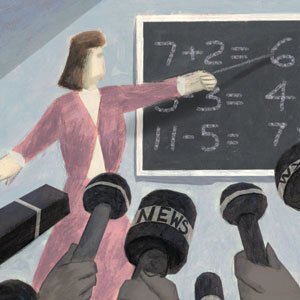
Politicians and policymakers from the White House to the schoolhouse talk earnestly about the need for highly qualified teachers and high-quality teaching. Few talk about what high-quality teaching looks like. Yet, it is teaching that is the most important school factor in how much children learn.
Education journalists can help address this lack of detail in the public dialogue by reporting more from classrooms about what matters most, teaching and learning. Teachers, principals, and other educators can help journalists do that important work by opening classroom doors and showcasing the wide variety of successful teaching methods.
Can you imagine a conversation about baseball that focused solely on the front office? How could anyone understand the game of golf without having watched Tiger Woods sink a long putt to win a tournament? Similarly, the “game” of education is teaching and learning, and we often take our eyes off the ball.
Classrooms reveal the reality of schools, and can be the stage on which great theater plays out—at times triumphant and at times tragic. Imagine how hard it is for a beginning teacher who cares deeply about her students but who is in over her head, her only preparation a few hours spent in Saturday-morning lectures with other rookies. Or think about the great story to be told about a brilliant 1st grade teacher whose compelling and purposeful reading lessons require students to collaborate with their peers and stretch themselves intellectually, not just absorb information. Similarly, the way Glenda Bishop connects reading and writing, whole-group and one-on-one discussion, teacher-led instruction and student work demonstrates how excellent teachers draw on various approaches in their lessons.
Here are five reasons we think educators need to teach us more about teaching, and journalists need to pay more attention to what happens in class:
1. While all of us think we understand what teachers are doing and why, we often miss the nuances. Stories about classrooms can provide more-realistic pictures of the hard work involved in good, effective teaching. Reporters need educators to help them communicate both their challenges and their successes.
2. Perceptive, knowledgeable classroom reporting can show the public and policymakers that successful teaching comes in many varieties. Adults’ perceptions of what makes teaching good are based on their own experiences as children. Times change, and so does teaching. Educators need the help of journalists to tell this story.
3. Greater public awareness about teaching can lead to policies that support improvement. Investments in professional development often are seen as expendable extras. Greater awareness of the skills involved in teaching could change this.
4. Reporters can show the public what teaching in specific schools looks like. Parents often evaluate schools based on test scores and demographics. Good, knowledgeable reporters can provide a multidimensional portrait of how well schools function, and why, by showing what goes on in classrooms.
5. Good classroom reporting makes teaching public. Teaching remains mostly a private profession, and there are few opportunities for teachers to see colleagues teach or to be seen by them. Journalists can provide a showcase for great teaching.
But journalists face many obstacles to achieving these goals. They are pressed for time, often denied the access they need, and uncertain of their ability to discern the difference between great teaching and that which is mediocre or worse. The downsizing of newsroom staffs hasn’t helped. But no matter how overworked and stressed they are, journalists know that the most important question for them to ask about any policy or decision is, “How will this improve teaching?”
There are no more important stories for the public to hear or read than those that clearly depict what is taught and how it is taught by the best in the profession.
To help journalists with this daunting task, the Hechinger Institute on Education and the Media at Teachers College, Columbia University, and the Los Angeles-based Cotsen Family Foundation have developed a Web site called “Tools for Reporting on Teaching: What to Look for in Classrooms” (http://cotsen.org/cotsen-hechinger). The foundation works with good teachers to help them become great. Its staff has observed more than 400 elementary school teachers and developed a framework that can guide journalists in what to look for and what questions to ask. Selected videos of some of the very best of those teachers are on the site, as are tips from respected colleagues in journalism, sample news articles, and a summary of research on teaching and on how teachers improve. All of these resources are designed to help journalists tell the story about what is happening in classrooms across the country.
Let’s go back to the action in Mrs. Malpass’ 1st grade class. At the overhead projector, a student smiles impishly as he shares his method of solving the candy-box math problem using the more difficult set of numbers. Working with groups of 100 and 25, he compiles four of 125 each, with a remainder of 52. “So,” he explains, “I know about a deck of cards. There’s 52 cards, and 13 cards are in each suit, and there’s four suits. So what I did then was I needed to split it into four, so there is 13. … So now I have 125 and 13. Five and 3 is 8, and 20 and 10 is 30. One hundred and zero is 100.” With 138 as the solution for one-fourth, he completes the last step. His classmates compliment the young presenter and raise their hands to ask questions.
This is not learning by rote. It’s not letting children play with the problem and treating every answer, right or wrong, as equal. This is the kind of activity that results from purposeful, well-executed teaching, and it demonstrates how such teaching can enable students to meet and even exceed academic standards and expectations.
We need to learn more about classes like Mrs. Malpass’ and Miss Bishop’s. What do they do that works? How can other teachers learn to do it as well? What public policies support such teaching and cause it to become more common? Journalists, using the tools of narrative, description, analysis, and characters, can make quality teaching and its effects on kids more visible, comprehensible, and compelling. There are no more important stories for the public to hear or read than those that clearly depict what is taught and how it is taught by the best in the profession. These are stories teachers and administrators need to help journalists tell.


