| Why is curiosity so important, and what can we do to create a more embedded culture of inquisitiveness within schools and society? |
Recently, the president of a large New York bank admitted before a congressional panel that his employees had not posed enough questions about a ballooning account from Russia. Faced with suspicions that the billions of dollars in this account were being laundered or diverted from International Monetary Fund loans, the bank president concluded that his institution needed “a culture of inquisitiveness.”
Such an observation applies not only to banks but to all institutions, including schools. By and large, our society has grown through the ingenuity, fierce independence, courage, and curiosity of its citizens. The amazing growth of business and industry, artistic expression, and scientific accomplishment attests to this.
But recently, several events in our national life have caused me to take a closer look at schools and what they can do to foster a sense of inquisitiveness in all students.
The Challenger disaster in January of 1986, for example, might have been prevented, had employees from Morton Thiokol and other contractors asked, with sufficient deliberateness and conviction, if it was safe to launch the space shuttle in the subzero temperatures that prevailed that fateful day. Two engineers, Roger Boisjoly and Arnie Thompson, had raised questions about the launch date. But their doubts and uncertainties failed to make an impression on decisionmakers at the National Aeronautics and Space Administration.
Similarly, we might have averted bombing the Chinese Embassy in Belgrade during our 1999 campaign against Yugoslav President Slobodan Milosevic, had one NATO officer persisted in his questioning. After examining a CIA-approved target image, he questioned whether it was the designated “warehouse.” But, again, his questions did not rise up the ladder of authority.
Where market forces prevail and profit is the bottom line, we tend to see more of a sense of innovation and inquiry. |
And 12 Texas A&M University students might still be alive today, had anyone in that campus culture thought to question the safety and wisdom of the traditional bonfire lit before the football game with the University of Texas. As an investigative report concluded, “No credible source ever suspected or thought to inquire about structure safety.” No one challenged the tradition, now a century old, of constructing and burning a three-story log structure that undergraduates were allowed to modify.
These events may be isolated examples of the unforeseen consequences that can flow from a lack of inquisitiveness. And the fact that they occurred in educational, governmental, and military organizations with rather rigid lines of authority may tell us something about how command-and-control organizations work, compared with business entities like Microsoft and Enron. Where market forces prevail and profit is the bottom line, we tend to see more of a sense of innovation and inquiry.
Why is curiosity so important, and what can we do to create a more embedded culture of inquisitiveness within schools and society? Here are three points from which to start:
- Every child growing up learns about the world by exploring everything in sight—asking, in effect, “What is it? What does it feel and taste like?” Curiosity is the beginning of meaningful learning.
- Developing a child’s curiosity during the very early years of life is what fosters brain growth and development, as the neuroanatomist Marion Diamond notes in Magic Trees of the Mind. She advocates creating “enriched environments” for kids, full of novelties, toys, and challenges to help them inquire and grow intellectually, emotionally, physically, and socially.
- Science, art, and the humanities—indeed, all of civilization—advance through our drive to ask questions and search for answers. We have only to look at the lives of Leonardo da Vinci, Thomas Jefferson, Marie Curie, Toni Morrison, and others to support this notion.
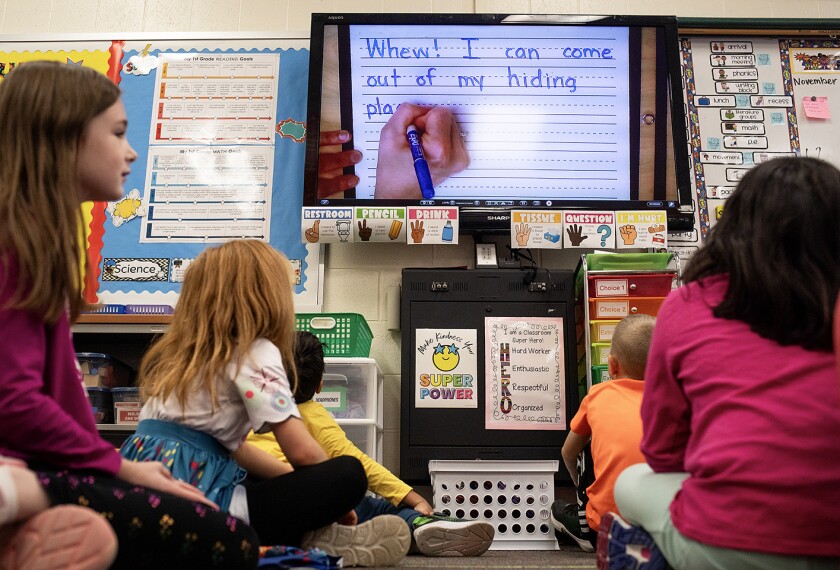
As presently constituted, however, many schools, from kindergarten through graduate school, reflect a preference for keeping students passively in their seats, listening to presentations of information they need to memorize and return in toto when asked. But there is hope for creating cultures of inquisitiveness within our schools.
| Many schools reflect a preference for keeping students passively in their seats, listening to presentations of information they need to memorize and return in toto when asked. |
The novelist Anatole France concluded that “the whole art of teaching is only the art of awakening the natural curiosity of young minds for the purpose of satisfying it afterwards.” And the late astronomer and popularizer of science Carl Sagan amended that goal to include developing students’ abilities to examine possibilities critically, with a healthy skepticism.
How could we go about working toward the goals of Anatole France and Carl Sagan?
First, we need to reorient our instructional and curricular practices toward a focus on solving authentic problems that challenge students to think productively. Many teachers already are doing this, helping their students think through the most complex issues in the process.
For example, at the beginning of a unit on Africa, Cheryl Hopper, a high school teacher in Paramus, N.J., challenged her students to come up with their own questions for the unit. One of the questions was “How and why did powerful kingdoms emerge in Africa, especially West Africa?” Her 9th graders thoroughly researched this and other questions, then used the knowledge they had gained to make simulated recommendations for economic development to a representative of the World Bank.
Similarly, Ann White, an elementary school teacher in East Orange, N.J., led her 4th graders on an expedition to a local geological site after they had first devised their own set of questions about rocks and minerals. One question particularly amazed me: “Would there be volcanoes without plate tectonics?” Here was an average 4th grader, tackling the complexities of continental drift and plate tectonics, sensing a relationship no one had made explicit to her until she posed the question to a geologist.
Both Cheryl Hopper and Ann White are model educators for what TheNew York Times columnist Thomas Friedman has called “the Internet Century.” Their students are completely at home researching topics on the World Wide Web, and they reflect the kind of openness to restructuring curriculum around authentic, problematic situations that stimulate students’ inquisitiveness.
Next, we need to reflect on Don Tapscott’s assertion, in Growing Up Digital: The Rise of the Net Generation, that our students today represent “an ethos of curiosity and investigation” different from that of those who sat for hours on their couches passively soaking up images from television. We know that many of our students are wizards when it comes to navigating the millions of “pages” available on the Web, and that they can solve many problems associated with the production of software-enhanced “products.” One thing that fascinates me is the number of K- 12 students who have already become authors of their own work on the Web, posting the results of their investigations on sites like “Angelfire” and elsewhere. This generation is more in command of its own learning, and we must encourage them.
Third, we need principals who want to be leaders of communities of inquiry within their schools. What would this look like? Probably like the schools that Roland S. Barth describes in Improving Schools From Within, where his preferred professional-development model included encouraging teachers to pose good questions about the teaching and learning processes within their classrooms. Inquiry can then proceed by using study groups similar to those supported by university teacher colleges, in networks of regional schools and through professional-development schools.
Finally, we can all learn from the family example of Isidore I. Rabi, the noted physicist and Nobel Prize winner for his work on the electron. Mr. Rabi said that when he came home from school as a child, his mother did not ask him, “So, what did you learn in school today?” Instead, she asked, “Izzy, did you ask a good question today?” That difference—asking good questions—is what made him become a scientist, the Nobel laureate maintained.
We need to reorient our instructional and curricular practices toward a focus on solving authentic problems that challenge students to think productively. |
If we were to challenge all our children and students to ask a “good question” daily, perhaps they would grow up within cultures of inquisitiveness that considered such questions as these:
What must we do to ensure that all citizens have equal access to “life, liberty, and the pursuit of happiness?”
To what extent are we, the adults, willing to share power and control over decisionmaking with our children and students in pursuit of knowledge and understanding?
What is an educator’s role in helping the Internet generation navigate, understand, and use that medium for sound educational purposes and not to engage in harmful hacking operations that can cripple businesses, government, and even cell-phone operations?
In which kinds of authentic settings, both formal and informal, can all our students best learn to become curious, self-directed, morally upright citizens who are able to collaborate with others on real and important endeavors?
How can we establish partnerships within and among schools and their publics to develop communities of inquiry that are willing to ask the hard questions about teaching and learning?
These are only some of the questions we should be considering in our national conversation as we move into this millennium. What are the others?
John Barell is a former professor of curriculum at Montclair State University in New Jersey, and is currently a consultant in professional development to the American Museum of Natural History in New York City. He can be reached at jbarell@nyc.rr.com.