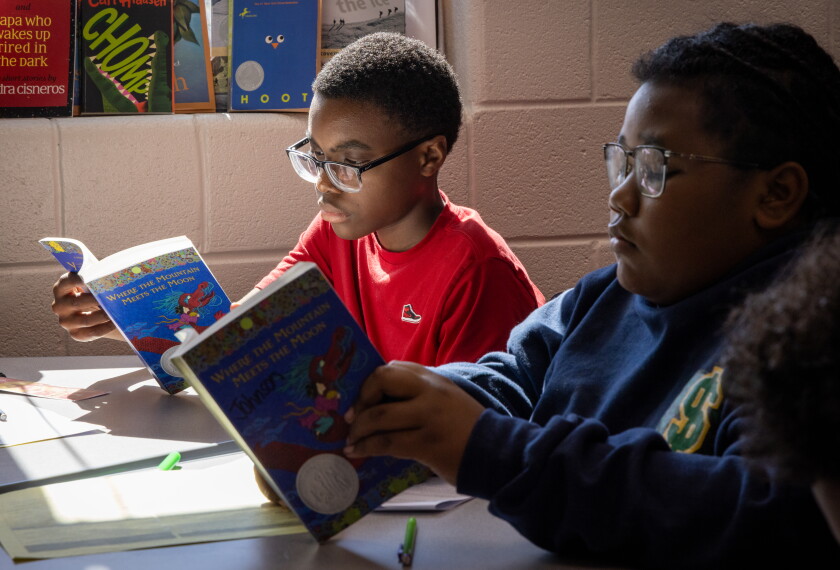
It’s that time of year again—the race to the finish line. In April, teachers are scrambling to teach every last bit of curriculum possible and students’ interest and engagement tends to be a little less than ideal.
However, a few events in the past week have helped rejuvenate me. No matter how my students perform on the impending standardized exams, I’ve seen evidence that many of them will at least walk away from my class with a renewed or newfound love of reading. To teachers, what could matter more?
Multiple times last week I heard students grumble and moan as they walked into the classroom, wondering if they could “just read today.” (If I didn’t still have multiple mini-lessons and reading and writing conferences planned for the remainder of the year, I’d say “Absolutely!”) In addition, our students just embarked on a writing campaign to the school principal, with a few students advocating for the daily literacy block period to include more independent reading. One student even asked for more dedicated reading time to be built into the whole school day.
These students barely wanted to touch books at the beginning of the school year. Now they are using persuasive writing to ask for more reading every day. I think we can chalk this year up as successful!
So how can you inspire a love of reading in your students? My lessons, activities, and thought processes tend to fit into five different methods (or, to borrow from R.J. Palacio’s middle-grade novel Wonder, “precepts”) to tackle this never-ending goal.
1. We must dedicate time for reading and make it clear that reading is a high priority for all of us.
If we don’t make time for reading within the instructional day, how can we expect that students will read on their own outside of our classrooms? It’s amazing the difference that dedicating 10 to 15 minutes of class time to reading can make. Once students see us prioritizing reading time, it will move up on their own list of priorities.
I also believe that cultivation of a classroom library fits into this precept. If my classroom library consists of a few yellowed paperbacks circa 1990 and earlier, it’s going to show my students that I don’t value staying up to date with current titles and genres in children’s and young adult literature. I make a consistent effort to reach out to students and parents to purchase books from Scholastic book clubs (reaping all the benefits of their bonus points and teacher deals), I used my Amazon credit card points for purchasing a few copies of the final book in the Divergent series, and I stalk the used book shelves at my local thrift store for lightly-used contemporary classics. When my students see new books constantly in rotation in our classroom library, they also see the importance I’m placing on reading.
2. We must model real-life reading behaviors, especially ones that are relevant to our own lives.
If we want students to give persuasive book talks or create engaging book commercials, we need to do these things too and model the processes for our students. Each time I add a new book to my classroom library, I make an effort to introduce it with a book talk and give recommendations for who I think might enjoy the new title. In turn, my students have eventually come to ask if they can host book talks, too!
Another idea: if we want students fully engaged with a book for 15 minutes of class time, we also need to be fully engaged with a book for 15 minutes of class time! Try making an effort to read alongside your students. Read the types of books they’re interested in. Read books you’d like to see them interested in. I think you’ll be surprised at how well they respond to seeing you read alongside them.
Also, think about ways you keep track of good books, as well as books you’d like to read. Introduce your students to programs you use to keep reading lists, such as Goodreads, or if you’re old school and keep a reading journal, try making students copies of your list templates.
3. We must encourage our students as readers and help them set, attain, and celebrate goals.
As teachers, we set professional goals for ourselves each year. Why shouldn’t our students set goals for themselves as readers? Try having students set an overall number of books they’d like to read for the year, or help them break that number down into genres, helping them to challenge themselves to read something new.
Once students have set a goal for the year, help them break it down into quarters, or by month. Use the SMART goal framework for detailing reading goals: make them Specific, Measurable, Achievable, Relevant, and Timely. Meet with students on a regular basis about how they’re progressing towards their reading goal, making adjustments as needed. And help students track their progress and data visually by posting a construction-paper “book spine” on a bulletin board each time they complete a book, creating an individual book “stack” or “shelf” for each student over the course of the year.
4. We must build relationships with our students through great books.
This is the precept that I hold nearest and dearest to my heart. A colleague and I talk often about the feeling of handing a student the perfect book and seeing their face light up as they dive into the pages.
But this feat cannot be achieved without trial and error. For every five book recommendations I make for a student, they find one book they really connect with. I find that my chances at success increase as the school year moves along and I get to know my students better. Throughout the year, I love browsing in a bookstore and thinking of a student when I pick up a book. What’s best is being able to then place that book in a student’s hands and watch them devour it. In the process, students gain trust in me through the recommendations that I make, enabling me to encourage them to try something new.
5. We must make reading fun.
Plain and simple: if our students all loved reading and thought of it as fun, I wouldn’t be writing this column. We have to change how our students view reading.
Our school has accomplished this in a few different ways. Last year, we hosted a reading fair. Students made projects about their favorite books and competed for prizes (book sets and bookstore gift cards). I’ve also hosted a reading raffle in my classroom. I chose two to four books each month that were raffled off to students. Students earned tickets in a variety of ways (positive behavior, meeting reading goals, etc.).
You can also host a book character dress-up day! You’d be surprised at the turnout, even in secondary grades. (Make sure that you dress up, too.) This year, my school is going to try a book club; yours can be school-wide, grade-wide, or class- or small-group-specific. Post a sheet of black butcher paper on your classroom wall, give your students some metallic markers, and have them write favorite quotes from books—creating a reading graffiti wall!
No matter what we do, we must make an effort to change students’ perception of reading. We must make reading more fun!
What are some of your precepts for inspiring a love of reading within your students? What are some of your struggles and successes?