Mathematics

Not for Dummies

By Hollice Fisher — February 26, 2007 1 min read
  • Save to favorites
  • Print
Teacher Tom Clemans

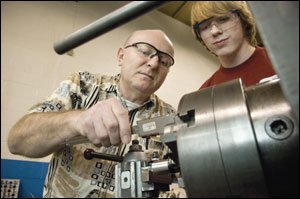
Tom Clemans never planned to become a precision-machining instructor. Twenty-five years ago, he spotted a help-wanted sign outside a machine shop, wandered in, and took a job sweeping floors. Clemans was immediately fascinated by the trade, which involves cutting and shaping metal or plastic into parts for airplanes, cars, and other machines. He learned by watching, by reading textbooks from the library, and, eventually, by practicing the trade himself.

Now in his 15th year of teaching at Sno-Isle TECH Skills Center in Everett, Washington, Clemans has another use for the trade—as a way to get kids interested in algebra, geometry, and trigonometry.

Clemans’ students, who are almost always all boys, spend half the day at local high schools and ride buses to Sno-Isle for sessions in Clemans’ shop. “Machining is the hook that gets them in here,” he says. “I used to sneak math into it. I don’t anymore. I just tell them, ‘This is math you can do.’”

Clemans, who is writing a machining textbook, knows how intimidating math can be: He failed college trigonometry twice. That’s why he works hard to make abstract concepts seem concrete and relevant.

“He gave us the basic information we needed,” says Joseph Alonso, a 2005 graduate who now works as a night manager in a machine shop. “But for the most part, he lets his students really go out there and try the stuff for themselves.”

When one student who was particularly wary of math wanted to make a bicycle sprocket, Clemans gave him a partial sketch. The boy then calculated the diameter, located tangent points between arcs, figured out various lengths—and built the sprocket.

“Many people, including academic teachers and counselors, think vocational education is for dummies,” Clemans says. But then he shows them his course handbook, which includes difficult math all students must master. “It is fun to see the startled look on [their faces].”
A version of this article appeared in the March 01, 2007 edition of Teacher Magazine as Not for Dummies

Events

This content is provided by our sponsor. It is not written by and does not necessarily reflect the views of Education Week's editorial staff.
Sponsor
College & Workforce Readiness Webinar
Smarter Tools, Stronger Outcomes: Empowering CTE Educators With Future-Ready Solutions
Open doors to meaningful, hands-on careers with research-backed insights, ideas, and examples of successful CTE programs.
Content provided by Pearson
Recruitment & Retention Webinar EdRecruiter 2026 Survey Results: How School Districts are Finding and Keeping Talent
Discover the latest K-12 hiring trends from EdWeek’s nationwide survey of job seekers and district HR professionals.
This content is provided by our sponsor. It is not written by and does not necessarily reflect the views of Education Week's editorial staff.
Sponsor
Professional Development Webinar
Recalibrating PLCs for Student Growth in the New Year
Get advice from K-12 leaders on resetting your PLCs for spring by utilizing winter assessment data and aligning PLC work with MTSS cycles.
Content provided by Otus

EdWeek Top School Jobs

Teacher Jobs
Search over ten thousand teaching jobs nationwide — elementary, middle, high school and more.
View Jobs
Principal Jobs
Find hundreds of jobs for principals, assistant principals, and other school leadership roles.
View Jobs
Administrator Jobs
Over a thousand district-level jobs: superintendents, directors, more.
View Jobs
Support Staff Jobs
Search thousands of jobs, from paraprofessionals to counselors and more.
View Jobs

Read Next

Mathematics How the Vocabulary Math Teachers Use Affects Student Learning
A new study draws a link between teachers' use of a discrete instructional practice and student performance.
4 min read
Word Cloud MATH terms: polygon, multiply, rectangle, ordered pair, place value, quadrilateral, subtract, algorithm, median, remainder, number line, factors, divide.
Education Week and Canva
This content is provided by our sponsor. It is not written by and does not necessarily reflect the views of Education Week's editorial staff.
Sponsor
Mathematics Quiz
Quiz Yourself: How Much Do You Know About Today’s Most Effective Math Practices?
Test your knowledge and explore what sets high-impact math instruction apart from traditional methods.
Content provided by MIND Education
Mathematics Opinion How to Make Every Student Feel Like a ‘Math Person’
Math teachers and researchers discuss how to make the subject more engaging and accessible.
3 min read
Learning math and mathematics education for problem solving and calculating mathematical concepts as algebra calculus geometry and physics science or mental disorder as Dyscalculia or symbol for economics and engineering or machine learning
iStock/Getty + Education Week
Mathematics High-Achieving Black and Latino Students Are Often Shut Out of Algebra 1
Middle schoolers' access to the course is stratified along racial, socioeconomic, and regional lines, new research finds.
3 min read
Logan Jeffiers teaches an eighth grade pre-algebra class on April 28, 2023, at Medlin Middle School in Trophy Club, Texas.
Logan Jeffiers teaches an eighth grade prealgebra class on April 28, 2023, at Medlin Middle School in Trophy Club, Texas. New data confirm that even when they have similar academic marks as their white peers, Black and Latino students tend to have less access to the gatekeeping course of Algebra 1.
Amanda McCoy/Fort Worth Star-Telegram via TNS