Mathematics

Not for Dummies

By Hollice Fisher — February 26, 2007 1 min read
  • Save to favorites
  • Print
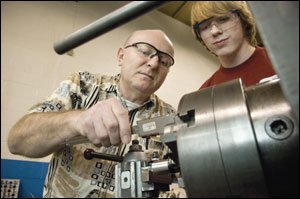
Teacher Tom Clemans

Tom Clemans never planned to become a precision-machining instructor. Twenty-five years ago, he spotted a help-wanted sign outside a machine shop, wandered in, and took a job sweeping floors. Clemans was immediately fascinated by the trade, which involves cutting and shaping metal or plastic into parts for airplanes, cars, and other machines. He learned by watching, by reading textbooks from the library, and, eventually, by practicing the trade himself.

Now in his 15th year of teaching at Sno-Isle TECH Skills Center in Everett, Washington, Clemans has another use for the trade—as a way to get kids interested in algebra, geometry, and trigonometry.

Clemans’ students, who are almost always all boys, spend half the day at local high schools and ride buses to Sno-Isle for sessions in Clemans’ shop. “Machining is the hook that gets them in here,” he says. “I used to sneak math into it. I don’t anymore. I just tell them, ‘This is math you can do.’”

Clemans, who is writing a machining textbook, knows how intimidating math can be: He failed college trigonometry twice. That’s why he works hard to make abstract concepts seem concrete and relevant.

“He gave us the basic information we needed,” says Joseph Alonso, a 2005 graduate who now works as a night manager in a machine shop. “But for the most part, he lets his students really go out there and try the stuff for themselves.”

When one student who was particularly wary of math wanted to make a bicycle sprocket, Clemans gave him a partial sketch. The boy then calculated the diameter, located tangent points between arcs, figured out various lengths—and built the sprocket.

“Many people, including academic teachers and counselors, think vocational education is for dummies,” Clemans says. But then he shows them his course handbook, which includes difficult math all students must master. “It is fun to see the startled look on [their faces].”
A version of this article appeared in the March 01, 2007 edition of Teacher Magazine as Not for Dummies

Events

This content is provided by our sponsor. It is not written by and does not necessarily reflect the views of Education Week's editorial staff.
Sponsor
Special Education Webinar
Bridging the Math Gap: What’s New in Dyscalculia Identification, Instruction & State Action
Discover the latest dyscalculia research insights, state-level policy trends, and classroom strategies to make math more accessible for all.
Content provided by TouchMath
This content is provided by our sponsor. It is not written by and does not necessarily reflect the views of Education Week's editorial staff.
Sponsor
School Climate & Safety Webinar
Belonging as a Leadership Strategy for Today’s Schools
Belonging isn’t a slogan—it’s a leadership strategy. Learn what research shows actually works to improve attendance, culture, and learning.
Content provided by Harmony Academy
This content is provided by our sponsor. It is not written by and does not necessarily reflect the views of Education Week's editorial staff.
Sponsor
School & District Management Webinar
Too Many Initiatives, Not Enough Alignment: A Change Management Playbook for Leaders
Learn how leadership teams can increase alignment and evaluate every program, practice, and purchase against a clear strategic plan.
Content provided by Otus

EdWeek Top School Jobs

Teacher Jobs
Search over ten thousand teaching jobs nationwide — elementary, middle, high school and more.
View Jobs
Principal Jobs
Find hundreds of jobs for principals, assistant principals, and other school leadership roles.
View Jobs
Administrator Jobs
Over a thousand district-level jobs: superintendents, directors, more.
View Jobs
Support Staff Jobs
Search thousands of jobs, from paraprofessionals to counselors and more.
View Jobs

Read Next

Mathematics 4 Research-Backed Tips for Mastering Math Facts
A new review of research offers evidence-based recommendations for classroom practice.
5 min read
A classroom at Lafargue Elementary School in Effie, Louisiana, on Friday, August 22. The state has implemented new professional development requirements for math teachers in grades 4-8 to help improve student achievement and address learning gaps.
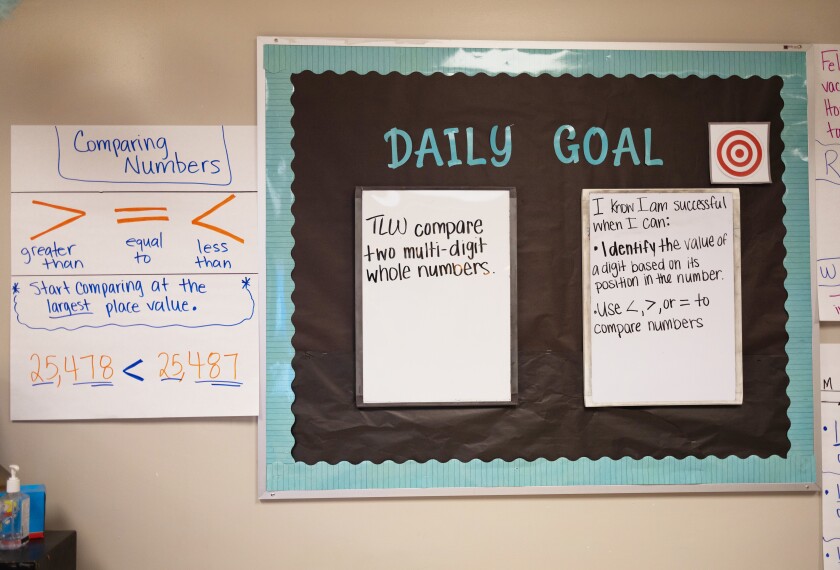
An elementary school classroom in Effie, La., shows how one of the learning goals is to master the ability to compare numbers, on August 22, 2025. New research points out steps teachers can take to memorize facts—through a combination of practice, drills, and playing with numbers.
Kathleen Flynn for Education Week
Mathematics Are Students Prepared for College-Level Math? A Senator Wants to Know
Cassidy has asked 35 institutions about incoming students' math abilities, citing a "crisis" in K-12 math education.
3 min read
Sen. Bill Cassidy, R-La., chairman of the Senate Health, Education, Labor and Pensions (HELP) Committee, strives for a closed-door meeting with fellow Republicans at the Capitol in Washington, Tuesday, Dec. 9, 2025.
Sen. Bill Cassidy, R-La., the chairman of the Senate Health, Education, Labor and Pensions (HELP) Committee, pictured on Capitol Hill on Dec. 9, 2025, has asked for details from colleges and universities about whether matriculants possess adequate math skills.
J. Scott Applewhite/AP
Mathematics Debates Over Math Teaching Are Heating Up. They Could Affect Classrooms
A controversial new movement promoting the "science of math" has come into the math establishment's crosshairs.
9 min read
Casey Dupuis points to class work for a one of her 5th graders during a math class at Lafargue Elementary School in Effie, Louisiana, on Friday, August 22. The state has implemented new professional development requirements for math teachers in grades 4-8 to help improve student achievement and address learning gaps.
A 5th grader works on a problem during a math class at an elementary school in Effie, La., on Aug. 22, 2025. A position paper on teaching math published by the National Council of Supervisors of Mathematics recently kicked off another round of conversations about what practices work best in the classroom—and what the ultimate goals of the subject even are.
Kathleen Flynn for Education Week
Mathematics How the Vocabulary Math Teachers Use Affects Student Learning
A new study draws a link between teachers' use of a discrete instructional practice and student performance.
4 min read
Word Cloud MATH terms: polygon, multiply, rectangle, ordered pair, place value, quadrilateral, subtract, algorithm, median, remainder, number line, factors, divide.
Education Week and Canva
