Mathematics

Not for Dummies

By Hollice Fisher — February 26, 2007 1 min read
  • Save to favorites
  • Print
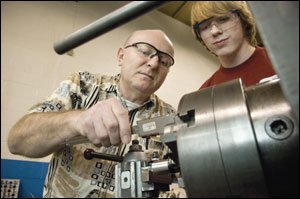
Teacher Tom Clemans

Tom Clemans never planned to become a precision-machining instructor. Twenty-five years ago, he spotted a help-wanted sign outside a machine shop, wandered in, and took a job sweeping floors. Clemans was immediately fascinated by the trade, which involves cutting and shaping metal or plastic into parts for airplanes, cars, and other machines. He learned by watching, by reading textbooks from the library, and, eventually, by practicing the trade himself.

Now in his 15th year of teaching at Sno-Isle TECH Skills Center in Everett, Washington, Clemans has another use for the trade—as a way to get kids interested in algebra, geometry, and trigonometry.

Clemans’ students, who are almost always all boys, spend half the day at local high schools and ride buses to Sno-Isle for sessions in Clemans’ shop. “Machining is the hook that gets them in here,” he says. “I used to sneak math into it. I don’t anymore. I just tell them, ‘This is math you can do.’”

Clemans, who is writing a machining textbook, knows how intimidating math can be: He failed college trigonometry twice. That’s why he works hard to make abstract concepts seem concrete and relevant.

“He gave us the basic information we needed,” says Joseph Alonso, a 2005 graduate who now works as a night manager in a machine shop. “But for the most part, he lets his students really go out there and try the stuff for themselves.”

When one student who was particularly wary of math wanted to make a bicycle sprocket, Clemans gave him a partial sketch. The boy then calculated the diameter, located tangent points between arcs, figured out various lengths—and built the sprocket.

“Many people, including academic teachers and counselors, think vocational education is for dummies,” Clemans says. But then he shows them his course handbook, which includes difficult math all students must master. “It is fun to see the startled look on [their faces].”

A version of this article appeared in the March 01, 2007 edition of Teacher Magazine as Not for Dummies

Events

This content is provided by our sponsor. It is not written by and does not necessarily reflect the views of Education Week's editorial staff.
Sponsor
Webinar
Smarter Tools, Stronger Outcomes: Empowering CTE Educators With Future-Ready Solutions
Open doors to meaningful, hands-on careers with research-backed insights, ideas, and examples of successful CTE programs.
Content provided by Pearson
Webinar Supporting Older Struggling Readers: Tips From Research and Practice
Reading problems are widespread among adolescent learners. Find out how to help students with gaps in foundational reading skills.
This content is provided by our sponsor. It is not written by and does not necessarily reflect the views of Education Week's editorial staff.
Sponsor
Reading & Literacy Webinar
Improve Reading Comprehension: Three Tools for Working Memory Challenges
Discover three working memory workarounds to help your students improve reading comprehension and empower them on their reading journey.
Content provided by Solution Tree

EdWeek Top School Jobs

Teacher Jobs
Search over ten thousand teaching jobs nationwide — elementary, middle, high school and more.
View Jobs
Principal Jobs
Find hundreds of jobs for principals, assistant principals, and other school leadership roles.
View Jobs
Administrator Jobs
Over a thousand district-level jobs: superintendents, directors, more.
View Jobs
Support Staff Jobs
Search thousands of jobs, from paraprofessionals to counselors and more.
View Jobs

Read Next

Mathematics Spotlight Spotlight on Teaching Tools to Make the Math Journey Easier
Students need to see math as useful and doable. This Spotlight focuses on giving teachers tools to help in that journey.
Mathematics How Should We Teach Math? General and Special Ed. Researchers Don't Agree
The divide makes it less likely that students who struggle will get access to proven strategies, researchers argue in a new study.
8 min read
A student works a problem in a second grade math class at Place Bridge Academy, May 20, 2025, in Denver.
A student works a problem in a 2nd grade math class at Place Bridge Academy, May 20, 2025, in Denver. The math instructional strategies that teachers employ can vary depending on whether they trained as general or special educators—a divide researchers say could hurt struggling students.
Rebecca Slezak/AP
Mathematics Opinion Do Math and Grade-Level Instruction Need a Divorce?
Every student can achieve math proficiency. Here's how.
6 min read
The United States Capitol building as a bookcase filled with red, white, and blue policy books in a Washington DC landscape.
Luca D'Urbino for Education Week
Mathematics By the Numbers: See How AP Precalculus Expanded Access to Advanced Math
The College Board broke down student-participation data for the inaugural AP Precalculus exam.
3 min read
Photo of pre-calc equation and graph.
iStock
