Special Education

Impartial Arbitrator Required in Special Education

March 03, 1982 2 min read
  • Save to favorites
  • Print

The U.S. Supreme Court last week let stand an appellate-court decision that an impartial hearing officer--not state education officials--must be the final arbiter in disputes over the identification and placement of handicapped students.

Costly Solutions

In the case, McDaniel v. Helms, Georgia state officials had argued that school authorities should decide appeals by the parents of special-education students, because hearing officers from outside the education system might be inclined to impose costly solutions.

The U.S. Court of Appeals for the Fifth Circuit ruled last year that, under P.L. 94-142, the Education for All Handicapped Children Act, an impartial hearing officer was required. The Supreme Court last week refused to review that decision.

The Court also declined to consider an appeal of one school-desegregation case and asked for the Justice Department’s views on another.

In Rapides Parish School Board v. Valley, a Louisiana case that attracted national attention in 1980 when a local judge tried to allow students to escape the busing plan ordered by a federal court, the Fifth Circuit last year rejected the school board’s contention that racial imbalance in the schools was caused by demographic change. The federal district judge’s busing order, the appellate court ruled, was proper so long as there are vestiges of illegal segregation in the school system.

The Supreme Court, in declining to hear the case, allowed the appellate-court decision to stand.

And in the 20-year-old Chicago case, the Supreme Court told the Justice Department to file a brief giving its views on a desegregation technique known as a “stabilization quota.”

Student Limit Set

The Chicago school board, in an attempt to prevent “white flight” from two public schools in racially mixed areas, set a limit on the num-ber of black children allowed to enroll in the schools. As a result, some 1,600 black students were required to attend schools outside their neighborhoods.

The quota system was challenged by a group of black students, originally with the support of the Justice Department, which was then at odds with the Chicago board over desegregation.

The U.S. Court of Appeals for the Seventh Circuit found the practice justifiable.

‘Stabilization Quotas’

Now that the Justice Department and the Chicago board have agreed on a desegregation plan, it is considered likely by some observers that the federal agency will take the board’s side on the use of “stabilization quotas.”

John V. Wilson, a spokesman for the Justice Department, said he did not know when the brief would be submitted. “It’ll probably be a while,” he said. “We’ll have to start from scratch and look at that case and look at the two high schools again."--P.C.

A version of this article appeared in the March 03, 1982 edition of Education Week as Impartial Arbitrator Required in Special Education

Events

Student Well-Being & Movement K-12 Essentials Forum How Schools Are Teaching Students Life Skills
Join this free virtual event to explore creative ways schools have found to seamlessly integrate teaching life skills into the school day.
This content is provided by our sponsor. It is not written by and does not necessarily reflect the views of Education Week's editorial staff.
Sponsor
Special Education Webinar
Bridging the Math Gap: What’s New in Dyscalculia Identification, Instruction & State Action
Discover the latest dyscalculia research insights, state-level policy trends, and classroom strategies to make math more accessible for all.
Content provided by TouchMath
This content is provided by our sponsor. It is not written by and does not necessarily reflect the views of Education Week's editorial staff.
Sponsor
School & District Management Webinar
Too Many Initiatives, Not Enough Alignment: A Change Management Playbook for Leaders
Learn how leadership teams can increase alignment and evaluate every program, practice, and purchase against a clear strategic plan.
Content provided by Otus

EdWeek Top School Jobs

Teacher Jobs
Search over ten thousand teaching jobs nationwide — elementary, middle, high school and more.
View Jobs
Principal Jobs
Find hundreds of jobs for principals, assistant principals, and other school leadership roles.
View Jobs
Administrator Jobs
Over a thousand district-level jobs: superintendents, directors, more.
View Jobs
Support Staff Jobs
Search thousands of jobs, from paraprofessionals to counselors and more.
View Jobs

Read Next

Special Education Quiz Quiz Yourself: How Much Do You Know About the Keys to Successful Dyslexia Education?
Answer 7 questions about the keys to successful dyslexia education
Special Education Educators Worry About How Trump's Autism Rhetoric Will Affect Students, Parents
Misinformation about autism can fuel stigma that harms students, educators say.
7 min read
Ear Defenders or Headphones And Fidget Toy To Help Child With ASD Or Autism On Table In School Classroom
iStock/Getty
Special Education Trump Canceled Millions for Special Education Teacher Training. What's Next?
More than $30 million for teacher training and parent resources will no longer flow as scheduled.
9 min read
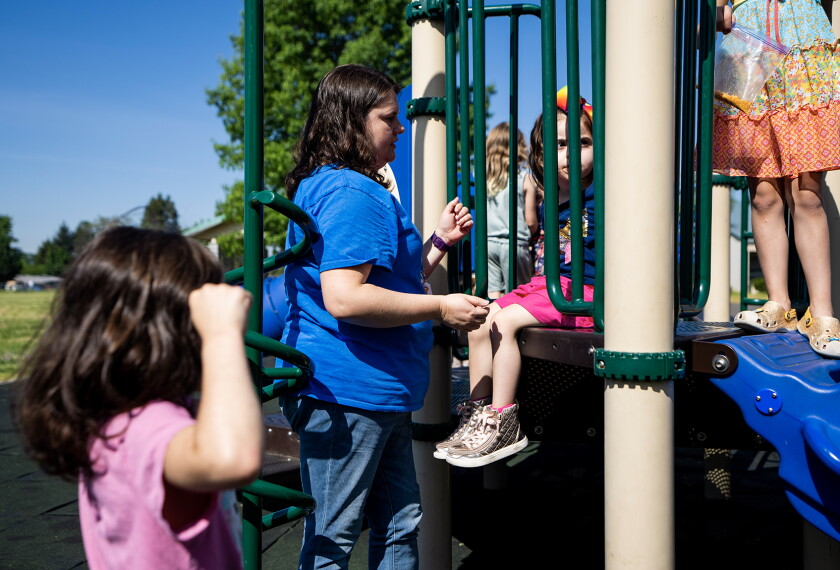
Vivien Henshall, a long-term substitute special education teacher, talks with Scarlett Rasmussen, 8, during recess at Parkside Elementary School on May 17, 2023, in Grants Pass, Ore. Scarlett is nonverbal and uses an electronic device and online videos to communicate, but reads at her grade level. She was born with a genetic condition that causes her to have seizures and makes it hard for her to eat and digest food, requiring her to need a resident nurse at school.
A long-term substitute special education teacher at Parkside Elementary School in Grants Pass, Ore., speaks with a student during recess on May 17, 2023. The Trump administration has canceled more than $30 million in special education grants, including some aimed at training special education teachers.
Lindsey Wasson/AP
Special Education Most—But Not All—Imperiled Federal Grants for Special Education Will Continue
The U.S. Department of Education says it wants projects aligned with Trump administration priorities.
5 min read
Scarlett Rasmussen, 8, tosses a ball with other classmates underneath a play structure during recess at Parkside Elementary School on May 17, 2023, in Grants Pass, Ore. Chelsea Rasmussen has fought for more than a year for her daughter, Scarlett, to attend full days at Parkside.
A student who receives special education services tosses a ball during recess at Parkside Elementary School on May 17, 2023, in Grants Pass, Ore. Several recipients of grants awarded under the Individuals with Disabilities Education Act learned Friday that the U.S. Department of Education would continue their grants for another year, provided they certify their projects align with Trump administration priorities.
Lindsey Wasson/AP
