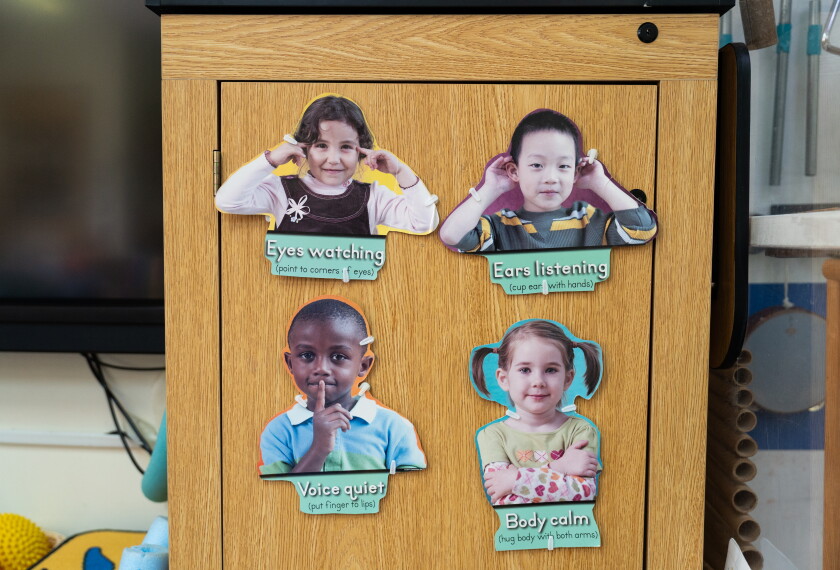
More than half of elementary school principals now oversee pre-K—a significant jump from 10% of school leaders who did so in 1986. But only a small number of school leaders are specifically trained in early childhood education, in part because most principal preparation programs don’t include the topic.
Leading early grades is no child’s play. Principals need to understand how young learners’ brains develop, why play is central to the curriculum, and how parent and community engagement are critical to ease the transition between grades for younger students. But principals often don’t have enough runway to learn these skills and theories before they’re tasked with leading early grades.
When principals transition from a middle or high school to an elementary, they often lack the instructional leadership skills to lead the early grades, said Gracie Branch, who oversees professional learning at the National Association of Elementary School Principals. The association runs a yearlong professional learning program called Pre-K-3 Academy to train principals new to early childhood education.
“It’s a really big shift for them,” said Branch. “How is a classroom that is really geared toward early learning set up? What does it look like? In early learning, one of the big things is it’s not just what they learn, but how they learn.”
For instance, principals need to know that classrooms for early learners should feel welcoming and include the right furniture, equipment, and learning materials, like manipulatives. The setup should accommodate small group instruction, space for physical movement, and student collaboration, Branch added.
Principals need to create the right environment for students, but working with teachers and parents is just as important. Kara Scholl, the principal of South Shades Crest Elementary School in Hoover, Ala., invites parents for coffee regularly to talk through their concerns and challenges.
As a principal of a pre-K-2 campus, Scholl said keeping parents in the loop is critical so they can reinforce the same routines and practices at home that their kids follow in school. “I’ve got tea, I’ve got bagels, they sit down, and we talk. I’ve surveyed parents for what topics they were interested in, and tried to plan my meetings around that,” said Scholl.
Her two-decade experience as a kindergarten teacher eased Scholl’s transition into leading early grades. She spoke with Education Week about the most important strategies to ensure the youngest students learn and thrive.
Priming school environments for play
To an untrained principal’s eye, play can look “messy,” Scholl said. Principals must learn to look beyond the act of play to understand what it conveys. For instance, playing with blocks can serve as a lesson in counting or grouping similar shapes and objects, provided that the teacher is intentional. On her observational rounds, Scholl regularly stops to talk to students and teachers about the games they play, and the intention behind them.
“There’s no right or wrong answer. I’m listening for if the teacher checks back to the overarching standards that they might be teaching,” said Scholl. “Is the teacher intentional [about play] versus, ‘Oh, well, I didn’t really have purpose for that, they just were drawn to it?’ We need to be deeper than that.”
Principals also need to learn how to balance fun with learning. Scholl models this for her teachers to replicate in their own classrooms. Faculty meetings, for instance, start with teachers making “glyphs” or pictorial representations to share information about themselves—summer trips, their TV preferences, or what grades they teach. The adults in the school need to be just as engaged and excited as the kids, said Scholl.
Supporting teachers in collaboration
When principals only visit pre-K and Kindergarten a few times a year, they risk isolating those teachers from the rest of the school and professional development opportunities.
At Scholl’s school, two systems run in parallel: grade-level teacher teams meet once a week with her, the assistant principal, and instructional coaches to discuss everyday math or reading routines, and how well students grasp those concepts through play. Scholl has also set up meeting times for teachers across grades to share and align practices for teaching math or reading. This collaboration can help students transition more easily to a higher grade, Scholl said.
A third, more infrequent meeting is between teachers from Scholl’s school and a sister school that starts in 3rd grade. In these sessions, teachers discuss how the same standard—such as phonics instruction—looks different across grade levels, and how each grade level teacher approaches it. The collaboration can help continuity when students move from one grade to the next because the teachers know what’s been taught and what will be taught in subsequent years.
Scholl has to be intentional about making time in the schedule for both the vertical meetings between grades and those between schools. The vertical meetings occur every six weeks; the school teams met three times last year, but Scholl hopes she can increase that count in the next school year.
Engaging families before and during the school year
Building trust with parents at the beginning of the school year is crucial, especially if their kids are stepping into a classroom for the first time, Scholl said.
Scholl hosts a “kindergarten kickoff” every year to get parents and students comfortable with the classroom. Students play with their teachers while Scholl talks to parents about routines or practices they can reinforce at home.
Parents are also invited to curriculum nights where they get a firsthand look at how their children learn through play and take-home activities. When parents have questions about reading, for instance, Scholl invites her literacy coach to share tips like reading small chapters from a book, pointing out names of grocery items in a store. A math coach could give tips like counting the number of forks coming out of a dishwasher.
“I want the family to know we love their child, and will make decisions on what’s best for them,” said Scholl.