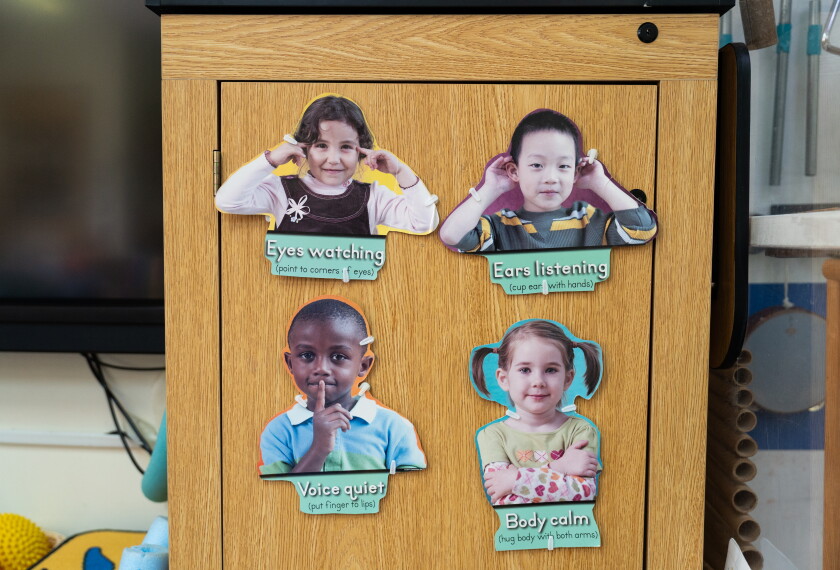
The demand for seats for 2-year-olds in an expanded public preschool program in New York City is far outpacing the spots available, raising questions about whether this approach will gather momentum in other parts of the country.
There were nearly 5,700 applications for 2,000 new seats for 2-year-olds in the city’s pre-K program, which had already provided free, public preschool for 3- and 4-year-olds for a decade. It plans to expand the program for 2-year-olds in 2027 to 12,000 children.
During a press conference about the program on Tuesday, Mayor Zohran Kwame Mamdani emphasized that one of the reasons for the popularity of the program is likely its emphasis on placing kids relatively close to where their parents live or work.
“For universal child care to work, it needs to meet parents where they are,” Mamdani said during the press conference. “Not a borough away, not three train transfers away, but in a way that works for working parents’ lives.”
Policymakers and educators have advocated for years for states and school districts to establish free, public preschool programs but few offer it for 3-year-olds. Most programs serve only 4-year-olds.
Research shows that children in early childhood education programs demonstrate stronger language and math skills compared to those who aren’t in these programs.
New York City offering free, public preschool to 2-year-olds is a big step, and one that some early childhood education advocates hope will lead to public programs for children starting at birth.
“There’s a lot of interest not just among people in New York, but across the country, examining New York City as one of the leaders in a citywide initiative for [preschool for 2- to 5-year-olds],” said Justin Doromal, a senior research associate in the Family and Financial Well-Being Division at the Urban Institute, a research organization based in Washington.
The way New York’s initiative is designed will give the city the “chance to really work through some of the issues [by slowly expanding],” Doromal added.
How families were selected to participate
Families were selected based on whether they already have a child attending a school in the district and whether they live in a participating district. Among the families selected, 82% were matched with one of their top three choices for a school, and more than half are getting their first choice.
Each seat will save a family an average of $26,000 per year. Families have until the end of August to accept their spots. For those not selected, a waitlist has opened in case additional seats become available in the coming weeks.
This initiative not only benefits families but the local workforce too, said New York Gov. Kathy Hochul, a Democrat, at the news conference.
When employers are trying to retain or recruit people, they can say, “come to New York, stay in New York because now we are helping with the cost of child care,” said Hochul. “This is going to be a game-changer that is going to position us for great leadership and excellence for decades to come.”
New York isn’t the first to aim for universal Pre-K education. New Mexico launched a similar program last fall. But New York is the largest city in the nation to do so, raising questions about the economic feasibility of the initiative.
Mamdani campaigned in 2024 on universal child care, which includes children 6 weeks to 5 years old. The city already provides free pre-K for 3- and 4-year-olds across the city. Mamdani has said he aims for universal childcare for 2-year-olds by the end of his first term in 2030.
Hochul has committed to funding the program for 2-year-olds for this year and next, setting aside $1.2 billion of state funds for it.
But the Center for New York City Affairs at The New School published a report on July 31, 2026, estimating the cost of a fully universal Pre-K system, meaning birth to age 5, would be between $8.7 billion to $9.3 billion per year.
“We plan to do an independent verification of the actual cost required, not just an outside study,” said Hochul. “I am committed to the program next year; I can’t commit future budgets at this time,” the governor said.
Lessons New York City can take from New Mexico
Both New York City and New Mexico are attempting to make preschool available to a larger age range of children but have gone about it differently. New Mexico’s initiative was announced and launched last year and was codified into law in March of 2026.
Since going into effect, an additional 12,000 children are receiving the benefits of the program, according to New Mexico’s Early Childhood Education and Care Department. However, numbers about the program’s cost and whether the state is meeting its demand are still being determined, as the state’s fiscal year ends in September.
“Some of the public feedback [has been], can New Mexico supply keep up with families’ demand? I think September would be the first honest way to look at whether that’s been true or not,” said Doromal.
“We’re [also] seeing if in the first year there was an increase in [child care provider] supply, and what types of supply,” he added.
One distinction Doromal made between the two early childhood education initiatives is that because New Mexico’s program became law, there is a backup plan in place in the event the state government can’t cover the costs.
According to the state law, copays can be introduced for high-earning families to generate revenue for the program. That is not the case for the New York City program, which is still in its initial phase and is not supported by state law.