Mathematics

How AI Should Change Math Education: New Guidance on How to Adapt

By Alyson Klein — March 05, 2024 2 min read
Conceptual image of A.I. robot head and numbers flowing through it's head.
  • Save to favorites
  • Print

Artificial intelligence-powered tools can help students learn math, but educators should also explain why students should be skeptical of the technology, concludes the National Council of Teachers of Mathematics in a recent AI position statement.

NCTM is among the first teaching organizations to take an official position on AI.

And its early stance may be especially influential: Educators are looking for guidance on how to use AI in the classroom but don’t feel that it must come from government officials, experts say. It can come from prominent, trusted organizations such as NCTM.

AI has “been around forever, but with ChatGPT, it’s [becoming] that much more common,” said Kevin Dykema, who teaches middle school math in Michigan and is the president of NCTM. “Math educators are looking for some guidance: ‘How do you best integrate AI into the classroom?’ This was a perfect opportunity for us to get out in front of the field.”

AI has great potential to make math teachers’ lives easier, by helping to create quizzes or tests, for example, the NCTM guidance says. It may also help personalize learning for students by presenting them with problems tailored not only to a particular math skill but to their own interests.

But the technology also tends to “hallucinate”—come up with answers that are “untrue or unreasonable,” NCTM writes, adding that AI tools don’t always cite the sources for their information, giving students the “illusion that the ideas do not need to be cited or vetted.”

And AI tools tend to reflect the biases in society, which typically show up in the data used to train the technology.

‘What can we de-emphasize?’

Math educators are already accustomed to changing how they teach because of a new technology, Dykema said.

After all, even before ChatGPT arrived in late 2022, raising educators’ awareness of AI, tools like PhotoMath were already solving algebra equations for students.

Before that, calculators were the game changer.

“Technology has evolved in such a way that it’s forcing us to think about what is that critical content that’s necessary for students,” Dykema said. “Calculators came out, and we had to figure out ‘how do we better integrate this new technology called a calculator into the classrooms? And what does that mean in terms of what we teach? What can we de-emphasize?’”

AI has highlighted the need for a similar, deep rethinking of how schools teach math, he said.

“We need to continue to help our students see that math is used in real life, that math is not something that’s just done in that K-12 classroom,” Dykema said. “Mathematics has historically, and continues to be used, to solve real-world problems.”

The organization also recommends that math educators be on the front lines of developing and testing AI tools aimed at teaching or reinforcing math skills.

The good news for math educators: It will take teachers with more math expertise, not less, to properly vet cutting-edge math education technology.

AI has “the potential to change how we do things,” Dykema said. But he added that “there’s a lot of limitations to some of the initial AI [tools] that are out there. And we need to recognize just because it says ‘powered by AI’ doesn’t mean it’s necessarily good.”

Related Tags:

Events

This content is provided by our sponsor. It is not written by and does not necessarily reflect the views of Education Week's editorial staff.
Sponsor
School & District Management Webinar
Too Many Initiatives, Not Enough Alignment: A Change Management Playbook for Leaders
Learn how leadership teams can increase alignment and evaluate every program, practice, and purchase against a clear strategic plan.
Content provided by Otus
This content is provided by our sponsor. It is not written by and does not necessarily reflect the views of Education Week's editorial staff.
Sponsor
Artificial Intelligence Webinar
Beyond Teacher Tools: Exploring AI for Student Success
Teacher AI tools only show assigned work. See how TrekAi's student-facing approach reveals authentic learning needs and drives real success.
Content provided by TrekAi
This content is provided by our sponsor. It is not written by and does not necessarily reflect the views of Education Week's editorial staff.
Sponsor
College & Workforce Readiness Webinar
Building for the Future: Igniting Middle Schoolers’ Interest in Skilled Trades & Future-Ready Skills
Ignite middle schoolers’ interest in skilled trades with hands-on learning and real-world projects that build future-ready skills.
Content provided by Project Lead The Way

EdWeek Top School Jobs

Teacher Jobs
Search over ten thousand teaching jobs nationwide — elementary, middle, high school and more.
View Jobs
Principal Jobs
Find hundreds of jobs for principals, assistant principals, and other school leadership roles.
View Jobs
Administrator Jobs
Over a thousand district-level jobs: superintendents, directors, more.
View Jobs
Support Staff Jobs
Search thousands of jobs, from paraprofessionals to counselors and more.
View Jobs

Read Next

Mathematics Opinion 3 Big Changes My School Is Making to Boost Math Achievement
It’s time for math educators to look inward to keep what's working and fix what's not.
Mark Miller
5 min read
Illustration of multiplication and division signs with arrow running through them.
iStock
Mathematics More States Are Calling for Math Reform. Will It Improve Student Outcomes?
National math scores are sitting at historic lows. But experts disagree on how to raise achievement.
7 min read
 In 2025, the Texas Legislature mandated professional development for classroom teachers, math coaches, interventionists, and building leaders working with students in grades K-3 in a bid to shore up math teaching in the state. The Texas State Capitol is shown on the first day of a special session on July 8, 2021, in Austin.
The Texas State Capitol on the first day of the 87th Legislature's special session on July 8, 2021 in Austin. In 2025, Texas lawmakers mandated professional development for classroom teachers, math coaches, interventionists, and building leaders working with students in grades K-3.
Tamir Kalifa/Getty Images via TNS
Mathematics Spotlight Spotlight on Creating a Positive Math Culture
This Spotlight explores instructional practices that help build students’ math skills, confidence, and willingness to tackle hard problems.
Mathematics 4 Research-Backed Tips for Mastering Math Facts
A new review of research offers evidence-based recommendations for classroom practice.
5 min read
A classroom at Lafargue Elementary School in Effie, Louisiana, on Friday, August 22. The state has implemented new professional development requirements for math teachers in grades 4-8 to help improve student achievement and address learning gaps.
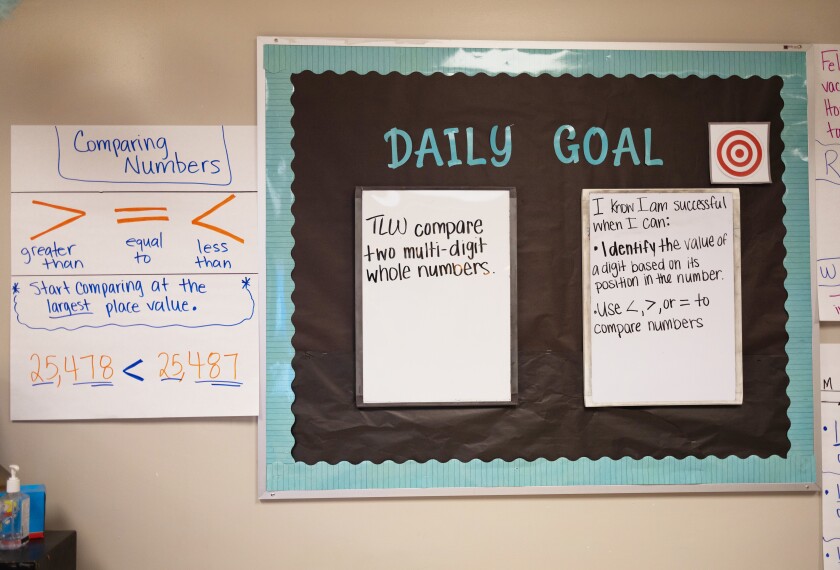
An elementary school classroom in Effie, La., shows how one of the learning goals is to master the ability to compare numbers, on August 22, 2025. New research points out steps teachers can take to memorize facts—through a combination of practice, drills, and playing with numbers.
Kathleen Flynn for Education Week