College & Workforce Readiness

Donald Trump Signs First Major Education Policy Bill of His Presidency

By Andrew Ujifusa — July 31, 2018 3 min read
Hours after signing a reauthorization of the Carl D. Perkins Career and Technical Education Act on July 31, President Donald Trump arrives for a rally in Tampa, Fla.
  • Save to favorites
  • Print

In a watershed moment for his administration on education policy, President Donald Trump on Tuesday signed the Strengthening Career and Technical Education for the 21st Century Act, the first legislation Trump’s signed that makes significant changes to federal education law itself.

The legislation is a reauthorization of the Carl D. Perkins Career and Technical Education Act, a $1.2 billion program last overhauled by Congress in 2006. The new law allows states to set their own goals for career and technical education programs without the education secretary’s approval, requires them to make progress toward those goals, and makes other changes to federal CTE law.

Trump celebrated the bill signing at a “Pledge to America’s Workers” event on Tuesday in Florida designed to showcase the administration’s focus on workforce development.

In a speech at Tampa Technical High School in Tampa, Fla., after the official bill signing at the White House, Trump said the new CTE law would contribute to the “booming economy.”

Thanks to the law, Trump told the crowd, “More than 11 million students and workers will have greater access to better training and more jobs.”

Career and technical education is attracting new attention and support, but it’s also facing new challenges as programs try to evolve to meet changing labor force demands.
See Also

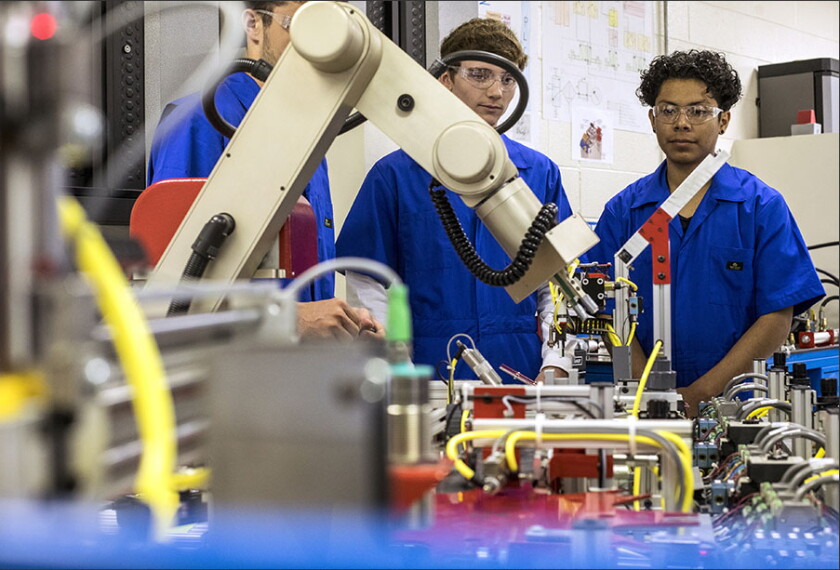
High school seniors Alex Yates, left, and David Romero work on an assembly line machine in a mechatronics class in the career and technical education program at Warren County High School in McMinnville, Tenn., in 2017. The technology skills they learn in the class help prepare them for jobs in the area’s booming automotive industry.
Joe Buglewicz for Education Week-File

Early in his presidency, Trump approved congressional resolutions that overturned Obama-era accountability rules for the Every Student Succeeds Act and a separate set of rules governing teacher preparation. So this isn’t the first act of Congress focused on education he has signed.

But there has been little to no progress on revamping other major education programs in Congress, whether they’re Trump priorities or otherwise:

  • Lawmakers have repeatedly rejected a push by Trump and U.S. Secretary of Education Betsy DeVos to create new federally funded school choice initiatives, such as a $1 billion public school choice program using Title I aid typically directed at low-income students.
  • Similarly, Congress hasn’t shown an interest in making dramatic cuts to the U.S. Department of Education like Trump and DeVos have called for in two education budget proposals so far.
  • Work on overhauling the Higher Education Act has stalled, even though a GOP-backed higher education bill awaits action by the full House. Sen. Lamar Alexander, R-Tenn., made an HEA overhaul a top priority at the start of the 115th Congress, but to no avail so far.
  • There’s been no tangible progress on revamping laws like the Individuals With Disabilities Education Act and the Head Start Act that are long overdue for reauthorization.

The Trump administration made reauthorizing Perkins a priority this year, and dispatched the president’s daughter and senior adviser Ivanka Trump to Capitol Hill to push senators to approve a bill. Shortly thereafter, the Senate education committee considered and unanimously passed a Perkins reauthorization bill, which was written by Sen. Bob Casey, D-Pa., and Sen. Mike Enzi, R-Wyo.

Last week, the Senate then passed the legislation, and the House quickly agreed to a Perkins reauthorization bill as amended by the Senate.

Business groups, the National Governors Association, and education groups like the Council of Chief State School Officers praised Congress’ quick work on CTE legislation over the past month. However, advocacy groups like Advance CTE and the Association for Career and Technical Education indicated that they believed the reauthorization was a mixed bag—the groups worried, for example, that the legislation could lead to states setting “unambitious” goals for CTE, and more paperwork for school leaders to deal with.

CTE educators are tackling a series of tough issues. Tennessee, for example, is trying to close down “dead-end pathways” in favor of programs that teach more sophisticated technology skills.

And there are growing concerns that some CTE courses of study limit access and don’t reach a diverse set of students.

A version of this article appeared in the August 22, 2018 edition of Education Week as Trump Signs Bipartisan Bill On Career-Tech

Events

School & District Management Webinar Squeeze More Learning Time Out of the School Day
Learn how to increase learning time for your students by identifying and minimizing classroom disruptions.
This content is provided by our sponsor. It is not written by and does not necessarily reflect the views of Education Week's editorial staff.
Sponsor
Reading & Literacy Webinar
Improve Reading Comprehension: Three Tools for Working Memory Challenges
Discover three working memory workarounds to help your students improve reading comprehension and empower them on their reading journey.
Content provided by Solution Tree
Recruitment & Retention Webinar EdRecruiter 2026 Survey Results: How School Districts are Finding and Keeping Talent
Discover the latest K-12 hiring trends from EdWeek’s nationwide survey of job seekers and district HR professionals.

EdWeek Top School Jobs

Teacher Jobs
Search over ten thousand teaching jobs nationwide — elementary, middle, high school and more.
View Jobs
Principal Jobs
Find hundreds of jobs for principals, assistant principals, and other school leadership roles.
View Jobs
Administrator Jobs
Over a thousand district-level jobs: superintendents, directors, more.
View Jobs
Support Staff Jobs
Search thousands of jobs, from paraprofessionals to counselors and more.
View Jobs

Read Next

College & Workforce Readiness Q&A An Alternative to AP and IB: How the Cambridge Program Has Found a U.S. Foothold
Leaders of the Cambridge program speak about how it differs from the AP and IB programs.
4 min read
Illustration of school textbooks.
iStock
College & Workforce Readiness Classroom View: How AI Is Influencing Teacher Approaches to Career and Technical Ed.
Teachers share examples of how the technology is playing a bigger role in their lessons.
8 min read
Students in Bentonville public schools’ Ignite program work on projects during class on Nov. 5, 2025, in Bentonville, Ark. The program offer career-pathway training for juniors and seniors in the district.
Students in the digital media pathway at Bentonville public schools’ Ignite program work on a group project during class on Nov. 5, 2025, in Bentonville, Ark. The program—which integrates lessons about AI into its curriculum—offers career-pathway training for juniors and seniors in the district.
Wesley Hitt for Education Week
College & Workforce Readiness From Our Research Center Businesses Want Employees With AI Skills. Are K-12 CTE Programs Keeping Up?
Most schools are still in the early stages of thinking about the role of AI in CTE programs.
6 min read
Students present their AI powered-projects designed to help boost agricultural gains in Calla Bartschi’s Introduction to AI class at Riverside High School in Greer, S.C., on Nov. 11, 2025.
Students do presentations about their AI-powered projects that are designed to help boost agricultural production during Calla Bartschi’s Introduction to AI class at Riverside High School in Greer, S.C., on Nov. 11, 2025. South Carolina is emphasizing the development of AI skills that are relevant for the careers students want to pursue in the future.
Thomas Hammond for Education Week
College & Workforce Readiness Schools Are Working to Show Boys That the Helping Professions Aren't 'Girly'
Experts say boys don't get support to enter traditionally female careers.
11 min read
PhD student and Physical Therapist Stephen Eaton, left, explains ultrasound imaging to RAMP students during a lab at the University of Maryland School of Medicine on Oct. 16, 2025, in Baltimore, Md. RAMP, which stands for Research and Mentoring Program, is a training program that targets high school juniors and seniors from Baltimore City to prepare them for careers in biomedical research.
Doctoral student and physical therapist Stephen Eaton, left, explains ultrasound imaging to students in the Research and Mentoring program during a lab at the University of Maryland School of Medicine on Oct. 16, 2025, in Baltimore. Men are heavily underrepresented in health fields, and more high schools are designing programs that, like RAMP, encourage boys to consider high-growth fields traditionally dominated by women.
KT Kanazawich for Education Week
