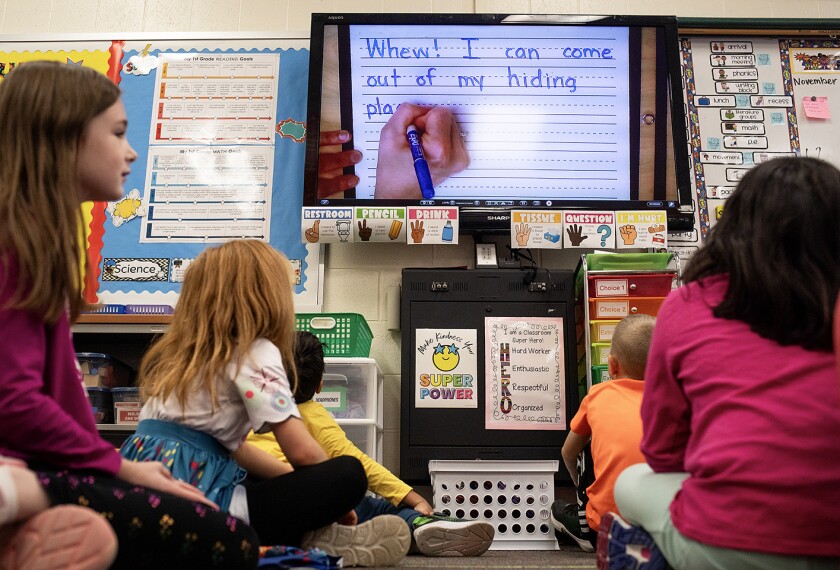
Pennsylvania students will soon join a growing number of their peers nationwide practicing the looping, connected script of cursive writing—part of a broader national revival of the once-standard classroom skill.
At least half of the nation’s states have adopted cursive writing instruction in recent years, reversing a sharp decline in teaching of that skill after the Common Core, launched in 2010, omitted it from its standards.
Lawmakers such as Republican Sen. Wayne Langerholc, who sponsored Pennsylvania’s cursive bill that became law on Feb. 11, tout what they see as the skill’s benefits to students.
“By reintegrating cursive into the curriculum, we are not simply teaching handwriting, we are investing in our students’ cognitive development, strengthening their legal preparedness and preserving their connection to historical literacy,” Langerholc told constituents.
But educators say the return to cursive won’t be without challenges. Schools will need to figure out where and when during the school day to fit in the teaching of those skills. It may compete with keyboard instruction for space in the schedule, as both skills are typically taught between grades 3 and 5. Also, teachers will require patience as they teach cursive instruction to today’s students, many of whom struggle with fine motor skills—a prerequisite to mastering this handwriting style. Additionally, the majority of teachers charged with teaching cursive writing may not remember how to teach it, and some probably never learned it when they were students, and most of the recent legislation around cursive doesn’t mention funding for teacher training.
The shift from cursive to keyboarding
After more than a century of teaching cursive handwriting to elementary school students, digital keyboarding skills began to show up in the curricula in the late 90’s. The shift accelerated after Common Core went into effect in 2010, which emphasized typing skills while omitting cursive writing.
Reliance on keyboard skills grew during the pandemic, as remote learning required the use of devices. Schools continued to rely heavily on devices after the pandemic.
In spring 2021, 90% of district leaders surveyed by the EdWeek Research Center said they were providing a device for every middle and high school student, and 84% said they were doing the same for elementary school students.
Balancing keyboard and cursive skills
As long as schools and employers continue to rely on electronic devices, students will need to become comfortable using a keyboard. Only now, many of these same students will be tasked with learning cursive, too.
“Keyboarding skills are important for both school demands and as a life skill,” said Denise Donica, professor and chair of the department of occupational therapy at East Carolina University in Greenville, N.C.
Donica sees the practical benefits of cursive, too. She noted that once students master cursive, it’s quicker than printing. And some students prefer cursive to print, in which each letter is formed separately. “Students who have struggled with printing may welcome a fresh start with cursive,” she said.
Other advocates of cursive argue that its outsized effects on cognitive development—especially compared to keyboarding—warrant its return to classroom instruction. But the majority of research on handwriting’s benefits applies to both cursive and print.
Fine motor skills: a prerequisite to cursive and print handwriting
Learning both cursive and print requires fine motor skills, while many teachers report that these essential foundational skills are on the decline.
In a January 2026 online survey of 1,163 early educators, the EdWeek Research Center asked: In the past two years, what—if any—changes have you seen in the percentage of students in your classroom, school, or program who have age-appropriate fine motor skills? Seventy percent of respondents said their students’ fine motor skills had decreased.
Other statistics mirror these findings. In a national 2025 survey of 569 primary school teachers in the United Kingdom, 77% of respondents said that, compared to 2000, students have more difficulty performing tasks that require fine motor skills, such as holding a pencil, drawing, writing, and using scissors.
Many educators blame young children’s worsening fine motor skills on their uptick in screen usage. Forty percent of U.S. children have their own tablet by the age of 2, and 75% of parents whose children use screen time don’t apply limits, according to Media Use by Kids Zero to Eight, a 2025 report by Common Sense Media.
Cursive writing: a new skill for students and teachers
As more states require students to learn cursive, it’s a skill that may be new to their teachers, too.
“The younger generation of teachers were never taught handwriting when they were in school. Right now, they’re expected to teach it,” said Christina Bretz, an occupational therapist with Learning Without Tears, a company that provides professional learning to educators on cursive handwriting and other literacy-related skills.
“That first year, teachers need to give themselves grace. If you’ve never been taught cursive, you’re learning it just alongside your students,” she said.
Melissa Mosley Wetzel, a professor of language and literacy studies at the University of Texas at Austin, teaches aspiring educators in her classes how to instruct elementary students on cursive handwriting. Most of her students will go on to teach in Texas, one of several states that now require students to learn cursive writing in elementary school.
Wetzel emphasizes to her students that strong penmanship isn’t pre-determined, and it can be learned.
“We really make this explicit connection that the instruction matters and that children can improve their writing, both in manuscript and cursive, through instruction,” she said.
Wetzel believes her teacher-prep students enjoy the cursive practice they’re getting in class.
“It’s sort of a delightful change of pace for them, and it doesn’t seem to be something that they’re resistant to,” she said. That could work in their favor as they introduce early learners to handwriting—or its precursor skills.
Although students generally aren’t introduced to cursive writing until 2nd or 3rd grade, occupational therapist Bretz says that strengthening students’ fine motor skills should begin in earnest by pre-K. For example, she says pre-K students should learn the coordinated skill of holding a crayon correctly while using the non-dominant hand to hold the paper steady.
“Those foundational skills are really going to set students up for success,” said Bretz.
Bretz recommends starting formal cursive handwriting instruction in 3rd grade, when most students possess the hand-coordination required to master the skill, she said.
To hear Bretz describe cursive writing makes it sound like something every young student would want to learn.
“The continuous flow of connecting the letters; that’s really what cursive is all about—connections,” Bretz said. “And when children write whole words in a connected way, they’re not having to pick up their pencil after every letter.”