
Assessment Report Roundup

Computer Science Draws Undergrads With Disabilities

By Sarah D. Sparks — February 07, 2017 1 min read
  • Save to favorites
  • Print

Students with disabilities are as likely as typically developing students to enter science and engineering fields in college, according to new data from the National Science Foundation.

The finding is part of the NSF’s annual study of students from traditionally underrepresented groups—including women, minorities, and students with disabilities—in science, technology, engineering, and mathematics fields.
College Track

BRIC ARCHIVE

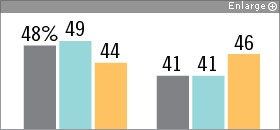
New federal data show that students with disabilities accounted for 1 in 10 undergraduate college students in the United States in 2012. They were more likely than other students to attend a two-year institution.

As of 2012, the most recent year for data, about 2.4 million of the 21.8 million students pursuing an undergraduate degree reported having a disability. That’s 11 percent, roughly on par with the 12 percent of K-12 students with a disability in U.S. schools. Those with disabilities were significantly older than undergraduates without disabilities; 36 percent were older than 30, compared with only 24 percent of those without disabilities. They were also slightly more likely than students without a disability to attend two-year rather than four-year colleges.

The data show students with disabilities were as likely as other students to enroll in science fields; they were a little more likely to study computer science and slightly less likely to pursue engineering or life sciences than their nondisabled peers. Students with disabilities were also equally likely to get financial aid for college.

However, students with disabilities were less likely to enroll in graduate school, often needed for top science careers, the data show. In 2012, only 7 percent of graduate students reported having a disability. And once out of college, students with disabilities who do go into science and engineering fields are as likely as their nondisabled peers to work in industry or government jobs.

Related Tags:

A version of this article appeared in the February 08, 2017 edition of Education Week as Computer Science Draws Undergrads With Disabilities

Events

Student Well-Being & Movement K-12 Essentials Forum How Schools Are Teaching Students Life Skills
Join this free virtual event to explore creative ways schools have found to seamlessly integrate teaching life skills into the school day.
This content is provided by our sponsor. It is not written by and does not necessarily reflect the views of Education Week's editorial staff.
Sponsor
Special Education Webinar
Bridging the Math Gap: What’s New in Dyscalculia Identification, Instruction & State Action
Discover the latest dyscalculia research insights, state-level policy trends, and classroom strategies to make math more accessible for all.
Content provided by TouchMath
This content is provided by our sponsor. It is not written by and does not necessarily reflect the views of Education Week's editorial staff.
Sponsor
School & District Management Webinar
Too Many Initiatives, Not Enough Alignment: A Change Management Playbook for Leaders
Learn how leadership teams can increase alignment and evaluate every program, practice, and purchase against a clear strategic plan.
Content provided by Otus

EdWeek Top School Jobs

Teacher Jobs
Search over ten thousand teaching jobs nationwide — elementary, middle, high school and more.
View Jobs
Principal Jobs
Find hundreds of jobs for principals, assistant principals, and other school leadership roles.
View Jobs
Administrator Jobs
Over a thousand district-level jobs: superintendents, directors, more.
View Jobs
Support Staff Jobs
Search thousands of jobs, from paraprofessionals to counselors and more.
View Jobs

Read Next

Assessment Why Some Schools Are Ditching Class Rank and Weighted GPAs
Educators wonder whether it is time to revisit class rank and weighted GPAs.
8 min read
Grading and assessment SR
Robert Neubecker for Education Week
Assessment Grading for Equity: Inside One District’s Big Policy Shift
Districts have been shifting grading to strictly assess student learning without add-ons such as extra credit.
8 min read
Image of students lined up
Robert Neubecker for Education Week
Assessment What Are Grades Really For? What Research Says About 4 Common Answers
Differing opinions about the purpose of grades are at the heart of the grading debate.
6 min read
Image of students holding up transparent transcripts.
Robert Neubecker for Education Week
Assessment Download A Strengths-Based Guide to Assessing Student Progress (DOWNLOADABLE)
Help students succeed with clearer, fairer rubrics that simplify grading and improve assessment consistency.
1 min read
Grading and assessment SR
Robert Neubecker for Education Week
