When Robert P. Moses worked on civil rights voter-registration drives in the 1960s, the math was simple. The more black citizens who voted, the stronger the voice they had in political affairs.
Almost 40 years later, the mathematician has trained his civil rights mission into more complex math: the study of variables and linear equations.
After starting as a one-man tutoring operation in 1982, Mr. Moses’ Algebra Project has grown to reach 100 schools sprinkled in urban centers and in rural areas in the South. The goal is to help minority children, mostly African-Americans, learn algebra so they can be prepared for the higher-level mathematics they need to succeed in some of the most high-demand jobs in today’s economy.
“Your education is tied to the kind of work that society has set aside for you,” Mr. Moses, 66, said in an interview here during a tour promoting Radical Equations: Math Literacy and Civil Rights, a book he wrote with journalist Charles E. Cobb Jr.
Without higher-level math, “the only jobs you can do are dead-end jobs,” he argued. “You can’t access the jobs that are driving society.”
Homegrown
The book recounts Mr. Moses’ experiences helping poor, black farmers in Mississippi in the early 1960s and explains how that sowed the seeds for creating the Algebra Project almost 20 years later.
The project began when Mr. Moses, who had studied the philosophy of mathematics at Harvard University, was tutoring his eldest daughter, Maisha. When she reached 8th grade in 1982, he thought she was ready to learn algebra. But her Cambridge, Mass., middle school didn’t offer the subject.
Mr. Moses had just won a “genius award” recognizing his civil rights work from the John D. and Catherine T. MacArthur Foundation, the Chicago-based philanthropy that gives unsolicited grants to artists, scholars, and community activists. The five-year grant underwrote Mr. Moses’ volunteer work as a tutor for Maisha and three of her classmates.
Mr. Moses stayed at the Martin Luther King Jr. school after his MacArthur funding ended in 1987, and he sought other grants that allowed him to expand the project elsewhere.
Today, Maisha Moses and two of his other children still work for the Algebra Project, based in Cambridge.
The goal of the project is to get black middle school students ready to take high school mathematics. It does so through providing teacher professional-development activities, teaching tools, and community-organizing activities.
“The project has had a lot of success in getting people to accept this as an important goal,” said Frank E. Davis, the director of the doctoral program in educational studies at Lesley University in Cambridge, who has evaluated the Algebra Project.
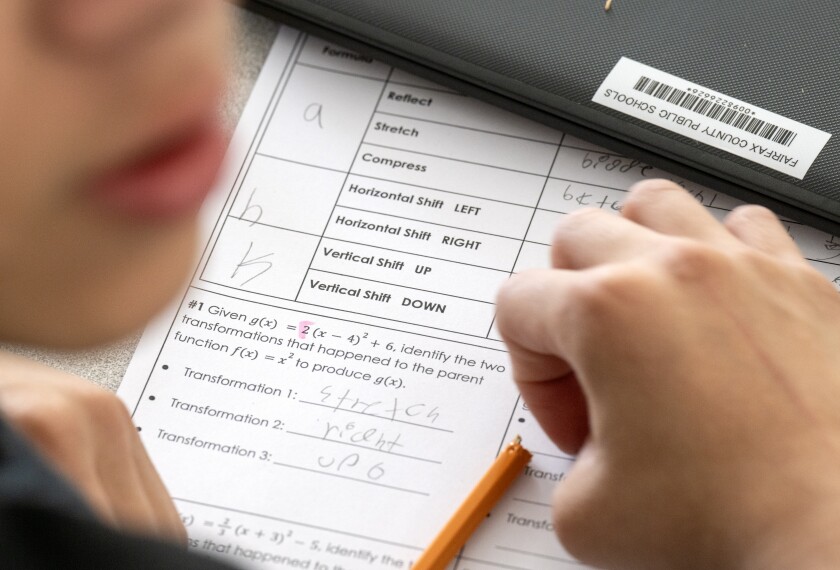
While the project doesn’t offer a specific curriculum, it does help teachers make mathematical principles concrete.
In one example, Mr. Moses tells teachers to organize a trip as a way to teach equations. Students can calculate how many stops on a subway or bus line they must pass before reaching their destination. After each stop, they can figure out how many remain.
The process helps teach the concept of subtraction in a way that prepares the children for higher-level mathematics. Instead of reinforcing the view of subtraction as simply “taking away” one number from another, he explained, the trip helps them see how the function expresses one number’s position compared with another’s.
“It establishes the pattern of one place compared to another place,” Mr. Moses said over tea at a Washington restaurant. “What we’re working toward is a picture that they can carry with them.”
Managed Growth
In his role as the leader of the Algebra Project, Mr. Moses teaches mathematics four days a week at Lanier High School in Jackson, Miss. Over the past five years, he’s created enough curriculum materials to cover algebra, geometry, and the rest of the content covered in the first two years of college-preparatory math.
He remains committed to his program, but he doesn’t want the Algebra Project to grow too quickly. He’d rather see it grow and improve in the communities where it already operates and provide a model for others to follow.
“I don’t think it’s important that we grow big,” he said. “I do think it’s important that we grow strong and be able to say: ‘If you haven’t been able to do this, come look at us.’”