The type of child care used by families and the number of hours young children are in care varies tremendously across the states, according to research the Urban Institute is releasing this week.
For More Information |
| The three Urban Institute reports are available online at www.urban.org. |
Presented as three distinct reports, the study by the Washington-based research organization confirms that, more than ever before, parents are relying on others to help care for their preschool-age children. Nationally, the research found that 76 percent of children under 5 with mothers in the workforce are regularly cared for by someone other than their parents.
Of those pre-schoolers with employed mothers, 32 percent spend time in child-care centers. Another 24 percent are cared for by one of their parents, 23 percent are cared for by a relative, approximately 16 percent are in family child-care homes, and 6 percent are cared for by nannies or babysitters.
But the reports, part of a project by the institute called Assessing the New Federalism, demonstrate that national statistics don’t tell the whole story.
All Care Is Local
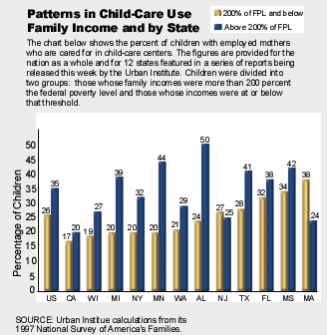
An in-depth look at 12 states shows, for example, that close to 40 percent of preschoolers with employed mothers are in center-based care in Alabama, Minnesota, and Mississippi. But in California, only 19 percent of such children regularly attend child-care centers.
The use of family child-care—which refers to care given in the providers’ homes, generally for children not related to them—ranges from a low of 10 percent of the total children with employed mothers in Massachusetts to a high of 20 percent in Wisconsin. Meanwhile, the proportion of Mississippi children cared for by relatives—32 percent—is more than twice what it is in Minnesota, with 13 percent.
“We’ve always said child care is local, but we’ve never had data that would allow us to explore this,” said Gina Adams, a senior research associate in the institute’s population-studies center. “National patterns do often hold true, but you can’t presume that the national finding is necessarily going to hold true in each state.”
Income Makes a Difference
The data on child care were drawn from the Urban Institute’s National Survey of America’s Families, which was conducted in 1997 and involved 44,000 households. The survey, which included a high percentage of low-income families, “draws a picture of where we were at the beginning” of the implementation of the 1996 federal welfare-reform law, Ms. Adams said.
In addition to state-level differences, the reports show significant variation in the type of care used by low-income and higher-income families.
Nationally, low-income children are less likely to be in child-care centers than wealthier children—26 percent of children in such care, compared with 35 percent. Those from poorer families, on the other hand, are more likely to be cared for by relatives than those from higher-income families—28 percent, compared with 20 percent.
But even more differences show up between states. New York, for example, has the highest rate of low-income children in family child-care homes, with 17 percent. Washington state, with 7 percent, has the lowest rate.
The researchers also found that the amount of time children spend in care also varies with income. For example, nearly half of low-income children in Florida and Mississippi with employed mothers are in full-time care—defined as 35 hours a week or more. But in California, Michigan, and Minnesota, only about one-third of such low-income children spend that much time in care.
The researchers say factors like the supply of child care, cultural preferences, and parental work schedules could be influencing such differences.
Looking for Answers
Later this year, the institute will release reports on school-age care and on family spending on child care. The initial findings on patterns of care will also be updated with 1999 survey results to show changes over time.
The three reports note that:
- On average, infants and toddlers are more likely to be cared for by relatives or parents, while older preschoolers are more likely to be in center-based arrangements. But in Minnesota and Michigan, for example, more than one-fourth of infants and toddlers with mothers in the workforce are in centers, compared with just 9 percent in California.
- On average, infants and toddlers are more likely to be cared for by relatives or parents, while older preschoolers are more likely to be in center-based arrangements. But in Minnesota and Michigan, for example, more than one-fourth of infants and toddlers with mothers in the workforce are in centers, compared with just 9 percent in California.
- Older preschoolers spend more time in care than infants and toddlers; 72 percent of 3- and 4-year-olds are in care for at least 15 hours a week, compared with 62 percent of infants and toddlers.
Though it’s often said that poor children are more likely to be in multiple child-care settings during the week, the study found that 37 percent of low-income children spend time in more than one arrangement, compared with 40 percent of higher-income children.


