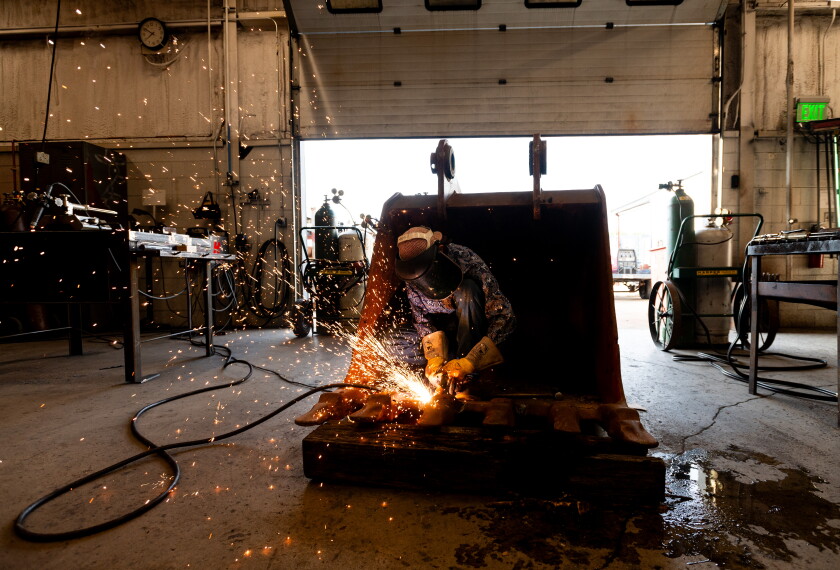
By the year 2030, the United States could face a deficit of 2 million-plus skilled trades professionals, according to the U.S. Department of Education. Enrollment in K-12 CTE programs that prepare students for careers in the skilled trades is rising, but not fast enough to close the gap, experts say.
Several factors prevent teens from choosing a pathway that would lead to a profession in the skilled trades. Most high school students continue to head to college immediately after graduation, despite rising college-tuition costs, a tight labor market awaiting them at graduation, and the high demand for skilled trades professionals. Continued social stigma and a lack of parental support keep some teens who might otherwise excel at the skilled trades from exploring them.
Districts’ traditional efforts to pique students’ interest in the skilled trades may miss the mark. A career fair representative or guest speaker from the skilled trades, many as old or older than teens’ parents, won’t necessarily inspire their young audience. But meeting teens where they “live”—online—may.
“One of the things we hear a lot is that students need more and earlier exposure to a wide variety of career opportunities so that they can make informed decisions about pathways,” said Alisha Hyslop, the chief policy, research, and content officer at the Association for Career and Technical Education. “So I certainly think social media is one of those avenues that can’t be overlooked in this conversation, given the way information is shared today.”
Meeting teens where they ‘live’
Teens spend a significant amount of time on social media—close to five hours a day, on average. While scrolling online, they’re more likely than ever to see posts from skilled trades “influencers” documenting their work lives.
Lexis Czumak-Abreu, a 27-year-old premed student-turned electrician in Cornwall, N.Y., has been posting videos from her job sites for four years. Thousands of her 2 million-plus followers credit her content with sparking their interest in trade work, Czumak-Abreu told The Wall Street Journal.
Similarly, Tyler Drew, a barber who documents his work online from Sacramento, Calif., has amassed 262,000 followers on Instagram. He stood at No. 8 of the top 40 skilled trades’ Instagram influencers of 2026.
Drew and Czumak-Abreu represent a growing number of skilled trades professionals who actively share their work lives with an audience that appears eager to learn what they do for a living.
Social media’s influence on skilled trades professions
Data suggest that social media is effective in influencing the career direction of young skilled trades professionals. In a 2024 global survey of 820 young skilled professionals from 69 countries, 44% of respondents said that social media influenced their career choice. DeWalt, a power tool company, and WorldSkills International, a global advocacy organization for the skilled trades, conducted the survey.
In the “Future of the Skilled Trades Report,” which surveyed 1,000 U.S. Gen Z’ers (ages 16-26) in July 2024, 67% of respondents agreed that social media influenced their professional interests. Notably, 55% of Gen Zers surveyed reported considering a skilled trades career.
“Social media is a powerful force shaping how young people think about their future. A single video of someone welding, wiring a building, or restoring an engine can shift perceptions because it shows the work as it really is—skilled, creative, and satisfying,” said David Hoey, the CEO of WorldSkills International.
Given this reach, online platforms will likely generate continued interest in the skilled trades among teens—that is, if skilled tradespeople continue to document their work lives online. That’s likely: Three-quarters of the participants in the 2024 WorldSkills competition said they were likely to use online platforms to raise awareness of their professions.
The CTE association’s Hyslop cautions that students need access to information about potential careers beyond what they see on social media.
“It’s not enough just to get students interested in a career,” she said. “That’s a great first step. But then we have to show them things like: What pathway do you need to take? Is it an apprenticeship? Is it an industry certification? And is it a postsecondary associate degree, or even a bachelor’s degree in some cases, or higher, depending on the career. All of those questions are ones that we as educators want to be ready for.”