Some special education practitioners have experimented with using generative artificial intelligence to speed up the mountain of paperwork they’re required to fill out to provide essential services to students with disabilities.
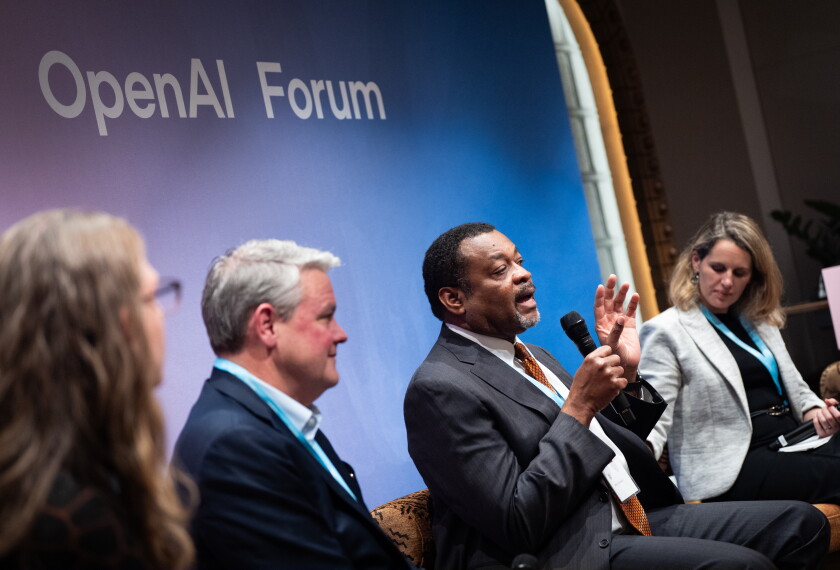
But using AI to improve instruction for students with disabilities or learning differences is a different challenge, and one that educators should approach with caution, experts said during a June 25 panel discussion at the International Society for Technology in Education conference here.
“There isn’t enough data for us to make a conclusive recommendation at the moment with the use of AI [for students with disabilities],” said Trey Vasquez, the director of the Toni Jennings Exceptional Education Institute and a professor at the University of Central Florida.
Vasquez and his team at the University of Central Florida are focused on researching the efficacy of AI and its impact on people with disabilities.
“We’re trying to answer some basic questions like, what are the right sensors that will produce the right predictions for our AI?” Vasquez said, referring to wearable technology that senses children’s classroom behavior and supplies data that AI can analyze, providing teachers with information on how students, particular those with developmental disabilities, are engaging in class. Teachers can use the information to better support those students and tailor interventions to them.
Most datasets that AI tools are trained on contain a lot of information about native English speakers and neurotypical students, but they don’t have nearly as much to draw from on English learners or students in special education.
That’s why Vasquez’s team members are also looking into how they can integrate evidence-based practices and more than 30 years’ worth of research on students with learning differences into large language models that power generative AI tools.
“All of those [academic research] publications are behind paywalls, and they’re not part of the large language models that you see online,” Vasquez said. “How do we make sure that those data are included in the large language models and provide advantageous outcomes for our students and researchers?”
Still, Vasquez and the other panelists said they were optimistic about the promise of using AI for personalized learning.
Personalization is “a core element of special education,” said Ayan Kishore, the CEO of Benetech, the nonprofit creator of reading platform Bookshare, an online library of accessible ebooks for people with print disabilities, such as dyslexia and visual impairment. Generative AI tools—whether they produce text, video, audio, or images—will make personalization easier, he said.
For instance, a reading specialist could help a student better understand phonics by using AI to generate materials on a topic the student is interested in, or teachers could use AI to adapt materials to each student’s reading level, Kishore said.
AI is more than chatbots that children interact with on computers or tablets, said Jody Britten, the head of research and innovation for nonprofit Team4Tech. For example, she talked about a plush toy that uses an AI-generated voice and helps children develop and practice executive function skills.
“We need to think about all of the AI tools out there, and not just the ‘we’re going to put a kid in front of a screen to learn’ habit,” Britten said.
As schools experiment with these AI tools, they should “bring parents along,” said Jamie Basham, a special education professor at the University of Kansas. “What does that mean? That means having time where parents can kind of come in, explore and learn and maybe be alongside educators, alongside students, so that we’re all learning together.”