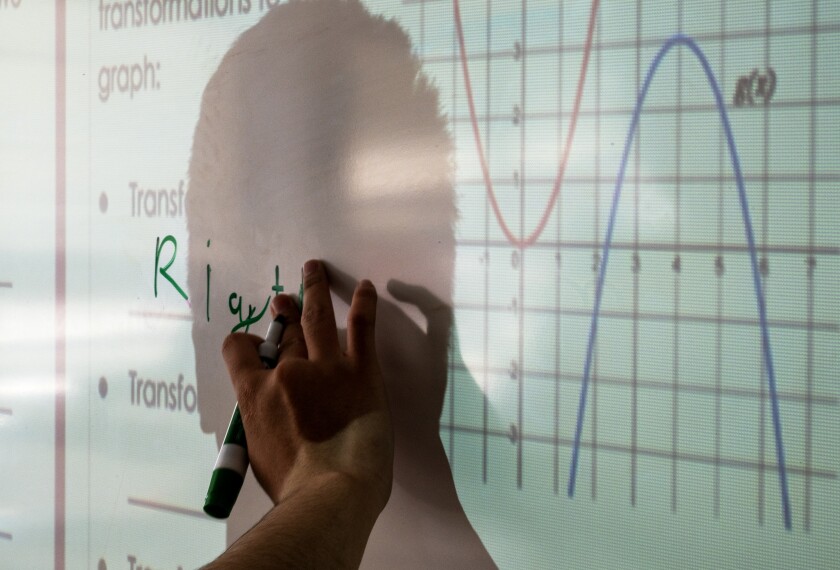
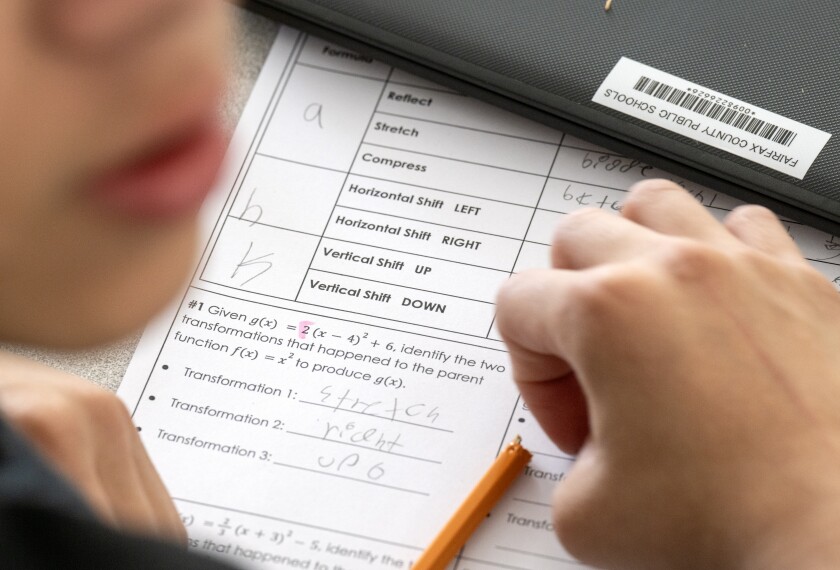
Nearly half of California’s school districts have asked to be exempted this year from a new state regulation that requires high school students to pass an Algebra 1 class to receive a diploma.
The California state board of education has already granted the 5,100-student Santa Cruz City School District a waiver to allow its otherwise-eligible students to graduate this year without completing the yearlong course. District officials asked for the waiver in January after they realized that they had overlooked the requirement.
The state board has signaled that it will grant the remaining requests if districts agree to stipulations from state officials.
Many districts mistakenly believed that the state postponed the algebra provision last summer when it delayed until 2006 statewide exit exams that had been slated to kick in this year, said Rae Belisle, the executive director of the state board.
Although the board postponed the exit exams, the algebra requirement still went into effect for this school year.
“There was some confusion in the field about this requirement and ... rather than deny the diploma to students with that level of confusion in the field, the board allowed this very limited waiver,” Ms. Belisle said of the roughly 200 districts that are seeking waivers.
The waivers come as state Superintendent of Public Instruction Jack O’Connell is lobbying for a 10-year plan to build a more rigorous high school curriculum and require all students to complete the courses needed to enter the state’s four-year colleges, including Algebra 1 and 2 as well as geometry.
Hilary McLean, Mr. O’Connell’s spokeswoman, said he was “reluctantly supportive” of granting the waivers, provided that the districts agree to stipulations from his office and the state board.
To receive a waiver, a district must require its remaining high school seniors who have not passed Algebra 1 to have enrolled in Algebra 1, whether or not they complete the course, and it must notify all students hoping to graduate next year that the course will be a requirement.
About 13,000, or 4 percent, of the state’s high school seniors have not passed the course, according to the state board.
“While 4 percent is bigger than we’d want, it’s definitely a small percentage of the student population,” Ms. McLean said.
‘Errors of Adults’
California has 93 high school districts and 328 K-12 unified districts. The districts that do not receive a waiver must enforce the regulation for this year’s graduating class.
Ms. Belisle said many of those districts already require students to pass Algebra 1 for a diploma, including the 750,000-student Los Angeles Unified district, which is the state’s largest district.
The rule does not exempt any student, including those with disabilities or limited English proficiency, from the algebra course.
Ms. Belisle said other reasons for seeking waivers of the requirement included a mistaken assumption that special education students could be exempted through individualized education plans, and the high mobility rates of some students that resulted in their falling through the cracks in meeting the requirement.
Carl Del Grande, an assistant superintendent in Santa Cruz, said his district found out about the requirement in September, and realized that about 130 of the district’s seniors had not yet taken Algebra 1. Believing that the state had not made enough effort to publicize the requirement when it was adopted in 2001, district officials decided to seek the waiver.
“We were perfectly willing to accept responsibility, but we didn’t want to unfairly deny students their diplomas because of the errors of adults,” Mr. Del Grande said.
Since then, the district has helped some students take algebra courses online or at a community college in less time than the district could offer them, Mr. Del Grande said. He now estimates that fewer than 60 students would not have received diplomas if the waiver had not been granted.
Ms. Belisle said that the state board was unlikely to revoke the algebra requirement in the future, and added that waiver requests after this year would likely be denied.