In his acclaimed Readicide (2009), high school English teacher Kelly Gallagher offered a provocative explanation for young people’s lack of interest in reading: A big part of the problem, he argued, could be traced to the “inane, mind-numbing” ways that reading is taught in many schools. Now, in Write Like This, he turns his attention to writing instruction, which he believes is in a similar state of crisis.
At a time when strong writing skills are a virtual prerequisite to meaningful employment, Gallagher says, writing as subject of study “seems to have gotten lost in many of our schools.” It has been “buried in an avalanche of standards, curricular pacing guides, huge class sizes, worksheets, over-the-top testing, and, yes, even more testing. …" When writing is taught at all, he continues, it is often subject to “prescribed school discourses” that limit students’ potential and fail to capture their imaginations. For Gallagher, it’s no wonder that, by one estimate, 70 percent of students leave high school with inadequate writing skills.
Browse our Teacher Book Club discussion on this book.
So how can teachers bring new life to the proverbial second “R”? Gallagher, a 25-year teaching veteran, argues that writing instruction needs to be reoriented around two interlocking premises. First, teachers should emphasize the “real-world” purposes of writing by giving students assignments that engage their intellects and demonstrate the value of thoughtful composition. Second, they need to provide students with authentic modeling of how this kind of writing is done.
Much of Gallagher’s book consists of detailed descriptions of how he teaches his students to write in six real-world discourses, including “Express and Reflect,” “Evaluate and Judge,” and “Take a Stand/Propose a Solution.” By his account, he generally begins by giving his students a graphing or brainstorming activity to get them familiar with the discourse in question. Then he provides a series of ever-deepening writing prompts designed to show the students how writing in these various modalities can help them express themselves and develop their thoughts in ways that are distinctly pertinent to their interests.

As a reader, it’s hard not to be impressed by the cleverness and variety of Gallagher’s prompts. In the “Express and Reflect” section, he has students writing “reverse poems” on their core beliefs, exploring “watermark events” in their lives, and reflecting on their personality types under Jungian psychology. You get the sense that students could have fun with these assignments—which, of course, is the point.
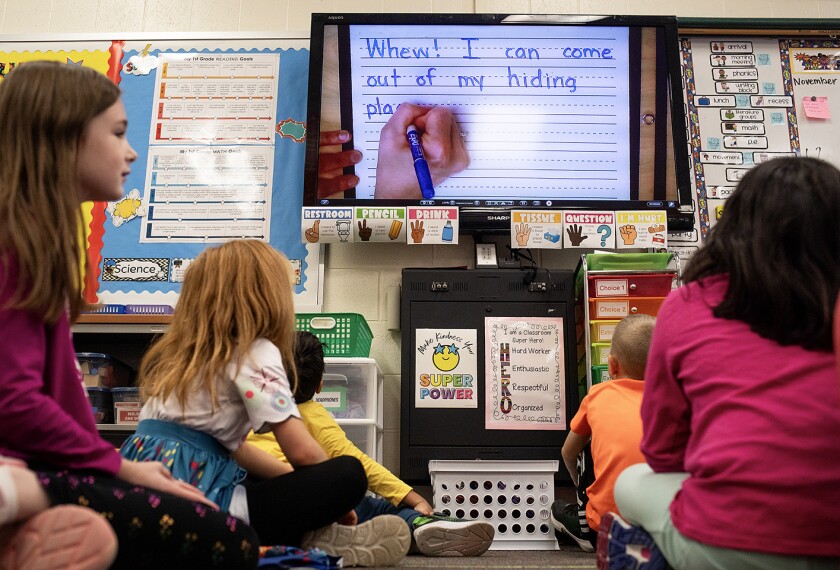
To provide a foundation for the assignments, meanwhile, Gallagher furnishes sample pieces by professional writers that the students are asked to reflect on, pull apart, and even imitate. And perhaps more unusually, he does the writing assignments himself in class, using an overhead projector or document camera to demonstrate his compositional process. Gallagher believes this modeling is a key to improving students’ conceptual grasp. “I am the best writer in the room, and as such, I need to show them how I grapple with this mysterious process we call writing,” he says. “Students must see the process to understand the process.”
If it sounds like Gallagher has a certain missionary zeal about writing instruction, that’s because he believes that, as an English teacher, he plays an important societal role. At several points, he emphasizes the value of writing development as a counterforce to a rampant consumer culture that devalues reflection and critical thinking. Teachers have an obligation, he suggests, to help students understand and harness the power of verbal expression.
That may mean sacrificing some state standards or diverting from prescribed curricula, Gallagher notes. “If my students grow into adults who cannot write,” he asks, “will it really matter that they had good scores on a state test they took when they were thirteen years old?”