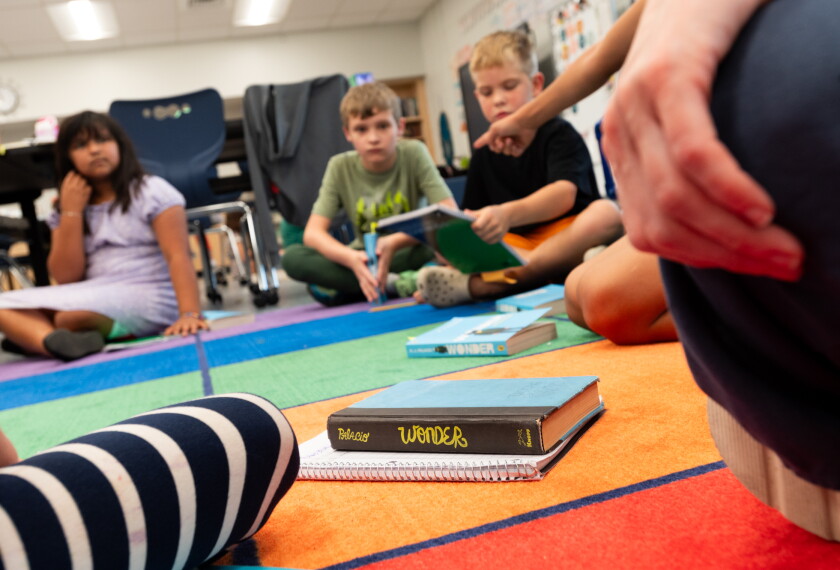
Too many boys think reading for fun isn’t “cool.”
This isn’t breaking news. Global studies from the mid-2000s found boys are less likely to read for pleasure than girls, a trend that continues today. But it matters, a lot.
Experts point to a direct correlation between reluctant readers and lower reading proficiency. And the abysmal reading scores on the 2024 National Assessment of Educational Progress, released this week, show a dire need to improve reading proficiency among all students—especially boys.

The NAEP results were poor overall: Just 31 percent of 4th graders performed at or above the “proficient” level on the reading assessment; 26 percent of all 8th graders scored proficient. But boys’ average reading scores were lower than girls’, as they were in 2022, and they fell further than girls’ scores from 2022. Notably, NAEP findings also concluded that lower-performing students reported feeling less confident in their reading skills.
It’s not surprising that students who lack confidence in their reading ability would avoid reading for fun—and, conversely, that reading more regularly leads to mastery. The 2022 NAEP results showed that 73 percent of high-performing 9-year-olds reported reading for fun either almost every day or once or twice a week, compared with 58 percent of their low-performing peers.
In response to the nation’s persistently poor reading report cards, a growing number of states in recent years have introduced sweeping legislation to mandate that schools implement evidence-based reading instruction in their classrooms. But overall, students’ reading test scores have yet to show significant improvement, and the number of “reluctant readers” grows.
Now, some educators are bearing down on a strategy they hope will create better, and lifelong, readers: pleasure reading. Here’s a look at how four teachers across grade levels are piquing boys’ interest in reading for fun.
Hook them early
David Buskirk is on a mission to get his young students to become literate—and hooked on reading. For him, it’s personal.
“I know education could really, really change the lives of children coming from poverty. I know because I grew up receiving a reduced-priced lunch,” said Buskirk, a kindergarten teacher at Beall Elementary School in Frostburg, Md., and the 2024-25 Allegany County teacher of the year.
He feels a particularly strong responsibility to introduce his male students to the joy of reading.
“Boys, especially from lower-income families, they just don’t have that role model of males who are reading at home, who are interested in academics,” he said.

In his classroom, the 15-year veteran educator focuses not just on early literacy skills but on gripping storytelling. Buskirk chooses a lot of fairy tales and folk tales to read to his students during class time.
“The kids, they really like it,” he said of the classic tales that he calls “kind of creepy.”
His efforts appear to be paying off. In any given year, the majority of students enter Buskirk’s kindergarten below where they should be on reading readiness,and, by the end of the year, they’re testing well above average, based on standardized literacy-assessment tools, said Buskirk.
Make it a group activity
When Susan Grover, now the principal of Symonds Elementary in Keene, N.H., was a 4th grade teacher, a male student, whom she referred to as a “reluctant reader,” refused to pick up a book for pleasure reading. The moment was a turning point for Grover.
“Whatever I was doing wasn’t inspiring him,” she said. “So I decided to change the way I was approaching reading with my class.”
She turned reading for pleasure into a book club format, providing students with choices from a wide sampling of books.
“You’re reading books because you want to and you’re reading them with other students in your class,” Grover said of the tactic which, according to her, helped “immensely” in getting that once-reluctant reader interested in reading for fun.
Model a reading culture
Henry Melcher, the head of the middle school at Boys’ Latin, an all-boys K-12 private school in Baltimore, said his staff has created numerous opportunities for students to read for pleasure throughout the school day—all of which involve an educator sharing in the activity.
Reading for pleasure is embedded into the school schedule: two 20-minute periods per seven-day cycle. During these periods, all the adults in the room are reading, too.
“It’s incredibly important that we’re modeling what we want to see from kids,” Melcher said.

To further motivate the students to read, gradewide incentives are built in for those who read the most pages, with prizes ranging from footballs autographed by professional players to pizza lunches. For boys who want to read even more, the middle school offers additional opportunities.
One is called Whatcha Reading?, a low-key periodic occurrence during the school day that students sign up for in advance, Melcher said. On the designated day, the boys bring whatever book they’re reading into the library during lunch, eat pizza, and discuss their book with their classmates and participating teachers and coaches. The educators talk about their own books, too.
“The straightforward, low-lift activity sends the message to boys that ‘it’s normal to read, it’s cool to read,’” Melcher said.
Offer choice and make reading material accessible
Joseph Rodriguez was determined to create a different reading environment for his students than the one he experienced in high school.
“In high school, I had to read my teachers’ favorite books, and that tormented me,” said Rodriguez, a language arts teacher at Akins Early College High School in Austin, Texas, and a teaching fellow at the National Book Foundation.
“Most of my English teachers in high school were white middle- and upper-class women, and I had absolutely no relationship with their favorite characters,” he said, adding, “I believe that I can connect with readers who are boys in ways that maybe some of their teachers haven’t in the past.”
While Rodriguez does assign his nearly 180 students specific reading tasks, he makes sure they include a diverse array of material—from analytical and science-based essays to classic works like Geoffrey Chaucer’s The Pardoner’s Tale. He also makes sure his students know where they can access reading material for pleasure.
“I have a classroom library. We have a school library, and then we also have an online digital library from our school library, and we also have a public library, and down the street is a little free library,” Rodriguez said.
Allocate class time for pleasure reading
Rodriguez’s students need options for finding reading material, as every 90-minute language arts period consists of 20 to 30 minutes of independent-choice reading—an embedded part of the curriculum used by all teachers in the high school’s language arts department.
It’s important, Rodriguez said, to let students have time to read (or listen to) what they choose—whether it’s a graphic novel, how-to article, or audiobook.
Rodriguez takes seriously the responsibility of ensuring that his students are readers: “It’s a way to understand the world around us—one that keeps changing so quickly.”