

The statistics on pleasure reading among children and teens are sobering.
Just 34% of 8- to 12-year-olds and 21% of teens read daily for pleasure, according to a 2021 nationally representative report by Common Sense Media. That includes print and e-books, as well as news and magazine articles.
Watching online videos and using social media pose stiff competition. Most teens engage in both daily, and the majority of kids ages 8 to 12 report watching online videos every day.
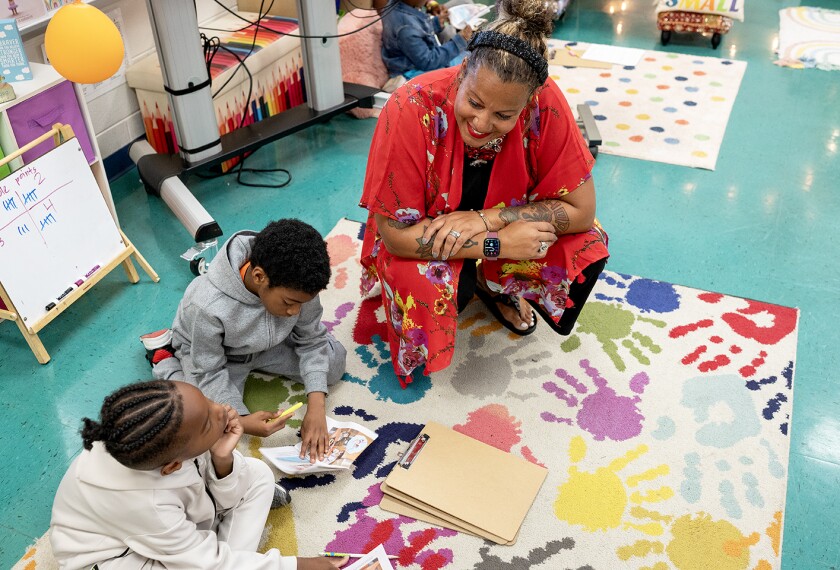
Teachers can’t oversee students’ media usage outside the classroom. But they can make concerted efforts to ensure that students get the opportunity to read for pleasure on a routine basis.
Here are five proven strategies to encourage students to read for fun.:

1. Protect independent reading time during instructional periods
Most teachers agree that this strategy is a no-brainer. Implementing it is another matter.
In a recent global report by the International Literacy Association that surveyed 1,443 K-12 literacy educators, the majority of respondents agreed that students should read independently for at least 20 minutes a day. But only 33% said they’re able to allot that amount of time in class, largely due to instructional constraints.
An earlier study found similar results. Scholastic in 2017 surveyed nearly 3,700 preK-12 educators and more than 1,000 principals on independent reading practices in school. Ninety-four percent of respondents agreed that independent choice reading should happen daily in school, but only 36% of teachers reported making time for it. Nearly a quarter of educators said they never did.
Teachers who do routinely set aside time for daily independent reading say they often have to get creative in order to protect it, sometimes squeezing it in during transitions, or between other aspects of literacy instruction. Those who make the effort say it’s worth it.
“We know kids have to have that independent reading time to be able to fall in love with books and be able to explore new content, new authors, new things, and really get lost in their stories,” said Eileen McGaughey, an educational technology specialist and former 4th grade teacher at R.M. Captain Elementary School in Clayton, Mo.

2. Prioritize read-alouds
Listening to an expert reader tell compelling stories using a lively voice is one of the most effective ways to enrich an emerging reader’s literacy skills.
“I would argue that, of all components [of reading], read-alouds have one of the longest-standing research bases. There’s a lot of data showing the power of read-alouds,” Molly Ness, a former teacher, reading researcher, and founder of the educational consulting firm Dirigo Literacy, told Education Week in 2024.
In addition to increasing students’ vocabulary and background knowledge, read-alouds also help boost comprehension and make students more likely to want to read, explained Ness, who refers to these positive effects as “an upward spiral of a literary trajectory.”

As with independent reading time, teachers may struggle to fit read-alouds into their instructional periods, especially in older grade levels.
Notably, the majority (62%) of 1,029 early educators and administrators who work with children in pre-K through 3rd grade who responded to an EdWeek Research Center survey in January said they or the teachers they work with do read-alouds for 15 to 30 minutes a day.
Fifteen percent reported reading aloud to students between 30 and 60 minutes daily, and another 19% practice this daily ritual for less than 15 minutes each day.
But recognizing how beneficial this practice is for students of all ages may encourage more teachers to make room for routine read-alouds, and for administrators to support it.

3. Start a student book club
This is a popular idea among literacy teachers that, again, may require some creative planning to schedule. But those who’ve successfully launched book clubs laude their success. Christina Torres, an 8th grade English teacher, shared how she piloted a book club with her students in a 2020 essay.
Torres started by giving her students the choice of five pre-selected books, each of which met curriculum goals. Then she assigned students who chose the same book to small groups, and provided the groups opportunities to discuss the books.
Torres said that the discussions were “loud, full of laughter, and a little chaotic—everything I hoped I would see as they shared the experience of reading a good book together.”

4. Host reading competitions
Some students need a push to start reading for pleasure. Group-oriented competitions can provide that motivation, say teachers. In a 2024 EdWeek Research Center survey of 600-plus K-12 teachers, more than 80% agreed that competition motivated their students to some degree.
Henry Melcher, head of the middle school at Boys’ Latin School of Maryland, an all-boys private school in Baltimore, told EdWeek in 2025 that his faculty has found group competition effective at motivating students for many reasons—including getting them to read more for pleasure.
Melcher said teachers focus on group rather than individual competitions to avoid singling out students. Group competitions help build camaraderie within teams—usually, advisories of 10 or so students.
“It’s not how many [incentives] one student can accrue,” Melcher said. “It’s by student advisory, so each member of advisory is playing a role.”

5. Promote audiobooks as a viable option
Audiobooks have long been seen as a “lesser” activity to reading written words; some even consider it cheating. But that’s changing, as a growing number of educators start to see audiobooks as an accessible way to get students to engage in books—for school or for fun.
This shift in attitude likely is welcome news to many students—such as those who struggle to read fluently; those who may be daunted by long, complex texts; and those who are strapped for time and may be more likely to listen rather than read a book on a commute to school or extracurricular activities.

Joel Garza, a 9th grade English teacher in Addison, Texas, long resisted assigning audiobooks as an option for his students. Two years ago, he changed his mind, deciding that it was more important to expose his students to classics in a format they were likely to consume than not at all.
He now assigns an audio adaptation of The Odyssey by Poet Laureate Simon Armitage. “The audiobook was not an option. It was required. Nobody had a book in their hand,” Garza told Education Week in 2024. “The students really enjoyed it.”
Teachers reluctant to turn to audiobooks may be persuaded by the results of a recent study published in the Journal of Neuroscience, in which researchers, using advanced imaging techniques, found that listening to and reading words stimulated the same cognitive and emotional areas of the brain.
Images by Vanessa Solis/Education Week + Getty


