States

What Happens to Students Who Join the Military? A New Effort Aims to Find Out

Effort will address a longstanding education data gap about which students go into the armed forces
By Evie Blad — March 18, 2026 3 min read
New military recruits take the Oath of Office during a swearing in ceremony at a Salute to Service event at an NFL football game between the Jacksonville Jaguars and the Minnesota Vikings, Sunday, Nov. 10, 2024, in Jacksonville.
  • Save to favorites
  • Print

As states seek to align their education and workforce strategies, they lack data on students who move on to serve in the military—creating a big gap in their ability to measure the academic paths that lead to success after high school graduation.

Arkansas, Kansas, Ohio, Tennessee, and Washington state hope to change that by piloting a new data-sharing agreement with the U.S. Department of Defense that will allow them to securely access data on which students enlist, which branches they choose, and how long they serve, announced the Council of Chief State School Officers, which will lead the effort. After a year, the cohort hopes to use feedback from the pilots to refine the agreements and expand to additional states.

Sixteen states try to include military enlistment data in their school accountability models, according to the Data Quality Campaign, an organization that advocates for longitudinal data systems. And at least 33 states track postsecondary data.

The effort, which launches in the fall, aims to address an issue that has vexed state and district education leaders. Different branches of the military have no clear, uniform process for states to access enlistment data, forcing many states to go without it, said Dean Folkers, senior director of education data and technology for CCSSO. About 70,000 people enlist in the armed forces every year, and about half are recent high school graduates.

“For a lot of years, states have relied on what we would characterize as inconsistent data,” Folkers said. “They had to rely on post-school surveys that they would send out and get a small percentage back. Those post-school outcomes are an incredibly important accountability metric for states.”

States lack access to data on students’ military service

The gap comes as states seek to improve longitudinal data systems, which track students’ data points over time related to academic participation, achievement, and postsecondary pathways.

Analyses of that data allow insights into what grades, courses, and other choices are linked with enrollment in higher education, being hired for full-time jobs, and enlisting in the military. And it is crucial as schools grapple with disruption created by artificial intelligence and changing workforce needs, state leaders say.
See Also

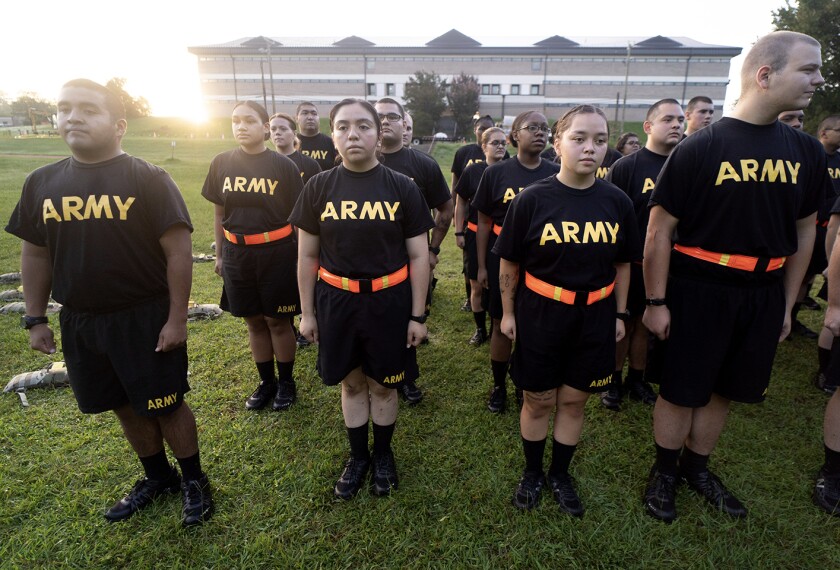
Students in the new Army prep course stand at attention after physical training exercises at Fort Jackson in Columbia, S.C., on Aug. 27, 2022. The new program prepares recruits for the demands of basic training.
Students in the new Army prep course stand at attention after physical training exercises at Fort Jackson in Columbia, S.C., on Aug. 27, 2022. State education leaders are working with the Pentagon to make graduates' enlistment data part of their data systems.
Sean Rayford/AP

But without a clear, consistent way to track that information, schools have opted not to report it or taken on the time-consuming task of verifying military services with graduates one-by-one.

“Let us be clear, our priority is to ensure that all high school graduates in our states are ready for college and career success,” 29 state education chiefs wrote in a 2023 letter to the Pentagon. “When students decide to pursue a career in the military, we hope that—and would like to know if—they are succeeding in that career choice. Our efforts as a state education system are only improved when we know how our students are doing.”

Five states will share data with the Pentagon

The new pilot agreements in the five states result from an effort called Military Enlistment Data Access to Lift Student Success, or MEDALS. Launched by CCSSO in 2024, MEDALS brought together a coalition of state education leaders, data experts, and Pentagon officials to explore ways to cut through the red tape.

The participating states will securely share military enlistment and persistence data with the Defense Department, but will not share it with other states or third parties, Folkers said. To get to this point, the working group had to identify an agreement that would address state and federal laws and protect data privacy. They also had to identify a technical process for states to access that data.

See Also

Photo of young female aircraft engineer apprentice at work.
E+
States Are States Equipped to Track Students’ Paths From Classroom to Career?
Evie Blad, November 18, 2025
4 min read

The Defense Department, known as the Department of War by President Donald Trump’s administration, “is pleased to partner with CCSSO to increase American students’ awareness of exciting military career options and to help them prepare to meet the Department’s high standards,” said Tim Dill, the agency’s assistant secretary for manpower and reserve affairs.

Using lessons learned from the pilot states, the MEDALS group will refine agreement language and the process for accessing data before expanding the effort.

The MEDALS working group expects to offer data-sharing agreements to additional states in the 2026-2027 academic year. Leaders are still working to determine how many will be included in the next cohort, Folkers said.

Events

This content is provided by our sponsor. It is not written by and does not necessarily reflect the views of Education Week's editorial staff.
Sponsor
Artificial Intelligence Webinar
Managing AI in Schools: Practical Strategies for Districts
How should districts govern AI in schools? Learn practical strategies for policies, safety, transparency, and responsible adoption.
Content provided by Lightspeed Systems
This content is provided by our sponsor. It is not written by and does not necessarily reflect the views of Education Week's editorial staff.
Sponsor
Student Absenteeism Webinar
Removing Transportation and Attendance Barriers for Homeless Youth
Join us to see how districts around the country are supporting vulnerable students, including those covered under the McKinney–Vento Act.
Content provided by HopSkipDrive
This content is provided by our sponsor. It is not written by and does not necessarily reflect the views of Education Week's editorial staff.
Sponsor
Reading & Literacy Webinar
Two Jobs, One Classroom: Strengthening Decoding While Teaching Grade-Level Text
Discover practical, research-informed practices that drive real reading growth without sacrificing grade-level learning.
Content provided by EPS Learning

EdWeek Top School Jobs

Teacher Jobs
Search over ten thousand teaching jobs nationwide — elementary, middle, high school and more.
View Jobs
Principal Jobs
Find hundreds of jobs for principals, assistant principals, and other school leadership roles.
View Jobs
Administrator Jobs
Over a thousand district-level jobs: superintendents, directors, more.
View Jobs
Support Staff Jobs
Search thousands of jobs, from paraprofessionals to counselors and more.
View Jobs

Read Next

States States Are Banning Book Bans. Will It Work?
Approved legislation aims to stop school libraries from removing books for partisan reasons.
5 min read
Amanda Darrow, director of youth, family and education programs at the Utah Pride Center, poses with books that have been the subject of complaints from parents in Salt Lake City on Dec. 16, 2021. The wave of attempted book banning and restrictions continues to intensify, the American Library Association reported Friday. Numbers for 2022 already approach last year's totals, which were the highest in decades.
Eight states have passed legislation restricting school officials from pulling books out of school libraries for partisan or ideological reasons. In the past five years, many such challenges have focused on books about race or LGBTQ+ people. Amanda Darrow, the director of youth, family and education programs at the Utah Pride Center, poses with books that have been the subject of complaints from parents in Salt Lake City on Dec. 16, 2021. (Utah is not one of the eight states.)
Rick Bowmer/AP
States McMahon Touts Funding Flexibility for Iowa That Falls Short of Trump Admin. Goal
The Ed. Dept. is allowing the state education agency to consolidate small sets of funds from four grants.
6 min read
U.S. Secretary of Education Linda McMahon is interviewed by Indiana’s Secretary of Education Katie Jenner during the 2025 Reagan Institute Summit on Education in Washington, D.C., on Sept. 18, 2025.
U.S. Secretary of Education Linda McMahon, pictured here in Washington on Sept. 18, 2025, has granted Iowa a partial waiver from provisions of the Every Student Succeeds Act, saying the move is a step toward the Trump administration's goal of "returning education to the states." The waiver allows Iowa some additional flexibility in how it spends the limited portion of federal education funds used by the state department of education.
Leah Millis for Education Week
States Zohran Mamdani Picks Manhattan Superintendent as NYC Schools Chancellor
Kamar Samuels is a veteran educator of the nation's largest school system.
Cayla Bamberger & Chris Sommerfeldt, New York Daily News
2 min read
Zohran Mamdani speaks during a victory speech at a mayoral election night watch party on Nov. 4, 2025, in New York.
Zohran Mamdani speaks during a victory speech at a mayoral election night watch party on Nov. 4, 2025, in New York. The new mayor named a former teacher and principal and current superintendent as chancellor of the city’s public schools.
Yuki Iwamura/AP
States Undocumented Students Still Have a Right to Education. Will That Change in 2026?
State-level challenges to a landmark 1982 Supreme Court ruling are on the rise.
5 min read
Demonstrators hold up signs protesting an immigration bill as it is discussed in the Senate chamber at the state Capitol Thursday in Nashville, Tenn. The bill would allow public school systems in Tennessee to require K-12 students without legal status in the country to pay tuition or face denial of enrollment, which is a challenge to the federal law requiring all children be provided a free public education regardless of legal immigration status.
Demonstrators hold up signs protesting an immigration bill as it was discussed in the Senate chamber at the state Capitol in Nashville, Tenn., on April 10, 2025. The bill, which legislators paused, would have allowed schools in the state to require undocumented students to pay tuition. It was one of six efforts taken by states in 2025 to limit undocumented students' access to free, public education.
John Amis/AP
