States

What Happens to Students Who Join the Military? A New Effort Aims to Find Out

Effort will address a longstanding education data gap about which students go into the armed forces
By Evie Blad — March 18, 2026 3 min read
New military recruits take the Oath of Office during a swearing in ceremony at a Salute to Service event at an NFL football game between the Jacksonville Jaguars and the Minnesota Vikings, Sunday, Nov. 10, 2024, in Jacksonville.
  • Save to favorites
  • Print

As states seek to align their education and workforce strategies, they lack data on students who move on to serve in the military—creating a big gap in their ability to measure the academic paths that lead to success after high school graduation.

Arkansas, Kansas, Ohio, Tennessee, and Washington state hope to change that by piloting a new data-sharing agreement with the U.S. Department of Defense that will allow them to securely access data on which students enlist, which branches they choose, and how long they serve, announced the Council of Chief State School Officers, which will lead the effort. After a year, the cohort hopes to use feedback from the pilots to refine the agreements and expand to additional states.

Sixteen states try to include military enlistment data in their school accountability models, according to the Data Quality Campaign, an organization that advocates for longitudinal data systems. And at least 33 states track postsecondary data.

The effort, which launches in the fall, aims to address an issue that has vexed state and district education leaders. Different branches of the military have no clear, uniform process for states to access enlistment data, forcing many states to go without it, said Dean Folkers, senior director of education data and technology for CCSSO. About 70,000 people enlist in the armed forces every year, and about half are recent high school graduates.

“For a lot of years, states have relied on what we would characterize as inconsistent data,” Folkers said. “They had to rely on post-school surveys that they would send out and get a small percentage back. Those post-school outcomes are an incredibly important accountability metric for states.”

States lack access to data on students’ military service

The gap comes as states seek to improve longitudinal data systems, which track students’ data points over time related to academic participation, achievement, and postsecondary pathways.

Analyses of that data allow insights into what grades, courses, and other choices are linked with enrollment in higher education, being hired for full-time jobs, and enlisting in the military. And it is crucial as schools grapple with disruption created by artificial intelligence and changing workforce needs, state leaders say.
See Also

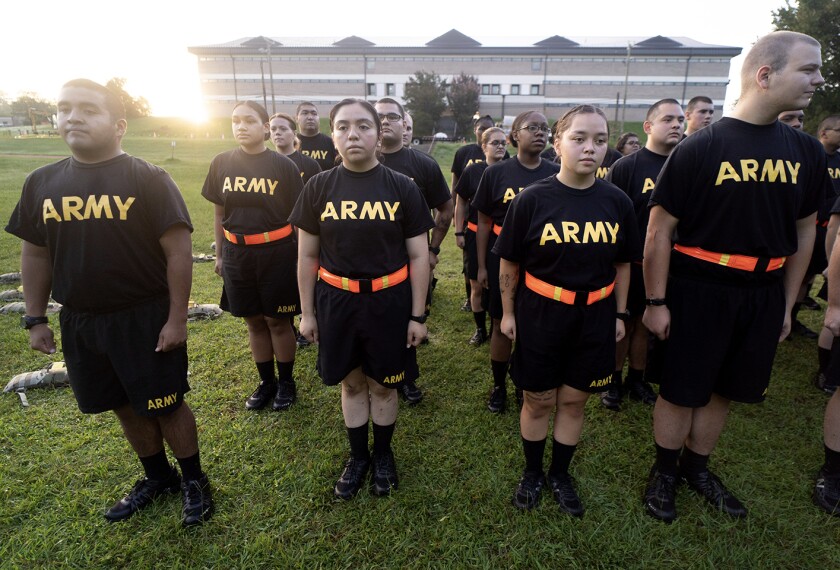
Students in the new Army prep course stand at attention after physical training exercises at Fort Jackson in Columbia, S.C., on Aug. 27, 2022. The new program prepares recruits for the demands of basic training.
Students in the new Army prep course stand at attention after physical training exercises at Fort Jackson in Columbia, S.C., on Aug. 27, 2022. State education leaders are working with the Pentagon to make graduates' enlistment data part of their data systems.
Sean Rayford/AP

But without a clear, consistent way to track that information, schools have opted not to report it or taken on the time-consuming task of verifying military services with graduates one-by-one.

“Let us be clear, our priority is to ensure that all high school graduates in our states are ready for college and career success,” 29 state education chiefs wrote in a 2023 letter to the Pentagon. “When students decide to pursue a career in the military, we hope that—and would like to know if—they are succeeding in that career choice. Our efforts as a state education system are only improved when we know how our students are doing.”

Five states will share data with the Pentagon

The new pilot agreements in the five states result from an effort called Military Enlistment Data Access to Lift Student Success, or MEDALS. Launched by CCSSO in 2024, MEDALS brought together a coalition of state education leaders, data experts, and Pentagon officials to explore ways to cut through the red tape.

The participating states will securely share military enlistment and persistence data with the Defense Department, but will not share it with other states or third parties, Folkers said. To get to this point, the working group had to identify an agreement that would address state and federal laws and protect data privacy. They also had to identify a technical process for states to access that data.

See Also

Photo of young female aircraft engineer apprentice at work.
E+
States Are States Equipped to Track Students’ Paths From Classroom to Career?
Evie Blad, November 18, 2025
4 min read

The Defense Department, known as the Department of War by President Donald Trump’s administration, “is pleased to partner with CCSSO to increase American students’ awareness of exciting military career options and to help them prepare to meet the Department’s high standards,” said Tim Dill, the agency’s assistant secretary for manpower and reserve affairs.

Using lessons learned from the pilot states, the MEDALS group will refine agreement language and the process for accessing data before expanding the effort.

The MEDALS working group expects to offer data-sharing agreements to additional states in the 2026-2027 academic year. Leaders are still working to determine how many will be included in the next cohort, Folkers said.

Events

This content is provided by our sponsor. It is not written by and does not necessarily reflect the views of Education Week's editorial staff.
Sponsor
Reading & Literacy Webinar
Unlocking Success for Struggling Adolescent Readers
The Science of Reading transformed K-3 literacy. Now it's time to extend that focus to students in grades 6 through 12.
Content provided by STARI
Jobs Virtual Career Fair for Teachers and K-12 Staff
Find teaching jobs and K-12 education jubs at the EdWeek Top School Jobs virtual career fair.
This content is provided by our sponsor. It is not written by and does not necessarily reflect the views of Education Week's editorial staff.
Sponsor
College & Workforce Readiness Webinar
Portrait of a Learner: From Vision to Districtwide Practice
Learn how one district turned Portrait of a Learner into an aligned, systemwide practice that sticks.
Content provided by Otus

EdWeek Top School Jobs

Teacher Jobs
Search over ten thousand teaching jobs nationwide — elementary, middle, high school and more.
View Jobs
Principal Jobs
Find hundreds of jobs for principals, assistant principals, and other school leadership roles.
View Jobs
Administrator Jobs
Over a thousand district-level jobs: superintendents, directors, more.
View Jobs
Support Staff Jobs
Search thousands of jobs, from paraprofessionals to counselors and more.
View Jobs

Read Next

States 'Success Sequence' Urges Marriage, Then Parenthood. These States Want Schools to Teach It
The decades-old concept is getting new attention, largely from Republican lawmakers.
6 min read
Illustration of a child with a backpack looking at game pieces and board from THE GAME OF LIFE.
Laura Baker/Education Week + iStock
States A State Gets Closer to Challenging Undocumented Students' Free Access to School
Lawmakers are debating legislation that would require schools to collect immigration information.
4 min read
Bryan Najera holds a sign during a House Education K-12 subcommittee meeting Tuesday, March 11, 2025, in Nashville, Tenn.
Bryan Najera holds a sign during a House Education K-12 subcommittee meeting Tuesday, March 11, 2025, in Nashville, Tenn. Tennessee lawmakers are debating amended legislation, originally introduced last year, to collect students' immigration information.
George Walker IV/AP
States Q&A This State Stepped In When the Feds Stopped Honoring Schools' Environmental Work
The Trump administration last year ended the Green Ribbon Schools recognition program.
4 min read
West De Pere High School is committed to sustainability and environmental stewardship, focusing on reducing greenhouse gas emissions and enhancing environmental literacy through facility upgrades such as LED lighting, motion sensors and advanced HVAC systems. To further explore energy, students have opportunities to explore alternative energy, including participation in the annual Wisconsin Public Service Solar Olympics Challenge. Going the extra mile, West De Pere hosts recycling drives that successfully collected 117 pounds of batteries and Christmas lights last year alone. The school's physical education program fosters a deep appreciation for the natural world, offering diverse activities like biking, fishing, and archery that emphasize physical health and lifelong skills. Additionally, West De Pere's involvement in the Farm to Table program highlights the importance of local produce, complemented by a school greenhouse that enhances hands-on learning. Through these initiatives, West De Pere High School is empowering students to become proactive stewards of the environment and advocates for sustainability in their communities.
West De Pere High School in De Pere, Wis., was a 2025 honoree in the state's Green and Healthy Schools Wisconsin program. The state expanded that recognition program honoring schools' sustainability work after the U.S. Department of Education ended its Green Ribbon Schools program last year.
Courtesy of Wisconsin Department of Natural Resources
States Heritage Foundation Targets Undocumented Students’ Access to Free Education
The conservative group put forward Project 2025, which has shaped Trump administration policy.
3 min read
An American flag is seen upside down at the conservative Heritage Foundation in Washington, May 31, 2024.
An American flag hangs upside down at the conservative Heritage Foundation in Washington, May 31, 2024. The think tank has called on states to enact legislation that would limit undocumented students' access to free, public education.
Jose Luis Magana/AP
